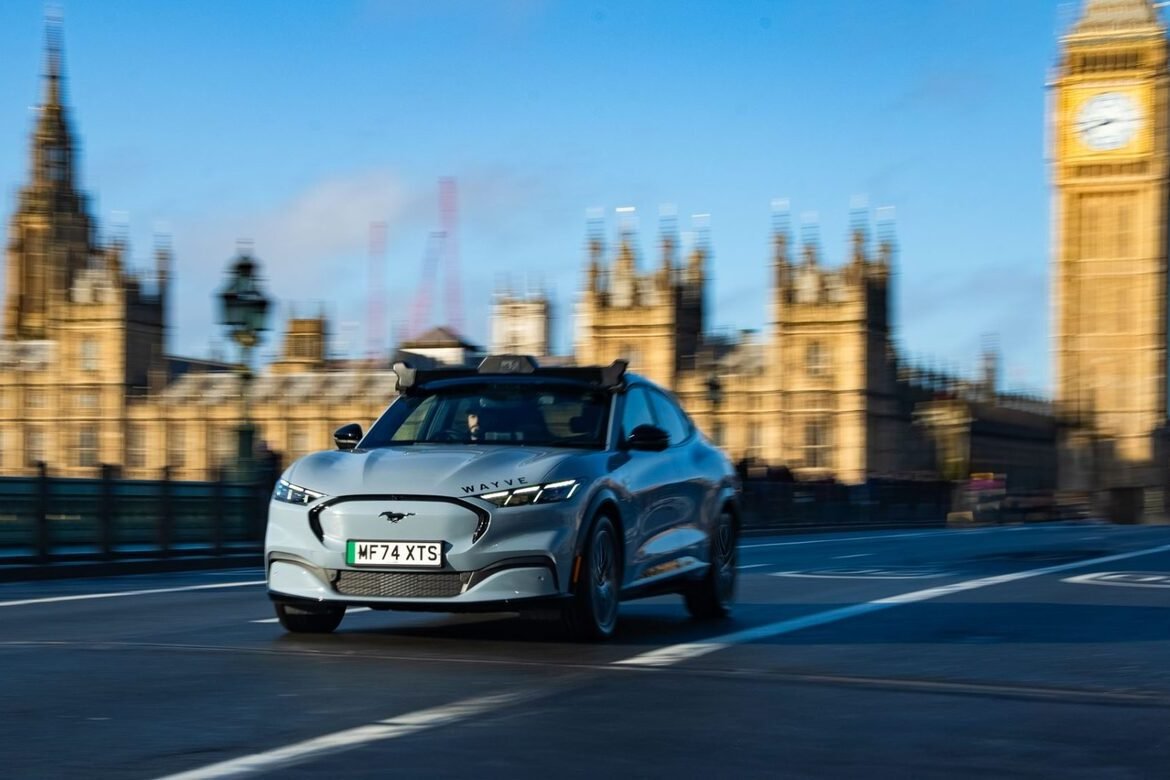
Wayve, a London-based autonomous driving startup, has raised up to $1.5 billion in new funding to accelerate deployment of its AI-driven vehicle software, marking a shift toward licensing-based autonomy as robotaxis prepare to launch on public roads. The round values the company at $8.6 billion and positions it to expand globally as robotaxi services using its technology enter commercial operation this year.
The funding includes $1.2 billion from investors such as SoftBank, Microsoft, Nvidia, Uber, Mercedes-Benz, Nissan, and Stellantis, with Uber committing an additional $300 million contingent on performance milestones. The capital injection brings Wayve’s total funding to more than $3 billion since its founding in 2017, underscoring growing investor confidence in software-centric approaches to autonomous driving.
Robotaxis powered by Wayve’s system are expected to begin operating in London in partnership with Uber later this year, while Nissan plans to integrate the company’s technology into consumer vehicles starting in 2027.
A Software First Approach to Autonomy
Wayve’s strategy differs fundamentally from competitors such as Waymo and Tesla, which have invested heavily in vertically integrated models involving proprietary vehicles or company-owned fleets. Instead, Wayve focuses on building a generalized AI driving system that can be integrated into vehicles produced by automakers or operated by third-party fleet providers.
The company’s software is designed as a plug-and-play platform capable of functioning across different hardware configurations, including vehicles equipped with cameras alone or those using lidar, radar, and other sensors. This flexibility allows automakers and mobility providers to deploy autonomous functionality without redesigning vehicles around proprietary sensor stacks.
Wayve co-founder and CEO Alex Kendall has described the licensing model as the most scalable path forward, allowing the company to focus on developing the AI software layer rather than managing vehicle manufacturing or fleet operations. This approach also reduces the capital intensity associated with building and maintaining autonomous fleets.
The model mirrors the broader shift in robotics and physical AI toward software-defined systems, where intelligence becomes the primary value layer and hardware serves as a deployment platform.
Commercial Deployment Signals Industry Transition
The new funding arrives as autonomous driving moves from pilot programs into early commercialization. Waymo, currently the leading operator of commercial robotaxis, has expanded its services to additional U.S. cities and continues to scale operations globally. Other companies, including Waabi and Tesla, are also pursuing robotaxi deployment, though at different stages of readiness.
Wayve’s entry into commercial service in London represents a key milestone, particularly because its business model depends on adoption by external partners rather than direct fleet ownership. Success will depend on whether its AI can operate reliably across different vehicle platforms and environments without extensive customization.
The company has already conducted testing across multiple international locations, including Germany, Japan, and the United States, reflecting its ambition to build a globally deployable autonomous driving system.
Partnerships with automakers such as Nissan, Mercedes-Benz, and Stellantis also extend Wayve’s reach beyond ride-hailing into consumer vehicles. This dual deployment model, spanning robotaxis and privately owned cars, could significantly expand the total addressable market for autonomous driving software.
Autonomous Driving Becomes a Software Platform Market
Wayve’s funding highlights a broader shift in autonomous driving toward platform-based business models, where companies compete to provide the AI systems that enable autonomy rather than owning the physical vehicles themselves.
This approach resembles developments in other robotics sectors, where software platforms increasingly define system capabilities and scalability. By separating the intelligence layer from the hardware, companies can deploy across diverse vehicle types and geographies without replicating infrastructure.
The outcome of this transition remains uncertain. Vertically integrated operators such as Waymo retain advantages in controlling system performance and deployment environments, while licensing-focused companies like Wayve aim to scale faster by leveraging existing automotive manufacturing and mobility networks.
If Wayve’s model succeeds, it could reshape the economics of autonomous driving, transforming autonomy from a capital-intensive infrastructure business into a software-driven platform integrated across the global automotive industry.