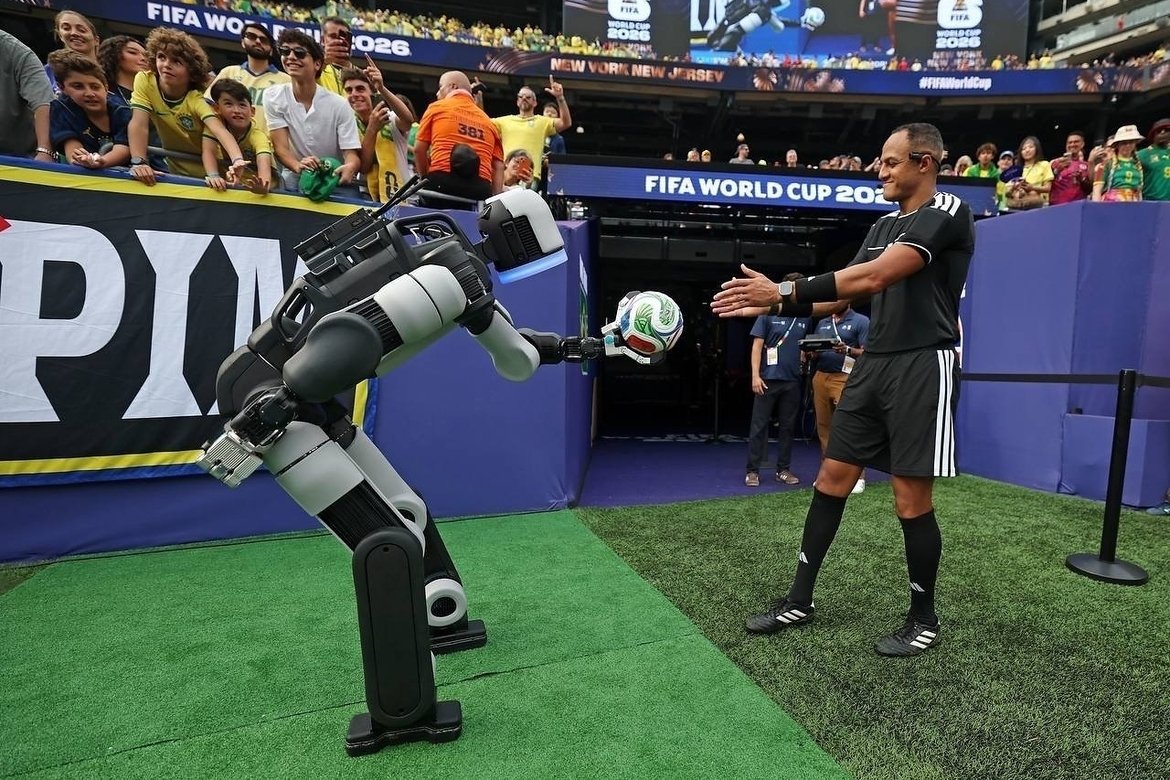

Boston Dynamics’ Atlas humanoid robot delivered the match ball to the referee at halftime of Brazil’s round-of-16 World Cup match against Norway at New York New Jersey Stadium in East Rutherford on Sunday, in the first deployment of a production humanoid robot at a FIFA World Cup. The robot, presented by tournament sponsor Hyundai Motor, also performed goal celebrations pitchside, including an imitation of Norwegian striker Erling Haaland’s meditation pose.
The appearance marked the culmination of Hyundai’s School of Football campaign, which began in May with Atlas learning soccer movements through motion capture and reinforcement learning training.
The Engineering Challenges
The World Cup deployment required solving two technical problems that standard robot operation does not encounter. Standard Wi-Fi communications were unusable in the stadium environment, where tens of thousands of fans surrounding the pitch with smartphones created RF interference dense enough to disrupt the control link. Boston Dynamics resolved this by attaching a dedicated radio device to Atlas’s back, establishing a new communications channel separate from commercial wireless infrastructure.
The second challenge was grass. Stadium turf has different friction characteristics, surface compliance, and unpredictability than the controlled floor environments where Atlas has been trained and tested. “We had to change the way that Atlas learns to walk and learns to jump and run so that it’s more robust,” said Alberto Rodriguez, director of robot behavior at Boston Dynamics. The locomotion adaptation required retraining specific movement policies to handle grass-specific dynamics before the robot could operate reliably on the pitch.
“We always looked at human skill as a way to motivate us and challenge us to push forward what robots can do,” Rodriguez said.
Hyundai’s Commercial Agenda
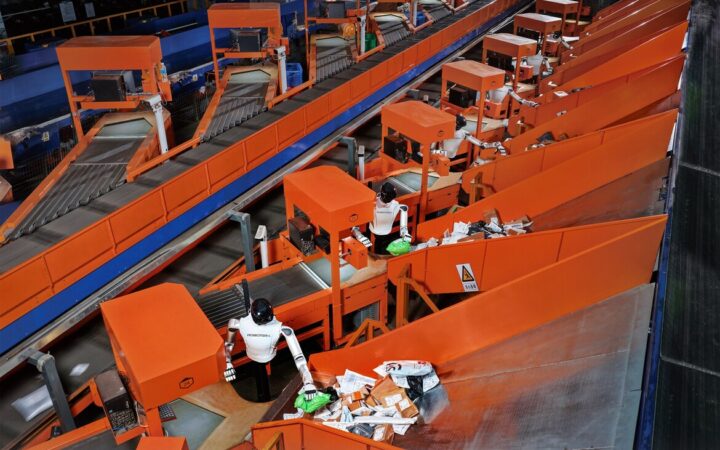
The World Cup appearance is the most globally visible single moment in Hyundai Motor’s robotics strategy, which is grounded in a concrete commercial plan. The group has announced deployment of more than 25,000 Atlas robots across Hyundai Motor and Kia manufacturing plants, with production targeting 30,000-unit annual capacity by 2028 and initial deployments at Hyundai Motor Group Metaplant America in Georgia beginning that year.
The Brazil-Norway match in a round-of-16 game at the 2026 World Cup – broadcast to a global audience across 180 countries – provided Hyundai with a platform to associate Atlas with elite athletic performance and technological aspiration at a scale that no trade show, factory demonstration, or earned media campaign can replicate. A robot that can navigate stadium grass, deliver a ball under radio interference conditions, and perform a credible Haaland celebration in front of 80,000 fans communicates readiness in a way that specification sheets do not.
The School of Football campaign, Atlas’s gymnastics demonstrations in May, and now the World Cup ball delivery form a coherent progression: from controlled athletic training, to acrobatic capability display, to live operational deployment in one of the world’s most demanding public environments. The next milestone in Hyundai’s public roadmap is the Georgia factory deployment starting in 2028.
Disclaimer: RobotsBeat is an independent media brand owned and operated by NuvexMedia LLC, publishing news, research, and insights on artificial intelligence, emerging technologies, automation, and related industries. NuvexMedia LLC invests in and collaborates with companies across the AI, Robotics, technology, software, and digital innovation sectors. These relationships do not influence RobotsBeat's editorial coverage, and the publication maintains full editorial independence to provide accurate, timely, and objective information. © 2026 NuvexMedia LLC. All rights reserved. This content is for informational purposes only and should not be considered legal, tax, investment, financial, or other professional advice.