

BMW has entered the pilot phase of its Leipzig humanoid robot deployment, using Hexagon Robotics’ Aeon platform in battery assembly and component manufacturing. The Leipzig program follows the completion of a ten-month deployment at BMW’s Spartanburg plant in the United States, in which a Figure AI robot supported the production of more than 30,000 BMW X3 vehicles – the most detailed public accounting any automaker has provided of a humanoid robot’s commercial production contribution to date.
The two deployments together represent BMW’s most comprehensive public disclosure on humanoid robotics in manufacturing, and reflect the company’s strategy of running structured pilot programs through a dedicated Centre of Competence for Physical AI in Production before committing to scaled deployment.
The Spartanburg Results
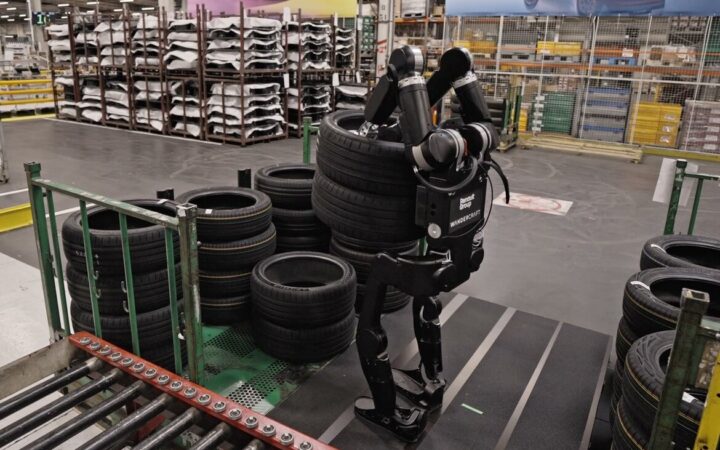
Within ten months at Spartanburg, the Figure 02 robot worked ten-hour shifts Monday through Friday handling the precise removal and positioning of sheet metal parts for the welding process – a task demanding in both speed and accuracy, and physically taxing for human workers. The robot moved more than 90,000 components, covered approximately 1.2 million steps, and accumulated around 1,250 operating hours.
A key finding from the Spartanburg deployment was that the transition from laboratory training to production-floor operation was faster than expected. Motion sequences developed in simulation transferred into stable shift operation more quickly than BMW had anticipated – a result consistent with what Boston Dynamics and other developers have reported about sim-to-real transfer timelines improving as training environments become more realistic.
BMW and Figure AI are currently evaluating additional use cases for a Figure 03 deployment at Spartanburg.
The Leipzig Deployment
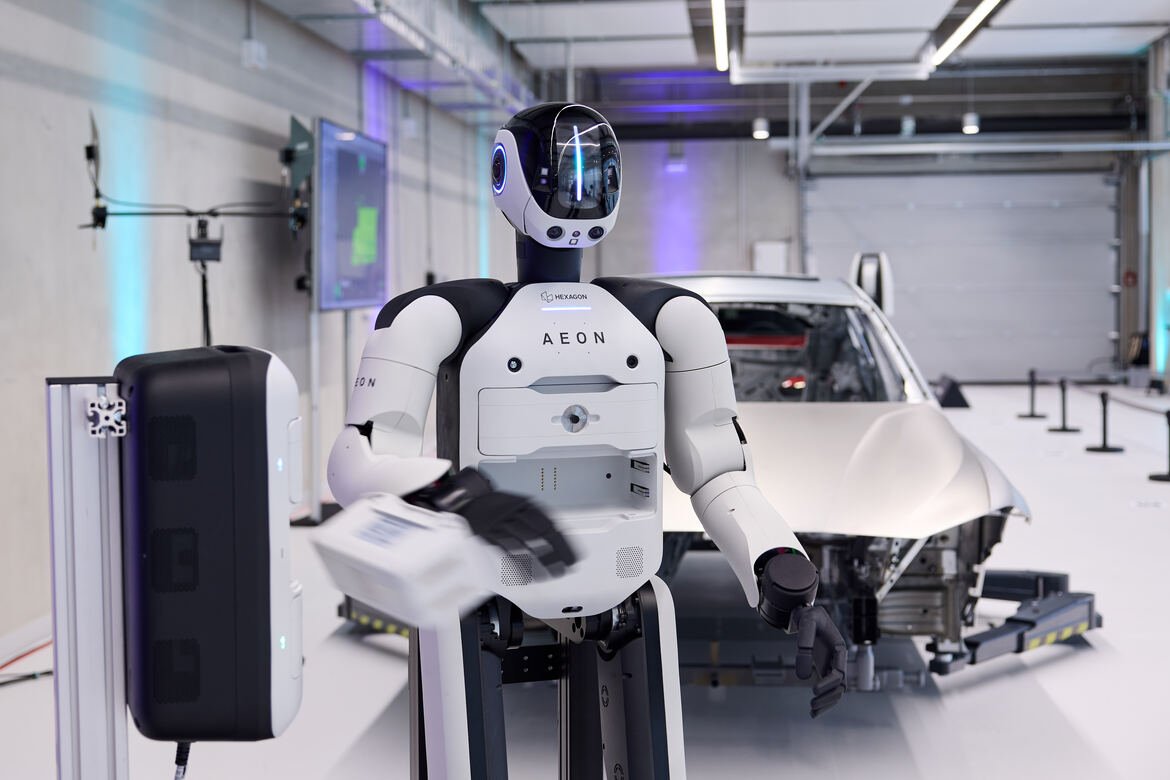
The Leipzig pilot uses Hexagon Robotics’ Aeon robot – a 1.65-meter, wheeled humanoid equipped with 21 sensors including cameras, radar, force and torque sensing for manipulation. The Leipzig program began with a theoretical assessment, followed by laboratory evaluation against real BMW production use cases, an initial test deployment in December 2025, extended test deployment from April 2026, and the current pilot phase running through the European summer.
The deployment targets high-voltage battery assembly and component manufacturing – areas BMW identified as particularly suited to humanoid robots given the combination of monotonous, ergonomically demanding, and precision-critical characteristics. The Leipzig project is also exploring applications in the broader integration of humanoid robotics into series car production.
BMW’s Centre of Competence for Physical AI
BMW has established a dedicated Centre of Competence for Physical AI in Production to evaluate technology partners against defined maturity and industrialization criteria. The assessment framework moves from theoretical evaluation to laboratory testing against real BMW production use cases, to initial real-world test deployment, to a full pilot phase – a structured progression designed to validate capability before scale commitment.
“Pilot projects help us to test and further develop the use of physical AI under real-world industrial conditions,” said Michael Nikolaides, BMW’s senior VP for production network and supply chain management. “Our aim is to be a technology leader and to integrate new technologies into production at an early stage.”
The Competitive Backdrop
BMW’s humanoid rollout is occurring against the backdrop of China’s accelerating factory automation. China had two million installed manufacturing robots as of 2024 – approximately 4.5 times Japan’s total – and accounted for 54% of all global robot installations that year. China’s 15th Five-Year Plan, launched in May, places robotics at the center of its industrial modernization strategy. Western European manufacturing reached a record density of 267 robots per 10,000 employees in 2024, ahead of North America’s 204 and Asia’s 131 – a density advantage that humanoid deployments are designed to extend.
BMW’s Rosslyn plant in South Africa, which produces the X3 for local and export markets, will not receive humanoid robots in the foreseeable future, according to a local BMW spokesperson.
Disclaimer: RobotsBeat is an independent media brand owned and operated by NuvexMedia LLC, publishing news, research, and insights on artificial intelligence, emerging technologies, automation, and related industries. NuvexMedia LLC invests in and collaborates with companies across the AI, Robotics, technology, software, and digital innovation sectors. These relationships do not influence RobotsBeat's editorial coverage, and the publication maintains full editorial independence to provide accurate, timely, and objective information. © 2026 NuvexMedia LLC. All rights reserved. This content is for informational purposes only and should not be considered legal, tax, investment, financial, or other professional advice.