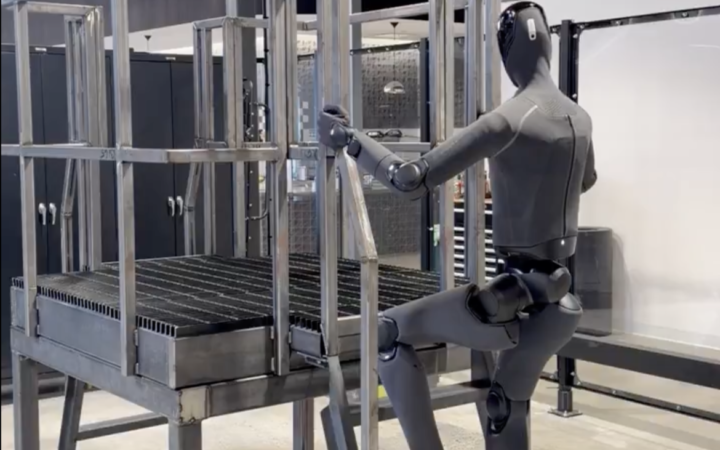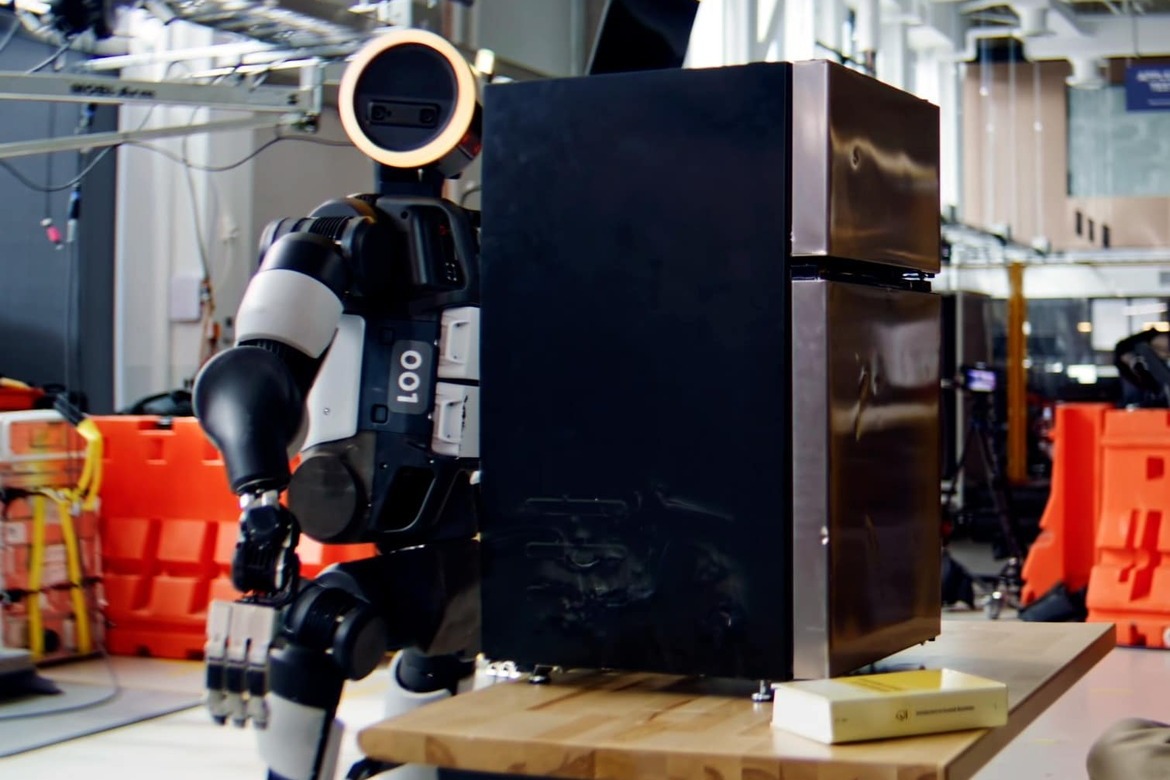


Boston Dynamics has published a technical blog describing how its Atlas humanoid robot was trained to lift and carry heavy industrial objects, including a mini-fridge weighing more than 100 pounds. The behavior was developed through reinforcement learning, with Atlas practicing the task for millions of simulated hours in parallel across GPU clusters before the technique was transferred to the physical robot. The company said the capability was ready within weeks of Atlas’ public debut earlier this year.
The disclosure provides the most detailed public account Boston Dynamics has given of the training methodology underlying Atlas’ industrial lifting capability – a set of skills directly relevant to the 25,000-unit deployment plan Hyundai Motor Group outlined to JPMorgan investors earlier this week.
How the Training Works
The process begins with a reference trajectory – either an animated movement or a teleoperated demonstration – that gives the reinforcement learning system a starting point. Atlas is then trained by repeating the task under systematically varied conditions: different object weights, floor friction coefficients, grip forces, and load positioning. The robot is rewarded for completing tasks correctly, maintaining grip, and staying balanced when external disturbances are introduced.
Boston Dynamics trained the lifting behavior on loads of 50 to 70 pounds before Atlas successfully lifted a fridge exceeding 100 pounds during physical testing – demonstrating that the learned behavior generalized beyond the training distribution. “You cannot lift a fridge just by looking at it and using your hands,” the company wrote. “You have to prepare for it to anticipate the weight, lean into it, and let your body do the work.”
Rather than relying primarily on cameras for load handling, Atlas uses proprioception – internal body awareness – to sense weight, balance, grip, and resistance in real time. The approach allows the robot to adapt to shifting loads and changing conditions without requiring precise visual tracking of every contact point.
Reducing the Sim-to-Real Gap
A central challenge in simulation-based robot training is the sim-to-real gap: behaviors that work reliably in virtual environments frequently fail on physical hardware due to unpredictable real-world variables including friction, sensor latency, and mechanical compliance. Boston Dynamics said Atlas’ hardware architecture specifically addresses this.
The production Atlas platform uses only two actuator types across the entire body, with symmetrical arm and leg designs. The simplified architecture makes accurate physics simulation easier, reducing the discrepancy between simulated and real-world behavior. Engineers also eliminated cables running across joints, allowing continuous joint rotation and greater freedom of motion while reducing wear – a hardware decision that expands the range of movements Atlas can be trained to perform.
Athletic Training as Industrial Preparation
Boston Dynamics linked Atlas’ athletic demonstrations – including the handstand and gymnastics moves shown in the May 6 video – directly to industrial readiness. According to the company, those movements train the same underlying capabilities that heavy industrial work requires: balance recovery from unexpected disturbances, agility under load, slip recovery, and thermal endurance in demanding operating environments.
The framing positions what might appear as showmanship as a functional component of the training pipeline – each athletic behavior developing physical AI capabilities that transfer to the factory floor tasks Hyundai is now publicly committed to deploying Atlas for at scale.
Disclaimer: RobotsBeat is an independent media brand owned and operated by NuvexMedia LLC, publishing news, research, and insights on artificial intelligence, emerging technologies, automation, and related industries. NuvexMedia LLC invests in and collaborates with companies across the AI, Robotics, technology, software, and digital innovation sectors. These relationships do not influence RobotsBeat's editorial coverage, and the publication maintains full editorial independence to provide accurate, timely, and objective information. © 2026 NuvexMedia LLC. All rights reserved. This content is for informational purposes only and should not be considered legal, tax, investment, financial, or other professional advice.