
Elon Musk predicted at Forbes’ Innovator 250 Celebration on May 19 that between 100 million and one billion humanoid robots will arrive within the next five years, and that digital intelligence will surpass all human brainpower by 2031. Musk also projected that the global economy could double within five to seven years as AI and robotics dramatically increase output, describing the future outlook as fundamentally different from anything shaped by previous technological transitions.
The remarks align with a broader set of predictions from technology leaders about the economic scale of the AI and robotics wave, though they substantially exceed the deployment timelines and production figures that robotics companies have publicly committed to.
Context: What Current Production Figures Suggest
The gap between Musk’s forecast and current industry data is significant. Global humanoid robot shipments reached 13,318 units in 2025, according to Omdia – a nearly fivefold increase from the prior year. Omdia projects 2.6 million units by 2035. Reaching 100 million units within five years from a 2025 base of roughly 13,000 would require a compound annual growth rate of approximately 300% sustained over the period – a trajectory with no analog in the history of manufactured hardware at this complexity level.
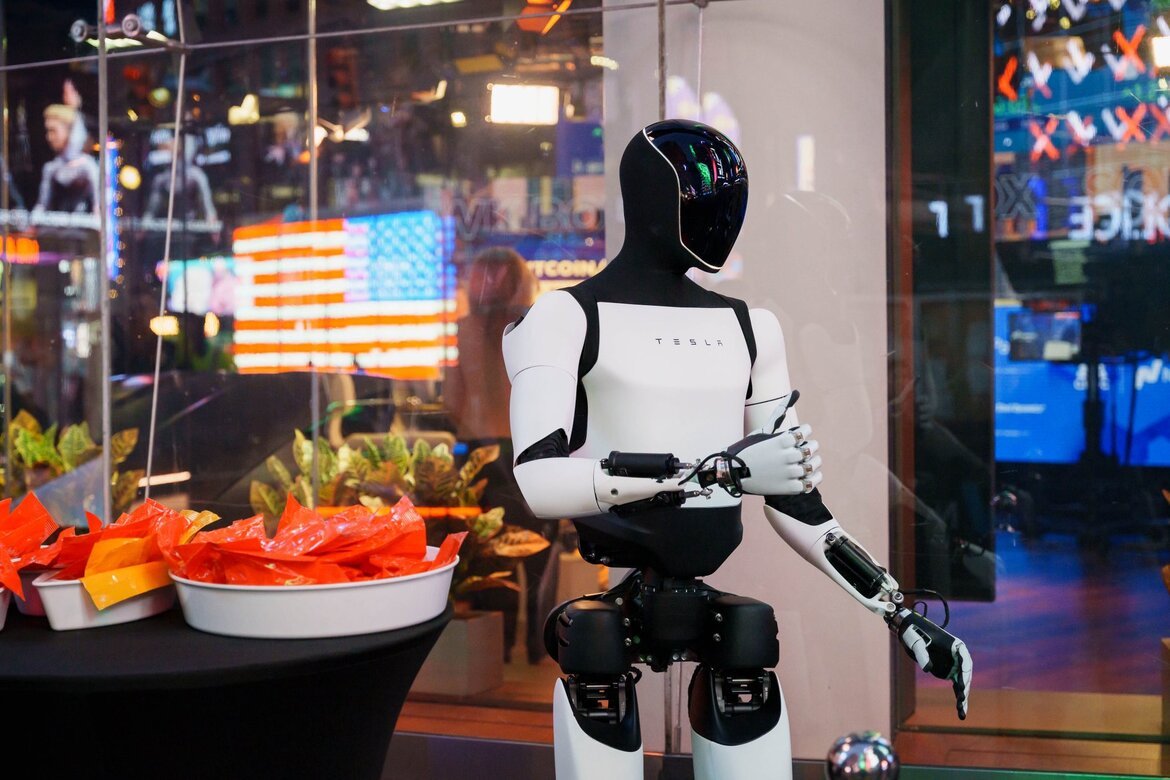
Tesla’s own Optimus program is targeting volume production from July 2026, with the Fremont facility conversion underway. Hyundai Motor Group’s 25,000-unit Atlas deployment plan, outlined to JPMorgan investors this week, targets 30,000-unit annual production capacity by 2028. Boston Dynamics is currently producing approximately four units per month. These are the most ambitious publicly stated production targets in the industry, and they collectively fall well short of the scale Musk’s forecast implies.
Jensen Huang on AI and GDP
Nvidia CEO Jensen Huang made complementary claims in a recent interview, arguing that AI will supercharge global GDP well beyond its current $100 trillion ceiling. “What is likely to happen is that AI will supercharge $100 trillion to $200 trillion, maybe $300 and $500 trillion, as there is no fundamental limit to GDP size,” Huang said. Musk endorsed the statement on X.
Huang framed the economic argument around productivity rather than displacement. “Our job is not to wrangle a spreadsheet. Our job is not to type on the keyboard. Our job is generally more meaningful than that. I am completely confident that AI will drive more productivity, revenue growth, and therefore more hiring,” he said.
The Forecast and Its Function
Predictions at this scale from figures with direct financial stakes in the outcome – Musk through Tesla’s Optimus program and SpaceX, Huang through Nvidia’s physical AI infrastructure position – serve multiple functions simultaneously. They signal strategic conviction to investors and partners, shape the narrative environment in which capital allocation decisions are made, and establish a competitive expectation that rivals must respond to.
Whether 100 million humanoid robots arrive by 2030 or by 2040 will depend on factors that no executive forecast controls: manufacturing yield at scale, battery and actuator cost curves, AI reliability in unstructured environments, regulatory frameworks, and the pace at which enterprise customers integrate humanoid robots into operations with sufficient confidence to order at volume. The current trajectory is rapid. Whether it is rapid enough to reach Musk’s figures on his timeline is a different question.
Disclaimer: RobotsBeat is an independent media brand owned and operated by NuvexMedia LLC, publishing news, research, and insights on artificial intelligence, emerging technologies, automation, and related industries. NuvexMedia LLC invests in and collaborates with companies across the AI, Robotics, technology, software, and digital innovation sectors. These relationships do not influence RobotsBeat's editorial coverage, and the publication maintains full editorial independence to provide accurate, timely, and objective information. © 2026 NuvexMedia LLC. All rights reserved. This content is for informational purposes only and should not be considered legal, tax, investment, financial, or other professional advice.