
A humanoid robot has entered Poland’s influencer economy, quickly drawing attention from brands, social media audiences, and technology observers.
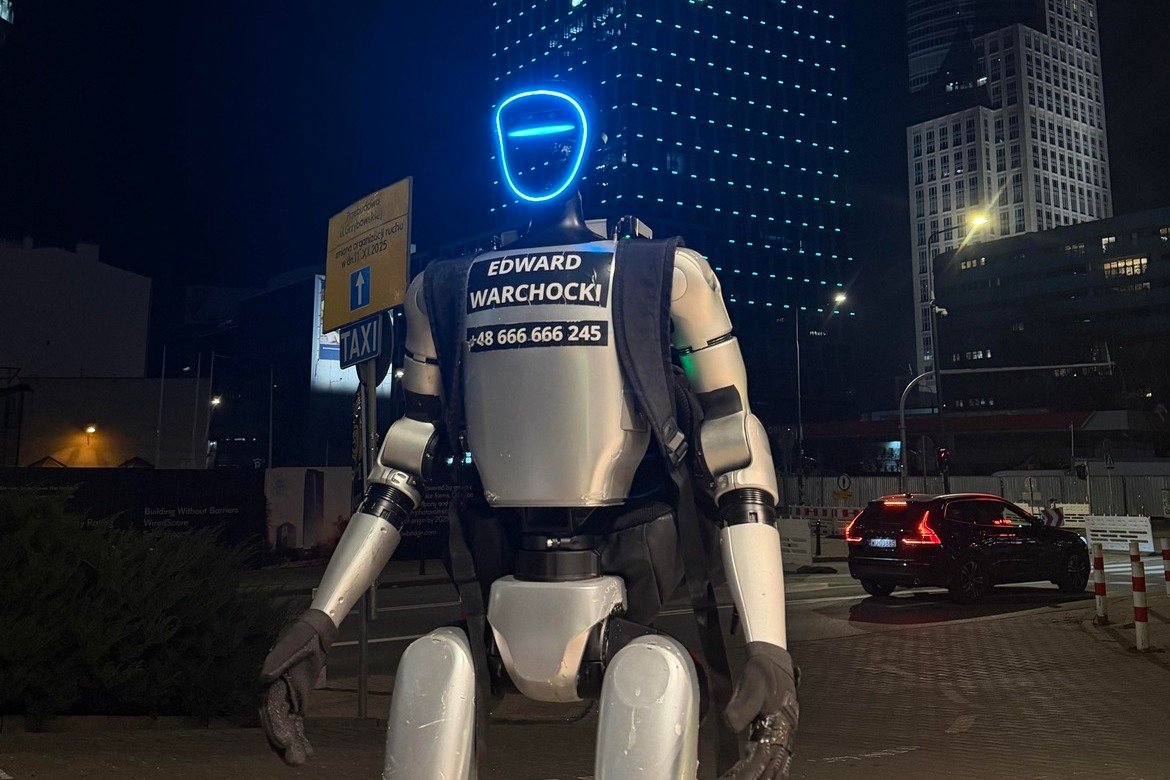
The robot, named Edward Warchocki, has appeared on streets in Warsaw and Poznań interacting with passers-by while building a growing presence on social media platforms. Within roughly two weeks of its debut, the project amassed tens of thousands of followers on Instagram and more than 100,000 on TikTok, while videos featuring the robot reportedly generated hundreds of millions of views across platforms.
The experiment places a physical humanoid robot into a market previously dominated by human personalities and digital avatars.
For companies experimenting with new forms of marketing, the project represents an early test of how embodied AI could reshape influencer culture.
From Lab Experiment to Commercial Platform
Edward Warchocki began as a technology experiment initiated by entrepreneur Radosław Grzelaczyk and supported by artificial intelligence developer Bartosz Idzik, who created the system that powers the robot’s conversational behavior.
Unlike scripted promotional mascots, the robot is designed to interact dynamically with people in real-world environments.
According to the project’s creators, the system uses a combination of proprietary AI tools and existing technologies to generate responses during live interactions. The goal was to create a robot that could adapt to conversations rather than simply repeat preprogrammed lines.
Public reactions have ranged from curiosity to enthusiasm. Videos show people approaching the robot on city streets to shake hands, ask questions, and record short interactions for social media.
These spontaneous encounters have become a key part of the robot’s appeal.
Brands Experiment with a New Type of Influencer
The project has already begun attracting commercial interest.
Edward’s first advertising collaboration reportedly involved promoting a luxury watch valued at approximately 80,000 złoty, marking a symbolic entry into the influencer marketing industry.
For brands, robots introduce a different set of characteristics than human creators.
A humanoid influencer cannot become involved in personal scandals, take breaks, or deviate from a brand’s messaging strategy. The creators of the project argue that this level of control makes robots attractive marketing ambassadors for companies seeking predictable campaigns.
Some analysts also point to engagement metrics as a key factor. Early data from projects involving robotic or virtual influencers suggests that novelty and public curiosity can generate unusually high engagement rates compared with traditional creators.
Physical Presence in a Digital Industry
The rise of virtual influencers is not new. Computer-generated personalities such as Lil Miquela in the United States or Rozy in South Korea have already built large audiences and signed partnerships with major global brands.
However, those figures exist entirely in digital form.
Edward represents a different model: a physical robot capable of interacting with people face to face.
This physical presence creates a type of engagement that purely digital characters cannot replicate. Passers-by can approach the robot, speak with it, and record the interaction in real time.
In practice, the robot becomes both an influencer and a live attraction.
For social media creators and marketers, such encounters provide content that can spread quickly across platforms.
A New Category of Embodied Media
The project reflects a broader trend in robotics where machines are increasingly designed to operate in social environments rather than purely industrial settings.
Humanoid robots have traditionally been developed for research or automation applications. But advances in conversational AI and robotics hardware are opening the possibility of robots that function as public-facing personalities.
If the experiment succeeds commercially, it could mark the emergence of a new category within influencer marketing: embodied influencers.
Analysts estimate that the global virtual influencer market could reach nearly $16 billion by 2026. Robots capable of appearing in both online content and physical events may represent the next stage of that market’s evolution.
For now, Edward Warchocki remains an experiment.
But its rapid rise suggests that the intersection of robotics, artificial intelligence, and digital media may be creating a new kind of celebrity – one built from code, hardware, and algorithms rather than human charisma.
Disclaimer: RobotsBeat is an independent media brand owned and operated by NuvexMedia LLC, publishing news, research, and insights on artificial intelligence, emerging technologies, automation, and related industries. NuvexMedia LLC invests in and collaborates with companies across the AI, Robotics, technology, software, and digital innovation sectors. These relationships do not influence RobotsBeat's editorial coverage, and the publication maintains full editorial independence to provide accurate, timely, and objective information. © 2026 NuvexMedia LLC. All rights reserved. This content is for informational purposes only and should not be considered legal, tax, investment, financial, or other professional advice.