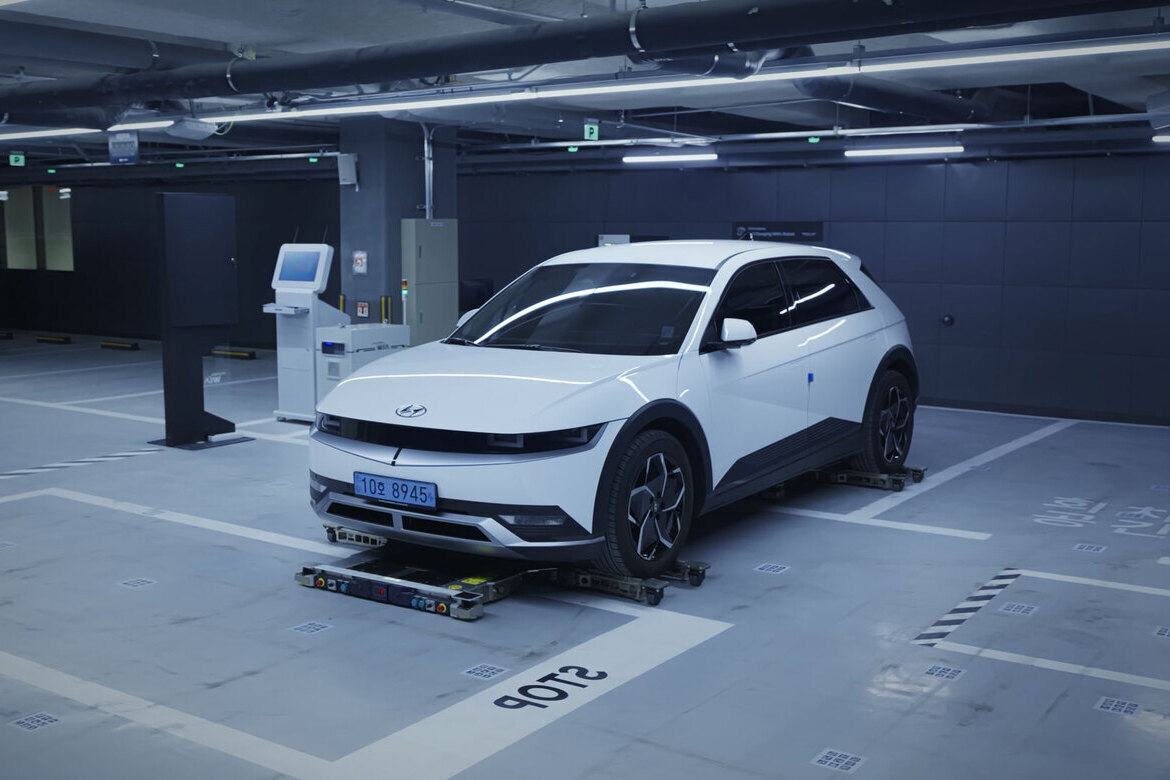

Hyundai Motor Group will pilot autonomous wheel-lifting parking robots at Hillstate The Wave City, an apartment complex in Siheung, Gyeonggi Province, in what the company describes as the first such deployment at a residential complex in Korea. The pilot is a collaboration between Hyundai Motor, Hyundai WIA, and Hyundai Engineering and Construction, the builder of the complex. It has been approved under the smart city regulatory sandbox and received state funding from the Ministry of Land, Infrastructure and Transport.
The robots were first shown publicly at CES 2026 in January. The Siheung pilot is their first real-world residential test.
How the Robots Work
Hyundai WIA’s parking robots work in pairs – two flat slabs, each 11 centimeters thick, that slide under a car and lift the front and rear wheels clear of the ground. Lidar sensors read the size and position of each wheel, allowing the pair to position precisely before lifting. Together the two robots can support an SUV weighing up to 3.4 tonnes and move it at up to 1.2 meters per second in any direction – forward, backward, and sideways.
A driver leaves the car in a marked drop-off zone and summons the robots using the wall pad – the wall-mounted terminal that controls apartment systems in Korean residential buildings. The robots carry the car to a free space autonomously. Retrieval works in reverse.
The Capacity Improvement
The core efficiency gain comes from how tightly cars can be packed when robots handle all movement. Conventional garages must leave clearance for driver doors and space for residents to enter and exit. When robots park the cars, none of that space is needed, allowing significantly denser packing. Hyundai WIA estimates the system can accommodate 20 to 50 percent more vehicles than conventional parking in the same floor area. Stacking configurations that park cars two and three deep would increase that figure further.
Two sets of robots will operate in a 53-space first basement level during the pilot. Hyundai WIA’s current control system can route up to 50 robot pairs simultaneously; a version handling 100 is in development.
What the Pilot Will Measure
Hyundai Motor Group will measure parking and retrieval times, actual user wait times, successful parking rates, and the optimal ratio of spaces to robots for different garage configurations. The data will be used to develop a standard deployment model for apartments, commercial parking structures, and other constrained urban environments.
Korean apartment garage congestion is a structural problem. Urban density limits the space available for parking relative to vehicle ownership rates, and underground garages at residential complexes are frequently congested during peak hours. Autonomous robots that can park more cars in the same footprint address that constraint without requiring new construction.
Disclaimer: RobotsBeat is an independent media brand owned and operated by NuvexMedia LLC, publishing news, research, and insights on artificial intelligence, emerging technologies, automation, and related industries. NuvexMedia LLC invests in and collaborates with companies across the AI, Robotics, technology, software, and digital innovation sectors. These relationships do not influence RobotsBeat's editorial coverage, and the publication maintains full editorial independence to provide accurate, timely, and objective information. © 2026 NuvexMedia LLC. All rights reserved. This content is for informational purposes only and should not be considered legal, tax, investment, financial, or other professional advice.