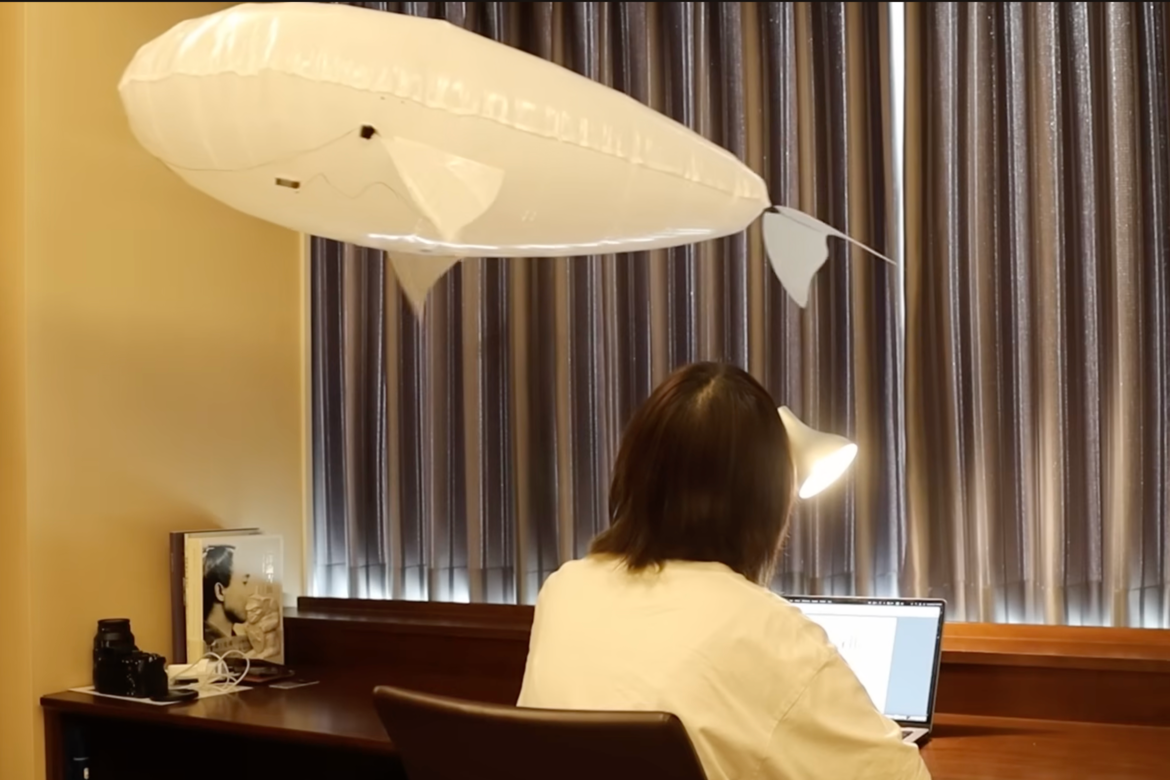


Researchers at Keio University in Tokyo, in collaboration with MIT Media Lab, have developed a soft floating robot that hovers indoors using helium buoyancy and flapping fins rather than spinning rotors, and have published the first systematic interaction design framework for this category of robot companion. The prototype resembles a small floating whale and is designed to serve as a quiet, physically safe presence in home environments.
The project is inspired by fictional floating characters – Tinker Bell, Pokémon’s Mew, and Studio Ghibli’s Soot Sprites – and is aimed at creating companion robots that feel approachable rather than mechanical.
Why Helium Rather Than Rotors
Conventional indoor drones use spinning propellers for lift, generating rotor noise and downwash that make sustained proximity to people uncomfortable and create safety risks from exposed blades. The soft floating robot approach inverts this: helium fill provides most of the lift, so the propulsion system only needs to generate movement and steering rather than supporting the robot’s full weight. The result is virtually silent operation, lower energy consumption, and longer hovering times.
The prototype combines a helium envelope with carbon-fiber-reinforced flapping wings, lightweight micro servos, a microcontroller, and a compact lithium battery. Symmetrical wing flapping generates forward thrust; differential wing motion provides steering. The smooth, rhythmic movement pattern reads as more biological than mechanical.
Because helium provides approximately one gram of lift per liter, payload capacity is a significant engineering constraint. The research team recommends ultra-light drone-grade electronics, offloaded computation, and minimized onboard processing to maximize useful payload within the buoyancy budget.
Safety Through Compliance
The soft, helium-filled body enables a safety approach the researchers call “safety through compliance”. Rather than relying exclusively on collision avoidance software, the compliant structure makes accidental contact with people, pets, and furniture inherently low-risk. The robot can make gentle physical contact – soft nudges, tactile reminders, or proximity that resembles a hug – without the injury potential of rigid hardware.
The buoyant design also gives the robot access to three-dimensional indoor space that wheeled robots cannot reach: floating above furniture, navigating stairwells, positioning at eye level or overhead, or settling near the floor. It occupies indoor space in a way that is qualitatively different from ground-based platforms.
The Design Framework
Beyond the prototype, the team’s primary contribution is a systematic interaction design framework for soft floating robots – described as the first of its kind. Developed through input from 12 experts in robotics, human-computer interaction, and design, the framework defines ten dimensions covering mobility, communication, physical design, movement style, human interaction patterns, relationship roles, and autonomy levels. The framework is intended to guide future development of this robot category across different propulsion approaches, including flapping wings, oscillating fish-like tails, jellyfish-inspired actuators, vectored thrust, and propeller-free ultrasonic micro-blowers.
The companion applications the researchers envision include waking users, delivering reminders, providing company during solitary activities, dancing alongside owners, and offering playful interaction – positioned as a physical presence that complements rather than replaces smartphones or smart speakers.
Disclaimer: RobotsBeat is an independent media brand owned and operated by NuvexMedia LLC, publishing news, research, and insights on artificial intelligence, emerging technologies, automation, and related industries. NuvexMedia LLC invests in and collaborates with companies across the AI, Robotics, technology, software, and digital innovation sectors. These relationships do not influence RobotsBeat's editorial coverage, and the publication maintains full editorial independence to provide accurate, timely, and objective information. © 2026 NuvexMedia LLC. All rights reserved. This content is for informational purposes only and should not be considered legal, tax, investment, financial, or other professional advice.