
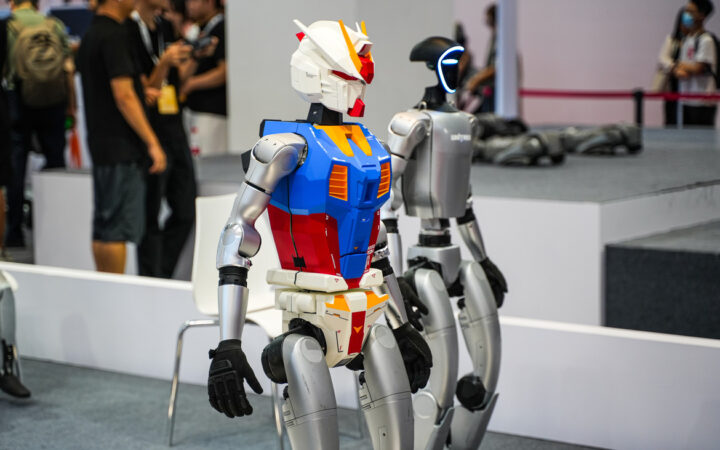
Samsung Electronics has been quietly developing a humanoid robot in-house, separate from its subsidiary Rainbow Robotics, with the project reportedly at an advanced stage, according to ZDNet Korea. The internally developed humanoid is believed to outperform major domestic competitors, drawing on Samsung’s hardware manufacturing expertise and operational data across its home appliance, smartphone, semiconductor, and display businesses.
The development has proceeded without public disclosure. Samsung has now formalized its robotics ambitions organizationally: last month the company established a new RX – Robotics eXperience – Business Office reporting directly to CEO TM Roh, a structural move that industry observers interpret as a signal that Samsung is escalating its push into humanoid robotics at the executive level.
Why Samsung Is Positioned Differently
Humanoid development is generally described as requiring three inputs: data, AI models, and hardware manufacturing capability. Samsung is one of the few companies globally with all three at institutional scale.
On data, Samsung operates manufacturing facilities spanning home appliances, smartphones, semiconductors, and displays – each generating operational process data that can be used to train robot behavior in structured industrial environments. A dedicated Data Factory is planned at Samsung’s Gumi campus to formalize that integration, converting existing process data into a dedicated robot training system and simulating a wide range of real-world scenarios before deployment.
On AI, Samsung has developed Samsung Gauss, its own large language model, providing an internal foundation model capability that does not require dependence on external AI providers for robot intelligence development.
On hardware, Samsung is developing proprietary actuators for humanoid robots using motor technologies originally designed for home appliances. Actuators – the joints of a robot, integrating motors, controllers, and reducers – represent one of the primary cost and performance bottlenecks in humanoid manufacturing. Samsung’s home appliance motor expertise provides a starting point that pure-play robotics companies do not possess. In semiconductors, Samsung Foundry is already manufacturing NVIDIA’s robot chips under contract, giving the company direct insight into the compute architecture that current physical AI systems require.
Key Executive Appointments
Samsung appointed Lee Dong-geon, a former Hyundai Motor executive who led Hyundai’s robotics strategy including the operational direction of Boston Dynamics, as head of its Robotics Strategy Team. Lee will oversee Samsung’s mid- to long-term robotics business strategy. The company is also recruiting robotics engineers at its overseas R&D centers including Samsung Research America and Samsung Research Beijing.
The Rainbow Robotics Relationship
Samsung’s in-house development is described as separate from Rainbow Robotics, the South Korean humanoid robotics company in which Samsung acquired a majority stake in 2023. Rainbow Robotics develops its own humanoid platforms. The parallel internal program suggests Samsung is pursuing a dual-track strategy – maintaining its Rainbow Robotics portfolio while developing proprietary hardware that may leverage Samsung’s unique manufacturing and data assets more directly.
Samsung has not publicly confirmed the in-house humanoid program. The competitive significance of the development lies in the scale of resources Samsung can bring to a sector where most competitors are building capabilities from a narrower manufacturing and data base.
Disclaimer: RobotsBeat is an independent media brand owned and operated by NuvexMedia LLC, publishing news, research, and insights on artificial intelligence, emerging technologies, automation, and related industries. NuvexMedia LLC invests in and collaborates with companies across the AI, Robotics, technology, software, and digital innovation sectors. These relationships do not influence RobotsBeat's editorial coverage, and the publication maintains full editorial independence to provide accurate, timely, and objective information. © 2026 NuvexMedia LLC. All rights reserved. This content is for informational purposes only and should not be considered legal, tax, investment, financial, or other professional advice.