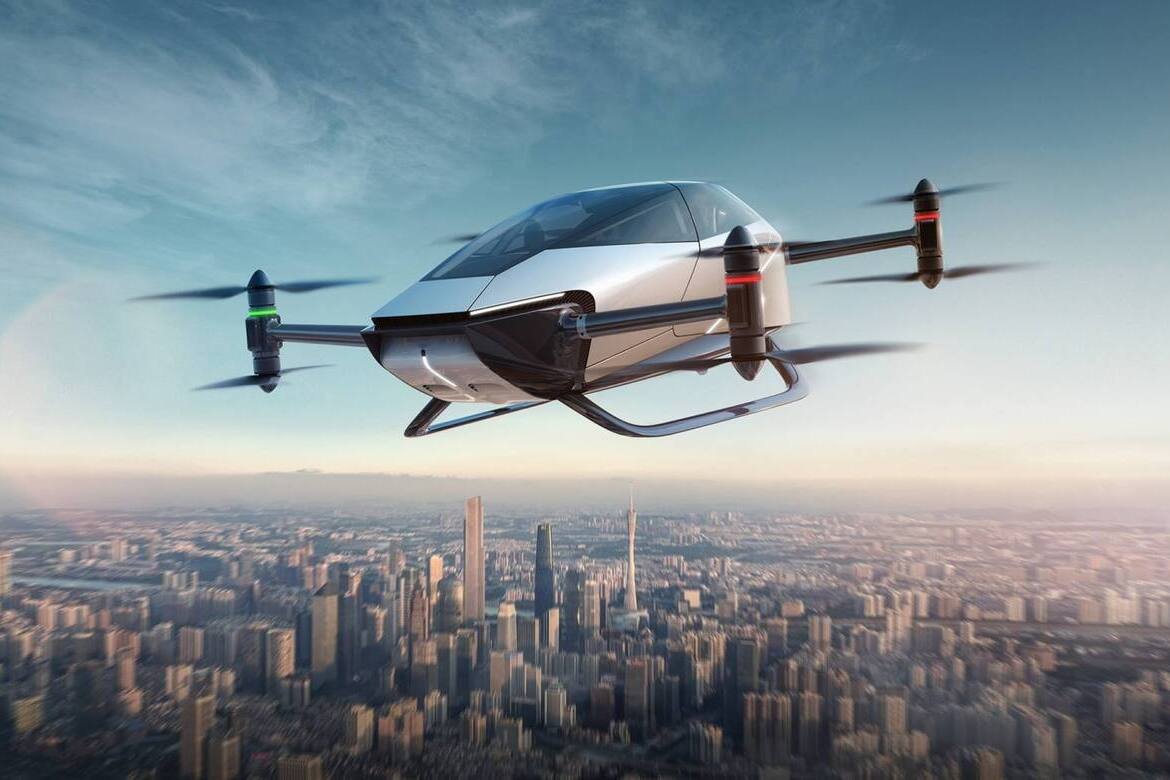

Xpeng president Brian Gu told Reuters on Thursday that the Chinese electric vehicle maker will begin mass production of its flying car in 2027 and plans to introduce humanoid robots to market by the fourth quarter of 2026. The statements, made on the eve of the Beijing Auto Show, outline an expansion strategy that extends Xpeng well beyond its origins as an EV manufacturer into autonomous vehicles, aerial mobility, and physical AI.
The announcements cover three distinct product lines advancing in parallel, each at a different stage of regulatory and commercial readiness.
Flying Cars and Early Demand
Xpeng has received more than 7,000 orders for its flying car, with the majority of demand originating within China. The company is in the final stages of obtaining approvals from Chinese aviation authorities before mass production can begin. A 2027 production start would position Xpeng among the first automakers to bring an electric vertical takeoff and landing vehicle to commercial scale, a market segment that has attracted significant capital globally but has so far produced limited consumer-ready products.
Humanoid Robots for Commercial Deployment
Xpeng’s humanoid robot program is targeting a Q4 2026 launch, with initial deployment focused on customer-facing roles such as receptionists and sales staff. The use case selection reflects a deliberate starting point – structured, relatively predictable environments where robot performance is visible and the cost of errors is lower than in manufacturing or logistics settings.
Gu said Xpeng expects its robotics business to surpass its automotive division in scale within the next 10 to 20 years, a timeframe that reflects both the long-term ambition and the current early stage of the product. The company has not disclosed technical specifications for the robot or detailed the underlying AI platform.
Robotaxis and International Expansion
Trials for Xpeng’s robotaxi service are set to begin in Guangzhou this year, with international testing planned through partnerships with global operators by 2027. The company aims to produce thousands of robotaxis within the next 18 months – a production target that would require significant supply chain preparation alongside the regulatory approvals needed in each market.
Xpeng is already present in more than 60 countries and currently generates 15% of total revenue from international sales. The company’s stated goal is to grow that share to more than 50% within five to ten years. The recently launched joint EV model with Volkswagen – commercial production of which began last month – represents the most concrete step toward that international revenue target to date.
The breadth of Xpeng’s announced pipeline – flying cars, humanoid robots, robotaxis, and international EV partnerships simultaneously – reflects the competitive pressure on Chinese technology companies to diversify quickly into high-growth categories. Whether execution across all four tracks can match the pace of the announcements will become clearer as each product line approaches its stated commercial deadline.
Disclaimer: RobotsBeat is an independent media brand owned and operated by NuvexMedia LLC, publishing news, research, and insights on artificial intelligence, emerging technologies, automation, and related industries. NuvexMedia LLC invests in and collaborates with companies across the AI, Robotics, technology, software, and digital innovation sectors. These relationships do not influence RobotsBeat's editorial coverage, and the publication maintains full editorial independence to provide accurate, timely, and objective information. © 2026 NuvexMedia LLC. All rights reserved. This content is for informational purposes only and should not be considered legal, tax, investment, financial, or other professional advice.