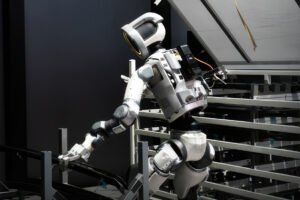
Humanoid Robots Are Being Trained by Gig Workers Filming Life at Home
Gig workers across more than 50 countries are recording household tasks to train humanoid robots, revealing a new data economy behind physical AI.
Browse the RobotsBeat archives for robotics news, AI robotics updates, automation trends, product launches, company coverage, funding stories, policy developments, and practical industry analysis organized by year and month. This archive helps readers revisit older RobotsBeat coverage across humanoid robots, drones, industrial robots, service robots, robot hardware, autonomy, sensors, safety, deployment, and the companies shaping the robotics industry.
Gig workers across more than 50 countries are recording household tasks to train humanoid robots, revealing a new data economy behind physical AI.
Researchers have developed a flexible sensor that allows robots to detect gentle touch with high precision, marking a step toward safer human-machine interaction.
BMW has overhauled its Munich plant with an AI-driven production system and thousands of robots, signaling a shift toward software-defined manufacturing for electric vehicles.
Researchers are developing DNA-based nanorobots capable of delivering drugs and targeting viruses, though the technology remains in early experimental stages.
LG CNS has partnered with Silicon Valley robotics startups to strengthen its physical AI capabilities, combining robot foundation models with new hardware platforms.
Unitree Robotics has filed for a Shanghai IPO after becoming the world’s largest humanoid robot seller, signaling a shift from experimentation to early commercialization.
Ubtech reported a 23-fold increase in humanoid robot sales, driven by industrial deployments. The results point to accelerating commercialization of embodied AI in China.
Humanoid robot prices have dropped more than 70% in two years, signaling a shift toward commercialization. The market is now dividing into premium, mid-range, and volume-driven segments.
European companies are accelerating investment in humanoid robotics as the region seeks to regain technological momentum. Industrial expertise and automotive supply chains are emerging as key advantages.
Saronic has raised $1.75 billion to expand autonomous ship production and shipyard infrastructure. The funding highlights a shift toward software-defined maritime manufacturing at industrial scale.