
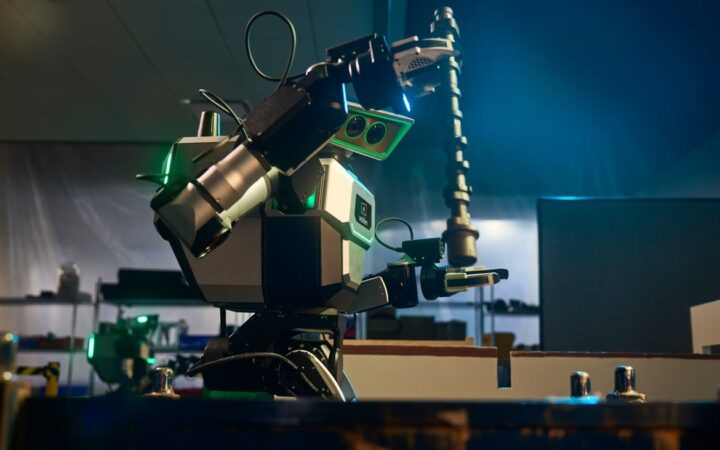
BMW is introducing humanoid robots into production at its Leipzig plant in Germany, marking the company’s first such deployment in Europe as automakers explore how artificial intelligence can move beyond software and into physical industrial work.
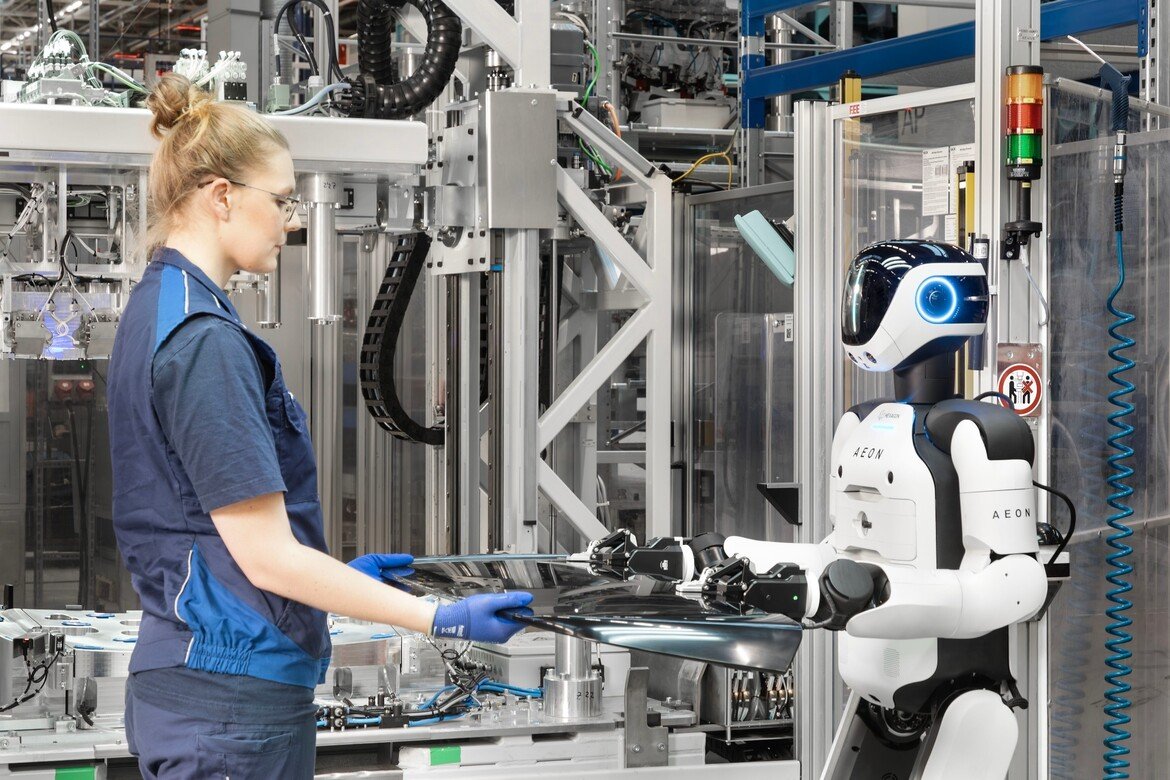
The pilot project centers on a robot called AEON, developed by Hexagon’s robotics division, which is being tested to assist workers with logistics and repetitive tasks inside the factory. BMW says the initiative forms part of a broader strategy to integrate what it describes as physical AI directly into manufacturing operations.
For an industry already heavily automated with fixed industrial robots, humanoid machines represent a different approach: mobile systems designed to operate alongside people and adapt to multiple tasks rather than performing a single programmed action.
From Industrial Automation to Physical AI
Industrial robots have long been a cornerstone of automotive manufacturing, performing highly precise tasks such as welding, bonding, and component handling. These machines are typically fixed in place and optimized for specific operations.
Humanoid robots are being explored as a complementary layer of automation. Their human-like form allows them to navigate factory environments originally designed for people and perform tasks that require mobility or flexible manipulation.
AEON stands about 1.65 meters tall and weighs roughly 60 kilograms. Instead of walking, it moves through the factory on wheeled legs, allowing it to travel at speeds of up to 2.5 meters per second while carrying materials and avoiding obstacles.
At the Leipzig plant, the robot is initially being tested in high-voltage battery assembly and component manufacturing, where it will handle repetitive tasks and transport materials along production lines.
BMW executives say the goal is not to replace workers but to support them by taking over physically demanding or repetitive jobs.
“Digitalisation makes our production more competitive both in Europe and globally,” said Milan Nedeljković, BMW’s board member responsible for production. “The combination of engineering expertise and artificial intelligence opens up entirely new opportunities in manufacturing.”
Building The Infrastructure for AI-Driven Factories
The Leipzig pilot is supported by a new internal competence center dedicated to physical AI in production. The group brings together robotics and AI specialists tasked with evaluating new technologies and integrating them into BMW’s global manufacturing network.
Behind the robots is a broader digital architecture the company has been developing for several years. BMW has restructured its factory IT systems into a unified data platform that connects production information across different systems and plants.
This infrastructure enables AI agents to analyze data, make decisions, and control machines across the production environment. When combined with robotic hardware and autonomous transport systems, the result is what BMW describes as physical AI: intelligent systems capable of perceiving, deciding, and acting directly on the factory floor.
Digital twins, AI-assisted quality inspection systems, and autonomous logistics robots are already part of that ecosystem. Humanoid robots represent the next step, bringing adaptable automation to tasks that previously required human mobility.
Lessons from BMW’s Earlier Robot Experiments
The Leipzig deployment follows earlier humanoid robot testing at BMW’s Spartanburg plant in South Carolina.
In that pilot project, conducted with robotics company Figure AI, a humanoid robot called Figure 02 assisted in vehicle body production. Over a ten-month trial, the system helped assemble more than 30,000 BMW X3 vehicles by retrieving and positioning sheet metal parts for welding.
According to BMW, the robot handled more than 90,000 components during the pilot and logged approximately 1,250 operating hours. The project also provided insights into safety systems and factory connectivity, including the need for improved wireless coverage and new safety barriers around collaborative work zones.
Engineers found that once the robot learned motion sequences in a test environment, it could reliably repeat them on the production line with millimeter-level precision.
The lessons from Spartanburg are now shaping how BMW approaches humanoid robotics in Europe.
Testing How Humanoid Robots Fit into Production
The Leipzig pilot is designed not only to evaluate the robot itself but also to determine how humanoid systems can integrate into existing manufacturing workflows.
Rather than assigning a single task permanently, BMW engineers are experimenting with different roles for AEON across battery module production and component manufacturing.
Factory workers are involved in the process, helping determine which tasks are suitable for humanoid robots and how workstations may need to change to accommodate them.
The rollout is proceeding gradually. After initial testing and laboratory validation, AEON began operating inside the Leipzig plant in late 2025. Further trials are scheduled throughout 2026 as BMW evaluates whether the technology can move toward broader deployment.
What This Signals for Automotive Manufacturing
Automakers have long been among the largest users of industrial robotics, but humanoid robots introduce a new category of automation that could reshape how factories are designed.
Because these robots can navigate environments built for human workers, they could allow manufacturers to automate tasks without redesigning entire production lines.
That flexibility may become increasingly important as electric vehicles, battery systems, and customized production introduce more variability into manufacturing processes.
BMW’s experiments also highlight a broader shift across the robotics industry toward physical AI, where machine learning systems control real-world machines rather than operating purely in software.
Whether humanoid robots will become common on factory floors remains uncertain. But pilot projects like those in Spartanburg and Leipzig suggest manufacturers are beginning to test how these systems might work alongside traditional industrial automation.
Disclaimer: RobotsBeat is an independent media brand owned and operated by NuvexMedia LLC, publishing news, research, and insights on artificial intelligence, emerging technologies, automation, and related industries. NuvexMedia LLC invests in and collaborates with companies across the AI, Robotics, technology, software, and digital innovation sectors. These relationships do not influence RobotsBeat's editorial coverage, and the publication maintains full editorial independence to provide accurate, timely, and objective information. © 2026 NuvexMedia LLC. All rights reserved. This content is for informational purposes only and should not be considered legal, tax, investment, financial, or other professional advice.