China Opens First 7S Humanoid Robot Store to Accelerate Commercial Adoption

China has opened its first 7S humanoid robot store in Wuhan, combining sales, training, and deployment services in a new retail model aimed at accelerating real-world adoption.

By Rachel Whitman | Edited by Kseniia Klichova Published:
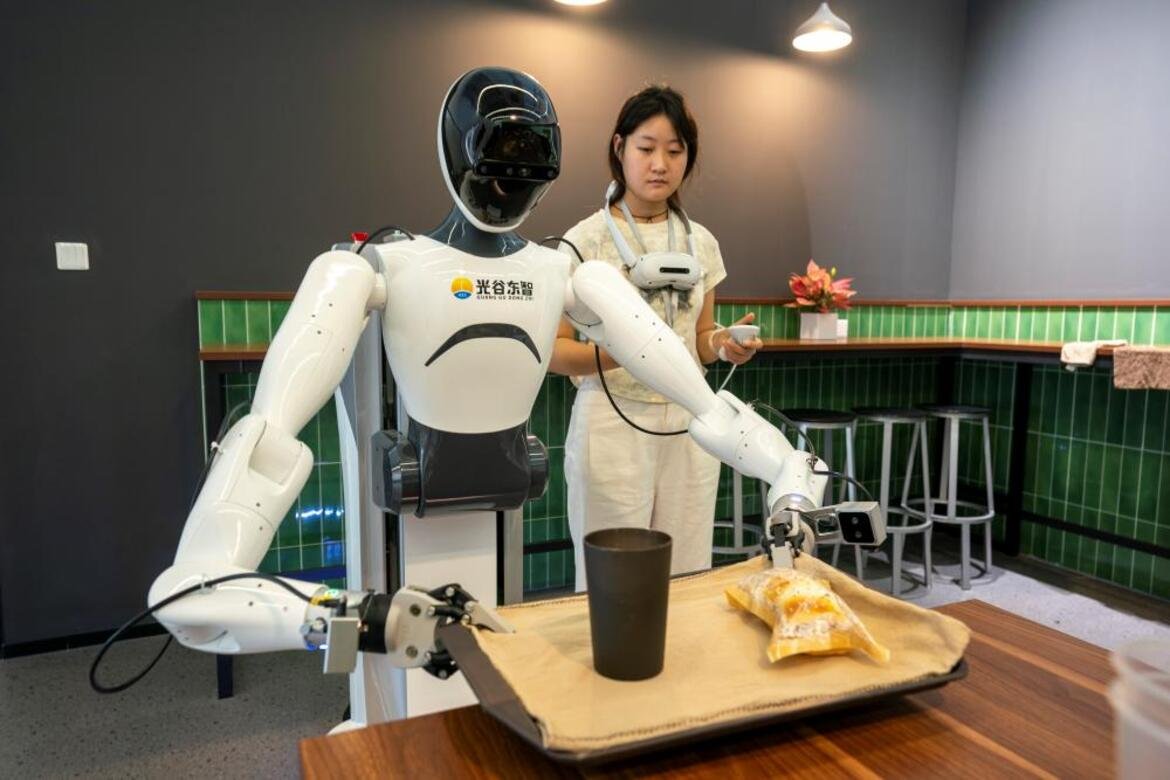
Humanoid robots demonstrate service and interaction capabilities inside China’s first 7S robot store in Wuhan, reflecting efforts to commercialize embodied AI systems. Photo: Hubei Humanoid Robot Innovation Center

China has opened its first 7S humanoid robot store in Wuhan, marking a new phase in the commercialization of embodied AI. The facility, operated by the Hubei Humanoid Robot Innovation Center, functions not only as a retail showroom but also as a full-service hub integrating sales, training, maintenance, and deployment support.

Located in Wuhan’s East Lake High-Tech Development Zone, a major technology cluster, the store represents an expansion of the traditional automotive dealership model into robotics. The “7S” framework extends beyond sales and service to include solutions development, demonstrations, and technical education, covering the entire lifecycle of humanoid robot deployment.

The concept reflects China’s broader effort to move humanoid robotics from demonstration to scalable commercial infrastructure.

A Retail Model Designed for Industrial Technology

Since opening in November 2025, the Wuhan store has attracted significant public and industry interest. According to operators, it has received approximately 18,000 visitors and generated roughly 615,000 yuan ($88,600) in revenue, with robots deployed in commercial events and experiential demonstrations.

The store features 17 humanoid robot models spanning a wide price range, from entry-level educational units to advanced industrial platforms costing up to 700,000 yuan. Demonstrations include robots serving as retail assistants, playing sports, and performing entertainment functions, as well as machines designed for industrial manufacturing, healthcare support, and public services.

This physical retail presence serves a strategic purpose beyond direct sales. It allows companies to expose customers, engineers, and policymakers to humanoid robots in operational settings, reducing barriers to adoption by providing hands-on experience.

The inclusion of rental services also reflects early commercial experimentation. Short-term deployments at events and public venues allow organizations to test robots in controlled scenarios while generating operational data and market awareness.

Training The Workforce And The Machines

One of the store’s most significant functions is education. Training programs provide hands-on instruction for robot operators, engineers, and students, addressing one of the key bottlenecks in robotics adoption: workforce readiness.

More than 1,000 participants have completed courses covering robot operation, programming, and maintenance. Training initiatives target both professionals and students, building technical capacity across multiple skill levels.

The store also connects directly to a larger training ecosystem. Nearby facilities operated by the Hubei Humanoid Robot Innovation Center use simulation environments and real-world data collection to train humanoid robots themselves. These systems generate large volumes of operational data, which is used to improve control models and accelerate performance improvements.

This dual training approach – educating both humans and robots – highlights the emerging infrastructure required to scale embodied AI.

Building a Domestic Supply Chain for Physical AI

The store also serves as a showcase for China’s growing humanoid robotics supply chain. Regional manufacturers and research institutions contribute key components, including sensors, actuators, and AI systems.

For example, one humanoid robot displayed at the store was developed with significant local supply chain participation, with more than 80 percent of its hardware sourced from regional suppliers. This reflects China’s vertically integrated manufacturing ecosystem, which enables faster development cycles and lower production costs.

Government support is reinforcing this industrial strategy. National and regional policies have identified humanoid robotics as a priority sector, with initiatives aimed at expanding deployment in manufacturing, healthcare, and public services.

Industry forecasts suggest that humanoid robot adoption could expand dramatically in coming decades, with millions of units potentially deployed across industries.

From Showrooms to Deployment Infrastructure

The launch of the 7S store signals a broader shift in robotics commercialization. Early robotics development focused on research labs and isolated pilot deployments. The emergence of retail and service hubs reflects a transition toward scalable distribution and support infrastructure.

Such facilities serve as access points for customers, developers, and integrators, helping bridge the gap between technology availability and practical deployment.

The model also addresses a fundamental challenge in robotics adoption: familiarity. Exposure to operational robots, training opportunities, and deployment services reduces uncertainty and accelerates integration into real-world environments.

The Wuhan store may represent an early prototype of robotics distribution infrastructure. Just as automotive dealerships enabled the expansion of personal vehicles, dedicated robotics service centers could play a similar role in scaling humanoid adoption.

As embodied AI systems move toward mainstream deployment, the creation of physical infrastructure to support sales, training, and lifecycle management may prove as important as advances in the robots themselves.

News, Robots & Robotics, Science & Tech

China Southern Power Grid Trains Humanoid Robots for Substation Inspection and Maintenance

China Southern Power Grid is training humanoid and quadruped robots to perform electrical inspections and basic maintenance tasks across its network, deploying them in the field as part of a broader push to automate physically demanding grid operations.

By Laura Bennett | Edited by Kseniia Klichova Published:
A humanoid robot operating electrical control equipment at a power grid maintenance facility during training and field preparation. Photo: China Southern Power Grid

China Southern Power Grid, the state-owned utility supplying electricity to 272 million people across five Chinese provinces, is training humanoid robots to perform substation inspections and basic electrical maintenance. At a laboratory within the company’s Guangdong operation, a cohort of robots is learning by mimicking young engineers – opening and closing control boxes, switching equipment on and off, and checking for electrical leakage using insulating rods.

The program reflects a broader effort by Chinese state enterprises to deploy robotics in infrastructure roles where labor demand is high, conditions are physically demanding, and error carries significant operational consequence.

What the Robots Are Being Trained to Do

The current training program covers six operational scenarios and 15 discrete skills. Robots have already been deployed and field-tested in some of these scenarios since last year. Tasks include inspecting transmission line insulators, detecting fractures in steel cores, and tightening screws on elevated equipment – work that must be carried out regardless of weather conditions.

“Taking a 500 kV substation as an example, there are thousands of pieces of equipment to inspect and nearly ten thousand inspection points,” said Li Duanjiao, head of the company’s robotics laboratory. “The work must be carried out under intense sunlight, in the rain, or during storms. When performed manually, the workload is enormous and highly repetitive.”

The utility uses a mixed fleet. Humanoid robots handle manipulation tasks at control equipment. A quadruped robot named Feiyun, capable of carrying loads up to 100 kilograms, transports robotic arms into field locations – a logistics role previously performed by human workers. Drones carry out aerial inspections. The company refers to these systems collectively as “digital employees”.

The Infrastructure Case for Robotics

Power grid maintenance is a natural fit for the current generation of industrial robots. The work is structured enough to be codified into repeatable sequences, physically demanding enough to strain human workforces, and geographically distributed enough – particularly in remote mountainous terrain – that labor deployment is expensive and slow.

Li said robots are gradually replacing humans in the most repetitive and remote inspection tasks, with the program expanding as training data accumulates from field deployments.

UBTECH Robotics, a Shenzhen-based private company, has taken a parallel approach in automotive manufacturing, deploying robots to transport materials and select components on car production lines. The company also developed one of the first robots capable of autonomous battery swapping. Tan Min, a company representative, estimated that five to ten years remain before robots are widely adopted across industries at scale – a timeline he tied directly to the volume of real-world training data still needed to advance the underlying AI.

Data as the Binding Constraint

The power grid program illustrates a challenge that applies across the sector: robots improve through real-world exposure, but real-world deployment requires robots capable enough to operate safely. China Southern Power Grid’s laboratory approach – structured mimicry training followed by controlled field deployment – is one model for managing that transition.

With more than 150 humanoid robot manufacturers active in China, the near-term competition is not primarily over hardware specifications but over which companies and institutions can accumulate sufficient operational data to make their systems reliable in unstructured, high-stakes environments. Infrastructure operators like China Southern Power Grid, with clearly defined task sets and existing engineering workforces to train from, are positioned to generate that data faster than most.

News, Robots & Robotics, Science & Tech

X Square Robot Pilots Home-Cleaning Service with Human-Robot Teams in Shenzhen

Chinese robotics startup X Square Robot has partnered with household service platform 58.com to deploy humanoid robots alongside professional cleaners in Shenzhen homes, in one of the first commercial pilots of embodied AI in domestic service environments.

By Rachel Whitman | Edited by Kseniia Klichova Published:
A humanoid robot performing structured cleaning tasks inside a residential space as part of a human-robot collaborative service team. Photo: X Square Robot

X Square Robot, a Shenzhen-based embodied intelligence company, has launched a pilot home-cleaning service in partnership with household platform 58.com, deploying humanoid robots alongside professional cleaners in residential settings across the city. The robots handle structured, repeatable tasks – wiping surfaces, collecting debris, tying garbage bags, and assisting with bedsheet folding – while human cleaners manage work requiring judgment and adaptability.

The pilot has drawn attention from the international robotics community as an early commercial test of embodied AI in one of the most operationally complex environments available: private homes.

Why the Home Environment Matters

Home cleaning represents a deliberate choice as a deployment context. Unlike factory floors or logistics warehouses, residential spaces are unstructured, variable, and unpredictable – no two homes are configured the same way, and conditions change between visits.

“The service industry has extremely high complexity and non-standard characteristics, and the home environment is regarded as the ultimate benchmark for evaluating general robots,” said Yang Qian, chief operating officer of X Square Robot. The company uses an end-to-end AI model that allows robots to interpret tasks, plan multi-step actions, and execute them autonomously – without scripts or remote control.

The hybrid deployment model – one robot, one human cleaner per booking – is also a deliberate design choice. Chris Paxton, an AI and robotics researcher, described the approach as one that “allows you to scale from 70 percent to 90 percent to 99 percent autonomy naturally”, as robots accumulate real-world data and improve over time.

Shenzhen as a Robotics Testing Ground

The pilot is operating within a broader industrial ecosystem. Shenzhen has gathered over 2,600 AI enterprises and more than 70,000 companies across the robotics supply chain. In 2025, the combined added value of Shenzhen’s AI and robotics clusters grew at a double-digit rate.

The city’s Robot Valley, where X Square Robot is headquartered, houses companies spanning hardware manufacturing, sensor development, and AI software. Pudu Robotics, another Shenzhen-based firm, now serves clients in more than 80 countries, with overseas markets accounting for over 80% of its total revenue for several consecutive years. Its commercial cleaning robots have found particular traction across Europe, North America, and Asia.

Beyond commercial applications, robots have begun appearing in Shenzhen’s public infrastructure. Robot volunteers have been deployed at Qianhaishi Park, and autonomous units have been observed directing traffic – deployments that reflect the city’s role as a live testing environment for a wide range of robotic applications.

Data and the Path to Scale

For X Square Robot, the 58.com pilot serves a dual purpose: generating revenue while accumulating the real-world operational data needed to train and refine its AI systems. Each cleaning session produces feedback on task execution, environmental variation, and edge cases that controlled environments cannot replicate.

The broader direction of China’s robotics sector is toward domestic service and eldercare alongside industrial applications – markets that require robots capable of operating reliably in unstructured, human-occupied spaces. The Shenzhen pilot is an early data point in that effort, and its results will likely inform how quickly similar deployments expand to other cities and service categories.

Business & Markets, News, Robots & Robotics, Science & Tech

Honor’s Humanoid Robot Wins Beijing Half-Marathon, Finishing Faster Than Any Human

A humanoid robot developed by Honor completed Beijing’s half-marathon in 50 minutes and 26 seconds, finishing ahead of all 12,000 human competitors and below the standing human world record for the distance.

By Laura Bennett | Edited by Kseniia Klichova Published: Updated:

A bipedal humanoid robot named Lightning, developed by Chinese smartphone maker Honor, won Beijing’s half-marathon on Sunday, completing the 13-mile course in 50 minutes and 26 seconds. The time placed Lightning ahead of all 12,000 human competitors in the race and below the current human world record for the half-marathon distance – set by Ugandan runner Jacob Kiplimo in Lisbon last month – by nearly seven minutes.

Honor’s robots also took second and third place, making it a clean podium sweep for the company. The result marks a significant escalation from last year’s inaugural event, when the fastest robot took 2 hours and 40 minutes to finish and only six of the 21 participating humanoids crossed the finish line.

The Race and What It Tested

The event, held in an industrial park in Beijing, featured more than 100 robots – a substantial increase in participation from the previous year. Nearly 40% of the competing units ran autonomously, navigating turns, uneven terrain, and course obstacles without remote input. The remainder were remote-controlled, with finishing times adjusted by category.

The conditions were not clean. Lightning crashed into a railing near the finish line and required assistance before recovering to complete the race. One robot face-planted roughly 200 feet from the start, continued the course with its upper body held together with packing tape, and finished. Another crossed the finish line and veered into a bush. Teams of technicians followed the field in golf carts, many equipped with stretchers.

The fastest human in the race, 29-year-old Zhao Haijie, finished in 1 hour, 7 minutes, and 47 seconds. At least four robots posted sub-one-hour times.

A Public Stress Test for Chinese Robotics

For several participating companies, the race served as a live performance benchmark. Intercity Technology used the event to validate a year of hardware and software upgrades to its child-size robot Xiao Cheng, including improved motor coordination, sensor arrays, and gait algorithms. “For us, this process is really about competing against who we were last year,” said Xue Qingheng, founder of Intercity Technology.

The race champion is set to receive orders worth over one million yuan (approximately $146,500), according to city officials. Hundreds of millions of viewers watched livestream coverage across Chinese platforms – an audience scale that underscores the event’s function as both a technical demonstration and a national showcase.

The Broader Context

China currently has more than 150 humanoid robot companies and research laboratories, operating under a state strategy that classifies robotics as a national priority. Government subsidies support both development and procurement, and Beijing’s 2026-2030 technology master plan includes humanoid-staffed factories as a stated objective.

The half-marathon format has limitations as a proxy for industrial readiness – straight-line locomotion at speed is a narrower capability than the dexterous manipulation and adaptive task execution required in most manufacturing or service environments. But as a public stress test of hardware durability, autonomous navigation, and the pace of iteration, the gap between this year’s results and last year’s is difficult to dismiss. “Robots today have the body of Mike Tyson but are still missing a brain like Stephen Hawking,” said Xue. “Once the brain problem is solved, the scope for imagination here is immense.”

News, Robots & Robotics, Science & Tech

Tesla Expands Robotaxi Service to Dallas and Houston

Tesla has launched its driverless robotaxi service in Dallas and Houston, extending a program that began in Austin and marking the company’s most significant autonomous ride-hailing expansion to date.

By Daniel Krauss | Edited by Kseniia Klichova Published:
A driverless electric vehicle operating as part of an autonomous ride-hailing service on urban streets. Photo: Tesla Robotaxi

Tesla has expanded its robotaxi service to Dallas and Houston, the company announced Saturday, extending a program that launched in Austin, Texas, last year. The rollout uses Model Y SUVs operating without a human driver or safety monitor in the front seat, a configuration Tesla has been working toward since first deploying the service in Austin with onboard monitors and restricted operating zones.

The expansion is the most geographically significant step yet in Tesla’s autonomous ride-hailing strategy, adding two of the largest metro areas in the U.S. to a service that also operates in parts of the San Francisco Bay Area.

Operational Details Remain Limited

Tesla announced the launches through its official robotaxi account on X, posting videos of vehicles operating in both cities alongside map images outlining service boundaries. The company did not disclose fleet size, pricing, or availability for general riders. CEO Elon Musk reposted the announcement without adding further detail.

The absence of operational specifics is consistent with how Tesla has managed the rollout to date – expanding the geographic footprint while disclosing limited data on performance, incident rates, or the regulatory approvals underpinning each new market.

The Competitive Context

Tesla’s expansion comes as the robotaxi sector broadly regains momentum. Alphabet’s Waymo has been scaling paid commercial operations in San Francisco, Los Angeles, and Phoenix, with further expansion underway. Amazon’s Zoox is also accelerating deployment of its purpose-built autonomous vehicle platform.

Tesla’s approach differs structurally from its competitors. Waymo and Zoox have relied on vehicles designed or heavily modified for autonomous operation, with extensive sensor arrays including lidar. Tesla uses a camera-based system derived from its Full Self-Driving software, applied to its existing production vehicles. That approach lowers hardware costs and allows rapid fleet scaling, but has drawn scrutiny over its safety validation methodology compared to lidar-dependent systems with longer commercial track records.

Stakes for Tesla’s Broader Strategy

Autonomous vehicles have become central to how Tesla justifies its valuation. Much of the company’s $1.3 trillion market capitalization is tied to expectations that its FSD software and robotaxi service will generate substantial recurring revenue. Musk had previously predicted that Tesla robotaxis would be operating widely across multiple U.S. metro areas by the end of 2025 – a target the company missed.

The Dallas and Houston launches represent tangible progress against that timeline, but the scale of the current deployments relative to the stated ambition remains unclear without fleet size data. How quickly Tesla can move from limited-zone launches to citywide commercial availability will be the metric that matters most for the company’s autonomous transportation thesis.

Agibot Deploys Humanoid Robots in Live Electronics Manufacturing, Eyes 100-Unit Expansion

Agibot has deployed its G2 humanoid robots at a Shanghai electronics manufacturer, reporting throughput of up to 310 units per hour and a success rate above 99%, with plans to scale to 100 robots by Q3 2026.

By Laura Bennett | Edited by Kseniia Klichova Published: Updated:
Humanoid robots operating on an electronics manufacturing line, handling precision loading and unloading tasks at automated testing stations. Photo: AGIBOT

Agibot has deployed its G2 humanoid robots in an active production environment at Longcheer Technology, a Shanghai-based consumer electronics manufacturer. The rollout marks one of the more concrete demonstrations of humanoid robots operating within a live industrial workflow, moving the technology beyond controlled pilots into continuous factory-floor use.

The deployment comes months after Agibot announced the production of its 10,000th humanoid robot in March, a milestone the company described as a turning point in the industrialization of embodied AI.

What the Robots Are Doing

G2 units are stationed at multimedia-integrated testing stations, where they perform precision loading and unloading of devices into testing fixtures. The task demands millimeter-level placement accuracy, consistent cycle timing, and the ability to sort finished and defective units without interruption.

Agibot reports throughput of up to 310 units per hour, with individual cycle times of approximately 19 to 20 seconds per operation and a success rate exceeding 99% in continuous use. Production line integration was completed within 36 hours, and each shift produces approximately 3,000 units. The system has logged over 140 hours of cumulative continuous operation, with downtime losses below 4%.

The robots use multi-modal sensing – combining visual perception and spatial awareness – to identify objects and execute task sequences without custom tooling. The platform supports mixed-model production, meaning it can handle different device configurations on the same line, reducing changeover time.

The Underlying Architecture

Agibot describes its approach as a full-stack ecosystem for embodied intelligence, integrating robot hardware, AI models, and large-scale data infrastructure into a single system designed for continuous learning. Rather than executing fixed instructions, the robots are built to adapt to task and environment variations over time through a combination of simulation-based validation, reinforcement learning, and on-device inference.

“This project shows that embodied AI is no longer experimental. It is a practical, production-ready capability that can operate reliably in real industrial environments and deliver measurable economic value,” said Maoqing Yao, Partner, Senior Vice President, and President of the Embodied Business Unit at Agibot.

Scale and Next Steps

Agibot plans to expand the deployment to 100 robots by Q3 2026 and has identified automotive, semiconductors, and energy as the next target sectors. The company is also developing Genie Sim 3.0, a simulation platform designed to accelerate training of new robot behaviors before physical deployment.

The broader implication of the Longcheer deployment is not the throughput figures alone, but what they suggest about deployment speed. A 36-hour integration timeline and no custom tooling requirement lower the barrier for manufacturers evaluating humanoid robots against conventional fixed automation. Whether those numbers hold across more varied factory environments – with different layouts, device types, and production rhythms – will determine how transferable the model is at scale.

News, Robots & Robotics, Science & Tech
Exit mobile version