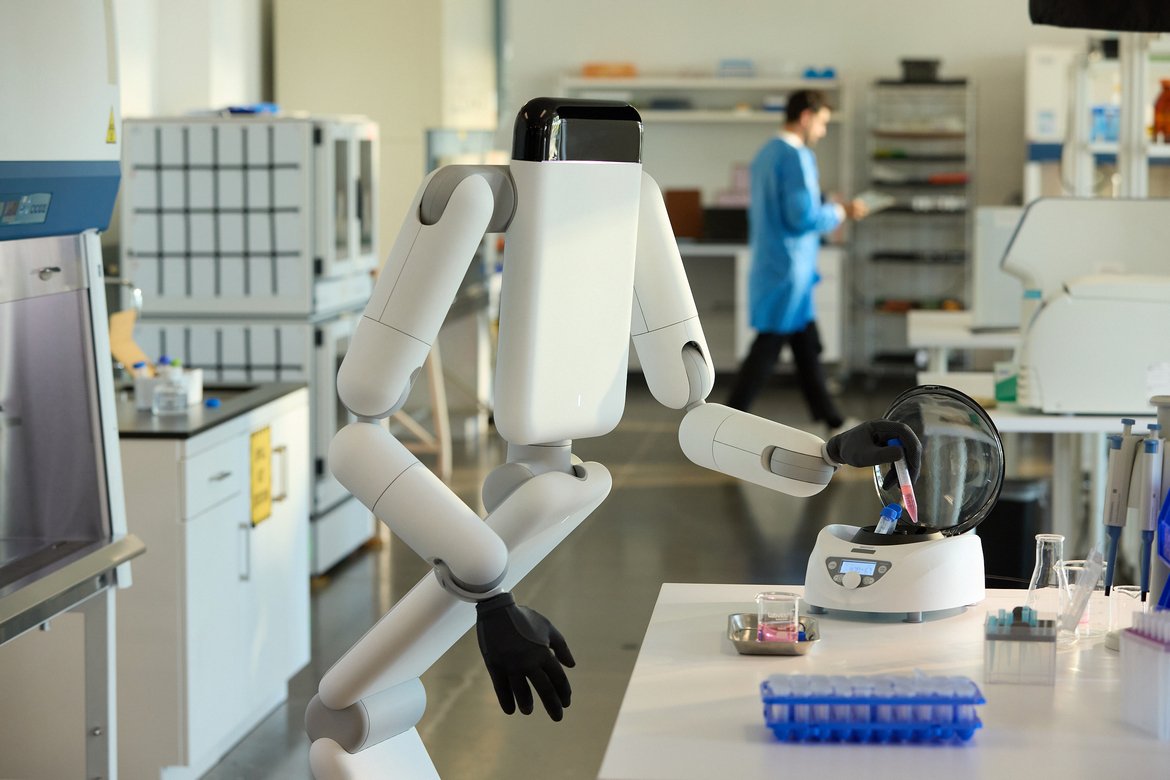

Genesis AI and LG CNS have announced a long-term strategic partnership to bring Genesis’s general-purpose robots into manufacturing and logistics operations across LG Group affiliates and LG CNS’s broader enterprise customer base, beginning in the U.S. and expanding globally. The partnership combines Genesis AI’s full-stack robotics platform – the GENE foundation model and Eno robot – with LG CNS’s system integration expertise and direct access to LG Group’s operational infrastructure across electronics, manufacturing, and logistics.
The announcement follows Genesis AI’s public debut in May, when the company unveiled GENE-26.5, a robotics foundation model demonstrating human-level dexterity across tasks ranging from wire harnessing and laboratory pipetting to Rubik’s Cube solving and piano performance.
How the Partnership Is Structured
The collaboration is designed as a multi-phase deployment program. In the initial phase, Genesis AI and LG CNS will conduct a strategic evaluation across LG CNS’s enterprise customers, including LG Group affiliates, to identify use cases where the Eno robot’s dexterity, adaptability, and real-world generalization can deliver measurable business value. That evaluation will produce a co-developed rollout plan.
A pilot phase will follow, establishing a joint deployment playbook covering workflow documentation, data collection, post-training procedures, and validation methodology. The playbook will serve as the operational foundation for a full multi-phase rollout across LG Group affiliates and LG CNS customers in manufacturing, logistics, and other labor-intensive sectors.
“Working with LG CNS will help give companies around the world a clear path to deploying general-purpose robotics at enterprise scale,” said Zhou Xian, Co-Founder and CEO of Genesis AI.
Why the Partnership Structure Matters
Enterprise robotics deployment has historically stalled at the integration layer rather than the hardware or AI layer. Connecting a robot to existing enterprise systems – workflow management, quality control, inventory tracking, production scheduling – requires deep domain knowledge of both the robot and the operational environment. LG CNS provides that integration capability alongside direct operational access to LG Group’s facilities.
For Genesis AI, the partnership solves a distribution problem that most robotics companies face: how to reach enterprise customers at scale without building a global sales and integration capability from scratch. LG CNS’s existing customer relationships and integration infrastructure create a deployment pathway for Eno that would otherwise require years to develop independently.
The GENE foundation model is built to compound in deployment efficiency over time – each new task the system learns requires less data and less training time than the previous one, meaning the partnership’s deployment velocity is designed to accelerate as the robot builds operational experience across LG Group facilities.
“We believe Genesis’ approach to general-purpose robotics will unlock new levels of generalization and automation across manufacturing, logistics and other complex environments,” said Sangyeob Park, CTO of LG CNS.
The Broader Context
The Genesis AI and LG CNS partnership reflects a structural pattern emerging across the humanoid and general-purpose robotics industry: AI model developers partnering with established system integrators who control access to enterprise operational environments. Similar dynamics are visible in Accenture’s partnership with General Robotics, Humanoid’s manufacturing agreement with Bosch, and UBTECH’s deployment collaboration with Hitachi. The integrator relationship is increasingly the critical bottleneck between robot capability and commercial deployment at scale.
Disclaimer: RobotsBeat is an independent media brand owned and operated by NuvexMedia LLC, publishing news, research, and insights on artificial intelligence, emerging technologies, automation, and related industries. NuvexMedia LLC invests in and collaborates with companies across the AI, Robotics, technology, software, and digital innovation sectors. These relationships do not influence RobotsBeat's editorial coverage, and the publication maintains full editorial independence to provide accurate, timely, and objective information. © 2026 NuvexMedia LLC. All rights reserved. This content is for informational purposes only and should not be considered legal, tax, investment, financial, or other professional advice.