
Humanoid robots are converging rapidly on the limits of human athletic performance in sprinting. Unitree Robotics recently released footage of its H1 robot reaching a peak speed of 10.1 meters per second on an athletics track – a figure that approaches the average race speed of 10.44 meters per second Usain Bolt maintained during his 9.58-second 100-metre world record. Unitree’s CEO Wang Xingxing has publicly predicted that Chinese humanoid robots will break the 10-second barrier in the 100-metre dash by mid-2026.
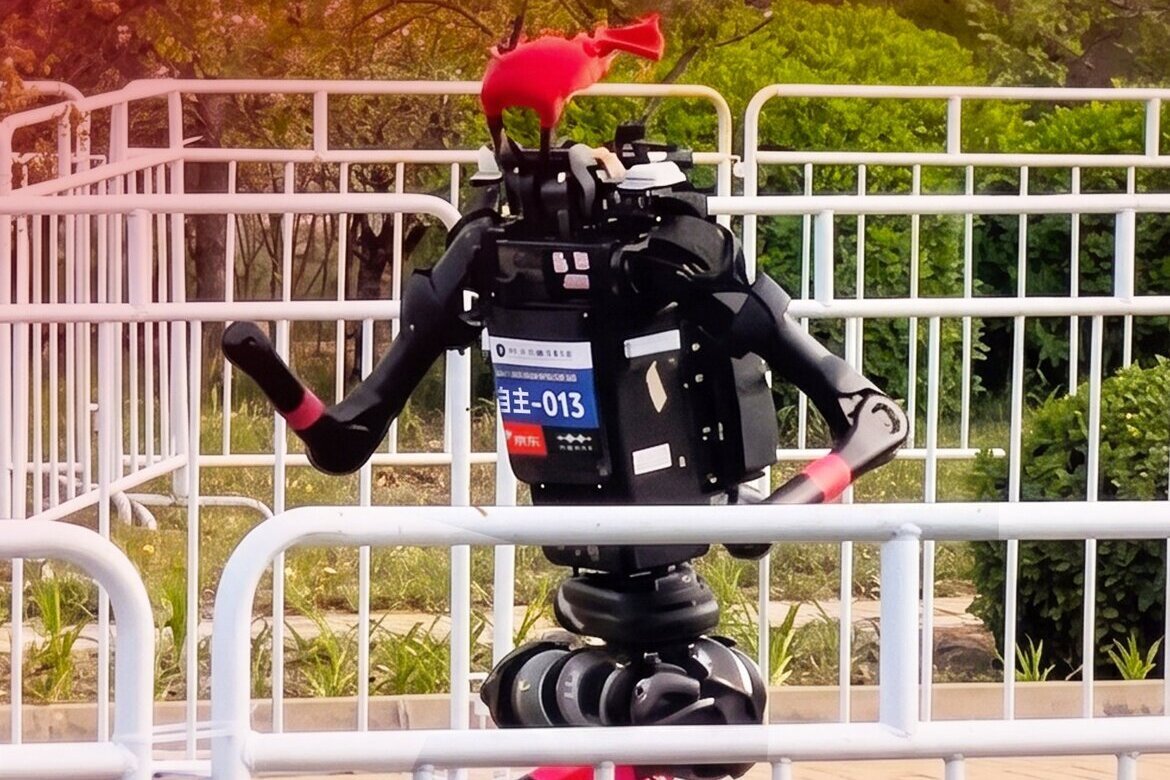
The sprint developments follow the Beijing half-marathon in April, where Honor’s humanoid robot Lightning completed the 13-mile course in 50 minutes and 26 seconds – below the standing human world record by nearly seven minutes. Taken together, the results mark a rapid compression of the performance gap between human and robotic bipedal locomotion across both endurance and speed dimensions.
What the Speed Numbers Represent
Unitree’s 10.1 m/s figure was recorded as the H1 passed a speed-measuring device during a track test, with the company noting possible measurement error in the video. The robot weighs approximately 62 kilograms with a combined leg length of 80 centimeters – proportions comparable to an average adult human. MirrorMe Tech, a startup linked to Zhejiang University, has separately demonstrated a humanoid named Bolt reaching 10 meters per second on a treadmill, with an explicit design goal of approaching or exceeding the biological limits of human motion.
At 10 seconds flat for a 100-metre sprint, a humanoid robot would place within range of elite Olympic competition. The current humanoid robot 100-metre record, set at the 2025 World Humanoid Robot Games, stands at 21.50 seconds – a figure that illustrates how quickly the performance envelope is shifting.
Engineering Progress, Not Scientific Breakthrough
Researchers with deep experience in bipedal robotics caution against overstating what the speed records demonstrate. Alan Fern, a computer science professor at Oregon State University who helped develop the Cassie bipedal robot, said the basic principles of robot locomotion are not new. What changed in the past year, he argued, was engineering quality and investment volume – faster machines that hold together longer, rather than a fundamental advance in how robots learn to move.
“What changed this year was good old-fashioned engineering and investment,” Fern said. “Last year’s robots were slower, and many broke. This year’s machines were fast and held together. That is not nothing, but it is not a breakthrough either.” Yanran Ding, a robotics professor at the University of Michigan, identified heat management as the more significant engineering achievement behind sustained high-speed operation.
Jonathan Hurst, whose company Agility Robotics builds the Digit warehouse humanoid, drew a sharp distinction between track performance and operational readiness. The gap between a robot that can run a premapped course and one that can navigate safely among people in a warehouse is the gap the industry is still working to close. “It’s like looking at the first cars and being like, ‘It doesn’t fly,'” Hurst said. “It’s a pretty high bar.”
Why Speed Benchmarks Still Matter
The investment in locomotion speed serves purposes beyond athletic competition. High-speed bipedal movement requires tight integration across perception, actuation, and learned control policies – the same control stack that governs how a robot navigates dynamic environments, responds to unexpected disturbances, and maintains stability under load. Progress at the performance extremes tends to transfer into improved reliability at the operational middle.
For Chinese manufacturers, publicly demonstrated speed records also carry strategic value in a sector where national competition is explicit. With more than 150 humanoid robot companies active in China and government support tied to performance milestones, speed benchmarks function as both technical validation and competitive positioning.
Disclaimer: RobotsBeat is an independent media brand owned and operated by NuvexMedia LLC, publishing news, research, and insights on artificial intelligence, emerging technologies, automation, and related industries. NuvexMedia LLC invests in and collaborates with companies across the AI, Robotics, technology, software, and digital innovation sectors. These relationships do not influence RobotsBeat's editorial coverage, and the publication maintains full editorial independence to provide accurate, timely, and objective information. © 2026 NuvexMedia LLC. All rights reserved. This content is for informational purposes only and should not be considered legal, tax, investment, financial, or other professional advice.