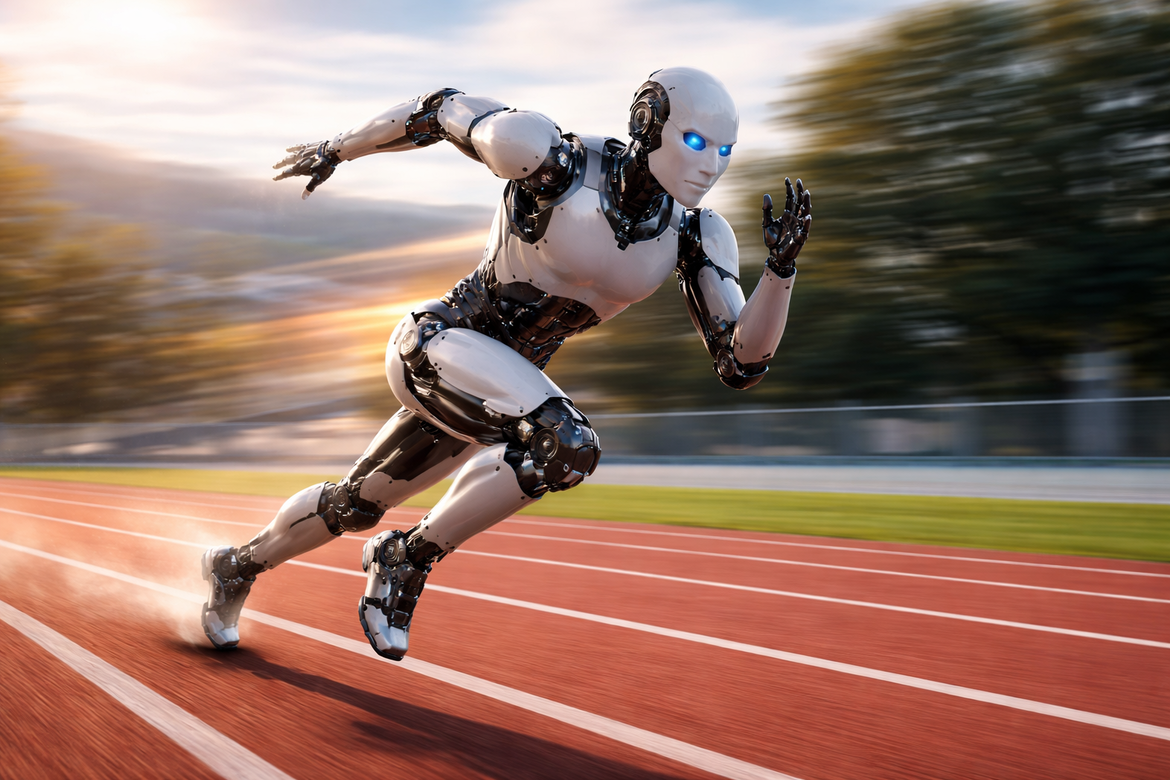

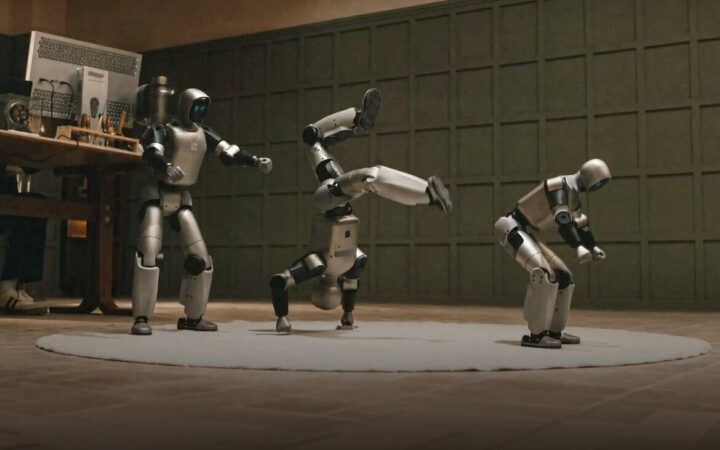
Humanoid robots are approaching a milestone that until recently belonged exclusively to elite human athletes: running as fast as the world’s best sprinters.
Recent advances in robotics suggest that machines capable of matching – or potentially surpassing – human sprint speeds may soon become a reality. According to Wang Xingxing, founder of Chinese robotics company Unitree Robotics, improvements in mechanical design and AI-driven control systems are rapidly closing the gap between human and robotic running performance.
Speaking at the Yabuli China Entrepreneurs Forum, Wang said humanoid robots could eventually complete the 100-meter dash in under 10 seconds, a benchmark associated with world-class sprinters.
While no humanoid robot has yet achieved such performance in real-world conditions, research prototypes are moving closer to that level.
The Engineering Race for Speed
The latest developments illustrate how quickly humanoid locomotion technology is advancing.
Earlier this year, researchers from Zhejiang University and Shanghai-based JingShi Technology unveiled a full-size humanoid robot called “Bolt” capable of reaching speeds of roughly 10 meters per second. That performance places it within striking distance of the pace achieved by Olympic champion Usain Bolt during his record-setting 100-meter sprint.
Bolt’s 2009 world record of 9.58 seconds corresponds to an average speed slightly above 10 meters per second, with peak velocities even higher during the race.
Closing that remaining gap requires solving a series of complex engineering problems.
Unlike wheeled robots, humanoid machines must maintain stability while balancing on two legs during rapid acceleration and stride cycles. High-speed running demands precise synchronization between sensors, actuators, and control algorithms, ensuring that each step maintains balance while maximizing propulsion.
Small errors in timing or force distribution can destabilize the robot, making high-speed locomotion one of the most difficult challenges in humanoid robotics.
Beyond Athletic Benchmarks
Although comparisons to Olympic sprinters capture attention, the implications extend beyond sports.
High-speed locomotion is closely tied to broader advances in embodied AI, the field focused on creating machines that can move, perceive, and interact with the physical world.
Robots capable of running quickly and stably would be better suited for tasks such as search-and-rescue operations, disaster response, and industrial inspections where mobility across complex terrain is essential.
At the same time, researchers acknowledge that achieving elite athletic performance does not necessarily translate into practical autonomy.
Wang noted that one of the biggest hurdles for humanoid robotics remains generalization. Many robots perform well in controlled environments or under carefully trained conditions but struggle when encountering unpredictable terrain or dynamic obstacles.
Bridging that gap between laboratory performance and real-world reliability remains a central challenge for the industry.
Even so, the rapid progress in humanoid locomotion highlights how quickly robotics is evolving. As advances in hardware, control algorithms, and machine learning converge, machines are steadily approaching physical capabilities that once seemed uniquely human.
Whether robots ultimately break sprint records may be less important than what the race represents: a new phase in which artificial intelligence is no longer confined to digital tasks but increasingly expressed through physical movement.
Disclaimer: RobotsBeat is an independent media brand owned and operated by NuvexMedia LLC, publishing news, research, and insights on artificial intelligence, emerging technologies, automation, and related industries. NuvexMedia LLC invests in and collaborates with companies across the AI, Robotics, technology, software, and digital innovation sectors. These relationships do not influence RobotsBeat's editorial coverage, and the publication maintains full editorial independence to provide accurate, timely, and objective information. © 2026 NuvexMedia LLC. All rights reserved. This content is for informational purposes only and should not be considered legal, tax, investment, financial, or other professional advice.