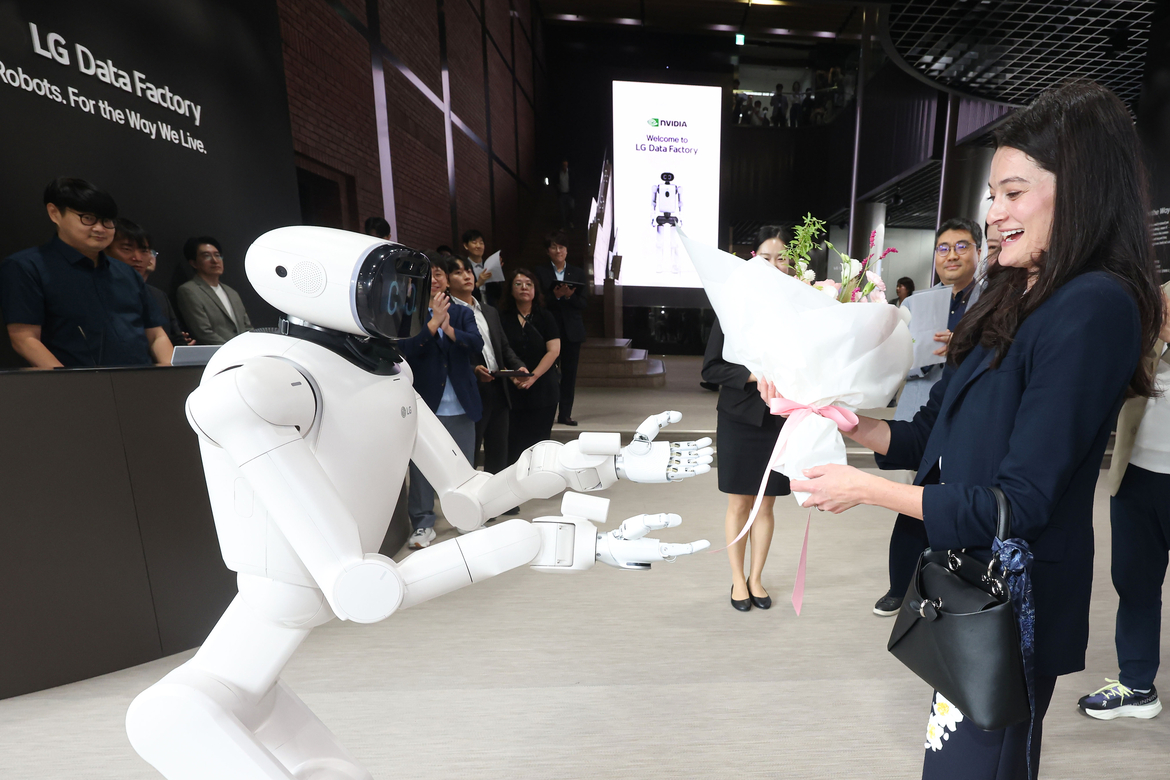

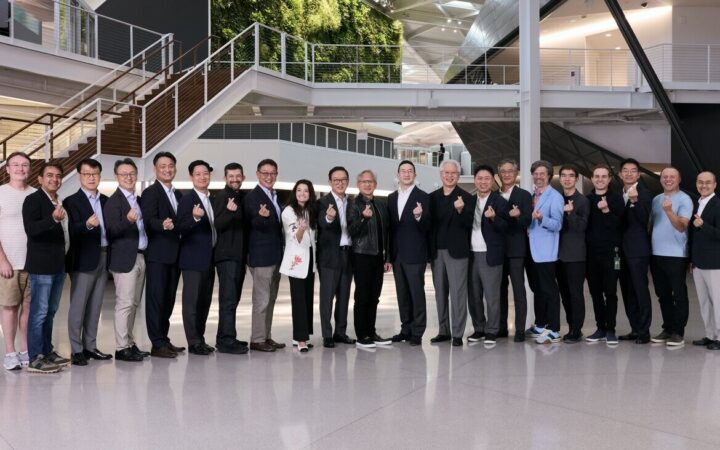
Senior NVIDIA officials visited LG Electronics’ Yangjae Data Factory in Seoul on August 17, four days after LG Group and NVIDIA signed a memorandum of understanding at NVIDIA’s headquarters in Santa Clara. The rapid reconvening signals both companies’ intent to move immediately from strategic agreement to operational execution on the robotics collaboration.
The Yangjae facility, currently under construction on LG Electronics’ Seoul R&D campus, covers 10,000 square meters across four floors. It is scheduled to be fully operational by year-end and will house several hundred LG CLOiD robots generating training data across multiple simulated environments. By year-end, the facility targets 100,000 hours of combined real and synthetic training data – equivalent to approximately 12 years of robot operational experience compressed into a single calendar year.
What Happens Inside the Data Factory
The facility contains distinct training zones corresponding to the environments where LG’s robots will eventually operate. A replicated home environment hosts CLOiD units learning and repeating cleaning tasks. A simulated manufacturing space – modeled directly on LG’s washing machine plant in Tennessee – has CLOiD robots moving, stacking, and assembling parts in conditions designed to transfer directly to the Tennessee facility’s real production environment.
Additional dedicated spaces include a LG CNS logistics automation zone where robots train for warehouse and logistics tasks, and a LG Innotek area where robotic hands are trained on manipulation tasks using the division’s optical component expertise. Data collected across all these environments feeds into a unified pipeline linked with NVIDIA’s robotics development stack.
The Data Flywheel Strategy
LG is framing its physical AI competitiveness around what it calls a data flywheel – a compounding loop where high-quality training data improves robot capability, which enables more effective data collection, which further improves capability. The data flywheel concept positions LG’s decades of manufacturing and logistics operational data as a structural competitive advantage that pure-play robotics companies starting from zero cannot replicate quickly.
NVIDIA’s contribution to the flywheel is the amplification layer. Real-world data collected at the Yangjae facility is augmented and synthesized using NVIDIA Omniverse libraries, NVIDIA Cosmos open world models, and the NVIDIA Isaac robotics development platform. The 100,000-hour target is the combined output of physical robot operation at the facility and synthetic data generation through Cosmos – the latter allowing LG to train on scenarios and edge cases that would take years to encounter in real operation.
LG plans to use the accumulated data to advance its Robot Foundation Model, the AI system that will underpin the performance of LG’s humanoid robots. The RFM is being developed in parallel with NVIDIA Isaac GR00T, with LG retaining its own model development track while using NVIDIA’s open models as a reference and training resource.
“Through the synergy built on ‘One LG’ – bringing together core capabilities across the Group – and strategic collaboration with global partners, we will secure our competitiveness in physical AI and become a comprehensive robotics solutions provider,” said Lyu Jae-cheol, CEO of LG Electronics.
Disclaimer: RobotsBeat is an independent media brand owned and operated by NuvexMedia LLC, publishing news, research, and insights on artificial intelligence, emerging technologies, automation, and related industries. NuvexMedia LLC invests in and collaborates with companies across the AI, Robotics, technology, software, and digital innovation sectors. These relationships do not influence RobotsBeat's editorial coverage, and the publication maintains full editorial independence to provide accurate, timely, and objective information. © 2026 NuvexMedia LLC. All rights reserved. This content is for informational purposes only and should not be considered legal, tax, investment, financial, or other professional advice.