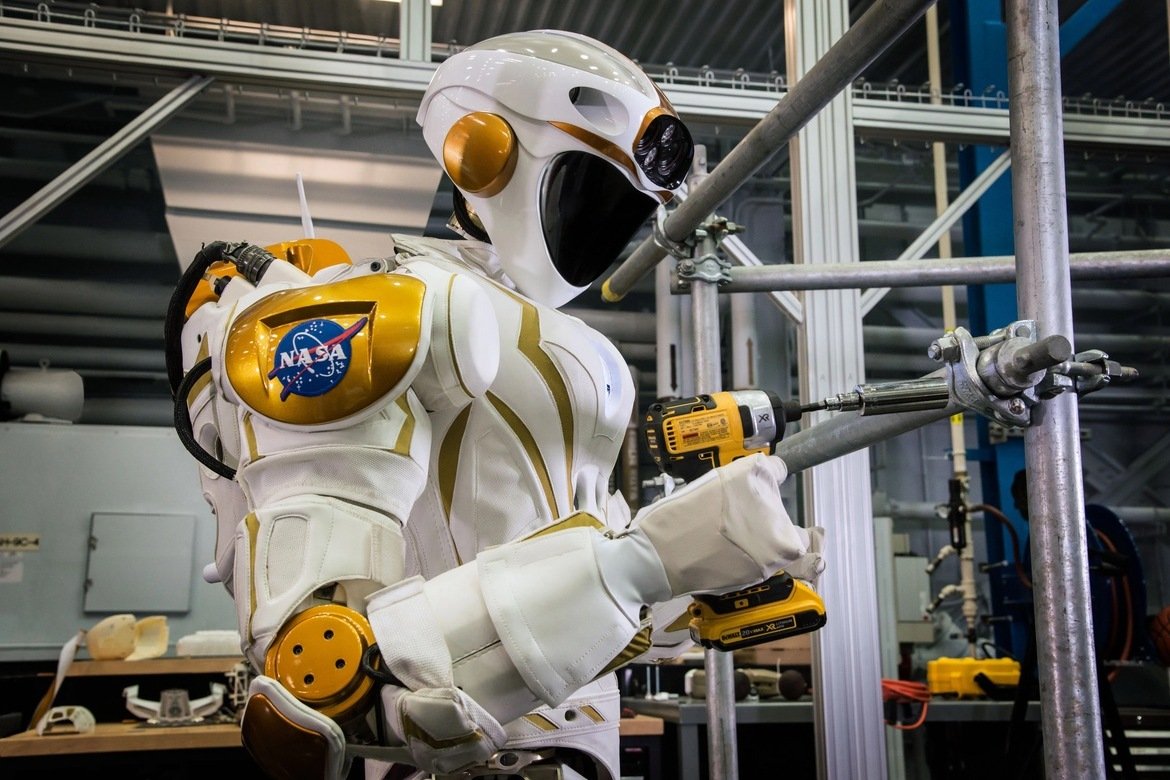

A humanoid robot originally developed for future Mars missions is returning to the United States after spending a decade in Scotland supporting robotics research.
The robot, known as Valkyrie, has been based at the University of Edinburgh since 2016 as part of a collaboration with NASA. The platform helped researchers advance technologies related to mobility, perception, and human-robot interaction before being transferred back to NASA’s Johnson Space Center in Texas for further development.
Standing roughly 1.8 meters tall and weighing about 125 kilograms, Valkyrie remains one of only a handful of humanoid research robots built for extreme environments such as planetary exploration.
Its return marks a new phase in the project, as NASA continues evaluating how humanoid robots could assist astronauts on future missions to the Moon and Mars.
A Research Platform for Space Robotics
Valkyrie was originally developed as part of NASA’s effort to build robots capable of preparing infrastructure in hazardous environments before human crews arrive.
The robot’s human-like structure allows it to operate in environments designed for people, including industrial tools, ladders, and access points. That design principle has long been central to humanoid robotics research: rather than redesigning environments for machines, robots are built to function within existing human systems.
The platform incorporates a range of sensors and Series Elastic Actuators, a type of joint mechanism designed to enable safer physical interaction between robots and humans while maintaining precise control.
When the robot arrived in Edinburgh nearly a decade ago, its capabilities were relatively limited. It could walk on flat surfaces and perform basic manipulation tasks such as grasping objects.
Over time, researchers enhanced the system using artificial intelligence and machine learning techniques that improved balance, perception, and decision-making. The work focused on helping the robot interpret sensor data, maintain stability on uneven terrain, and translate visual information into coordinated physical actions.
A Decade of Progress in Humanoid Robotics
At the time Valkyrie was deployed in Edinburgh, humanoid robots were still largely confined to research laboratories. Commercial systems had yet to emerge, and only a small number of prototypes existed worldwide.
The robot provided researchers with a rare experimental platform for studying how humanoids move, maintain balance, and interact with people in real-world environments.
According to researchers involved in the program, the project helped train a generation of roboticists while contributing to the broader development of humanoid robotics.
Vladimir Ivan, who worked on the Valkyrie project as a student and now serves as chief technical officer of robotics start-up Touchlab, described hosting the robot as a unique opportunity during a period when advanced humanoid systems were largely inaccessible to academic labs.
The presence of the NASA robot also helped strengthen the University of Edinburgh’s role as a global hub for robotics research, supporting collaborations between academia, industry, and emerging robotics companies.
Influencing the Next Generation of Robots
Beyond its role in academic research, Valkyrie has also influenced newer humanoid platforms.
Elements of the robot’s architecture have informed the development of modern systems, including humanoid designs emerging from robotics companies that are beginning to transition the technology from laboratories into industrial environments.
One example is Apptronik’s Apollo robot, which draws on research lineage connected to earlier NASA humanoid programs.
Meanwhile, research in Edinburgh has continued with newer platforms such as the Talos humanoid robot, which scientists use to study advanced locomotion, manipulation, and collaborative interaction between humans and machines.
This research includes work on dyadic human-robot interaction, where robots and people cooperate directly to complete tasks. Such approaches could eventually support applications ranging from assisted living technologies to rehabilitation systems.
What Valkyrie’s Return Signals
The return of Valkyrie to NASA comes at a moment when humanoid robotics is moving rapidly from academic experimentation toward commercial deployment.
Companies across the United States, Europe, and Asia are developing humanoid machines for factories, logistics centers, and service environments. At the same time, space agencies are continuing to explore how similar technologies could support exploration missions.
For NASA, robots like Valkyrie remain part of a long-term strategy to extend human capabilities in hazardous environments. Humanoid machines could eventually assemble infrastructure, maintain equipment, or conduct preliminary exploration before astronauts arrive.
The past decade of research in Edinburgh helped advance the fundamental technologies behind that vision.
Now, as Valkyrie returns to the United States, the robot is expected to play a role in the next stage of development as space agencies and robotics companies alike push toward machines capable of operating far beyond Earth.
Disclaimer: RobotsBeat is an independent media brand owned and operated by NuvexMedia LLC, publishing news, research, and insights on artificial intelligence, emerging technologies, automation, and related industries. NuvexMedia LLC invests in and collaborates with companies across the AI, Robotics, technology, software, and digital innovation sectors. These relationships do not influence RobotsBeat's editorial coverage, and the publication maintains full editorial independence to provide accurate, timely, and objective information. © 2026 NuvexMedia LLC. All rights reserved. This content is for informational purposes only and should not be considered legal, tax, investment, financial, or other professional advice.