

Engineers at Northwestern University have developed a new type of modular robot capable of continuing to move and operate even after being physically separated into pieces, a design approach that could change how robots are built for unpredictable environments.
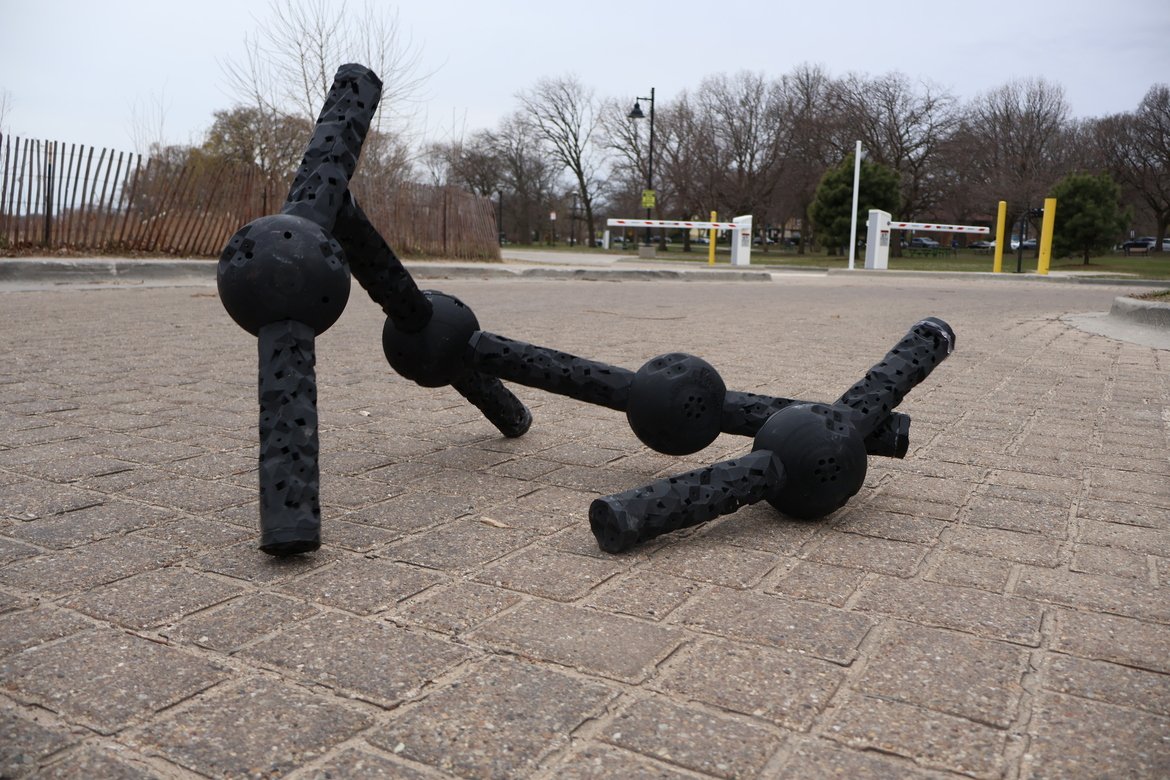
The machines, described by researchers as “legged metamachines”, are composed of self-contained robotic modules that can connect, detach, and reorganize themselves while maintaining mobility. Each module includes its own electronics, power source, and motor, allowing it to function as an independent robotic unit.
When combined into larger structures, the modules behave like limbs of a larger robot, capable of performing complex movements such as jumping, flipping, and traversing uneven terrain.
The project explores how robotic systems might achieve a level of resilience that traditional designs lack.
Robots Built from Autonomous Modules
Unlike conventional robots built around a single centralized body, metamachines are constructed from multiple independent units that snap together like building blocks.
Each module resembles a small mechanical limb composed of two elongated segments connected through a central spherical joint. Inside that spherical core are the essential components required for operation, including circuitry, battery power, and a motor.
Individually, these modules are capable of rolling or jumping across the ground. But when combined into multi-limbed configurations, they form coordinated robotic structures capable of far more complex movement.
Researchers describe this architecture as similar to a robot made from smaller robots, where each piece contributes to the overall motion while retaining its own sensing and control systems.
AI Designed the Robot’s Body
The unusual appearance and motion of the metamachines emerged from an AI-driven design process rather than conventional engineering.
The research team used an evolutionary algorithm that simulated a process similar to natural selection. Digital robot designs were generated, tested in simulation, and iteratively modified through virtual “mutations” until high-performing configurations emerged.
Because the algorithm explored design possibilities unconstrained by traditional engineering intuition, it produced unusual structures that resemble the movement patterns of animals.
Some configurations move with motions similar to seals undulating across terrain, while others bound like small mammals or leap using spring-like dynamics.
According to the researchers, these AI-evolved designs allowed the robots to move effectively across a variety of surfaces.
Surviving Damage and Reassembling
Perhaps the most distinctive feature of the metamachines is their ability to continue functioning after severe physical damage.
In traditional robots, losing a limb or structural component often renders the entire system unusable. In modular metamachines, however, damage simply alters the configuration of the system.
If a component is severed, the remaining modules immediately adjust their movement pattern and continue traveling with fewer limbs.
Meanwhile, detached modules do not become inert debris. Each segment remains an autonomous robot capable of sensing its environment and moving independently.
Researchers observed detached modules crawling or rolling across the terrain, potentially allowing them to reconnect with the rest of the system.
The team described the result as a form of functional resilience that resembles biological organisms capable of regenerating or adapting after injury.
Testing Robots in the Real World
To validate the concept outside of simulation, the researchers built physical prototypes composed of three, four, and five modules.
The robots were tested outdoors across uneven terrain, including sand, soil, and forest floor environments.
During these experiments, the metamachines demonstrated the ability to flip themselves upright when overturned and to traverse obstacles without external control adjustments.
The experiments were designed to test whether AI-evolved designs developed in computer simulations could function effectively in real-world environments.
According to the researchers, the robots performed these movements immediately after assembly without requiring manual calibration.
What Modular Robots Could Enable
The research highlights a potential direction for robotics focused on adaptability and resilience rather than rigid precision.
Modular machines capable of self-repair and reconfiguration could be particularly useful in environments where human intervention is difficult or impossible.
Possible applications include planetary exploration, disaster response, and infrastructure inspection, where robots may encounter unpredictable terrain or physical damage.
By distributing intelligence and mobility across many small units rather than relying on a single central structure, such systems may continue operating even when individual components fail.
As robotics researchers continue exploring new approaches to embodied intelligence, designs inspired by biological resilience may play an increasingly important role in machines intended to operate beyond controlled laboratory environments.
Disclaimer: RobotsBeat is an independent media brand owned and operated by NuvexMedia LLC, publishing news, research, and insights on artificial intelligence, emerging technologies, automation, and related industries. NuvexMedia LLC invests in and collaborates with companies across the AI, Robotics, technology, software, and digital innovation sectors. These relationships do not influence RobotsBeat's editorial coverage, and the publication maintains full editorial independence to provide accurate, timely, and objective information. © 2026 NuvexMedia LLC. All rights reserved. This content is for informational purposes only and should not be considered legal, tax, investment, financial, or other professional advice.