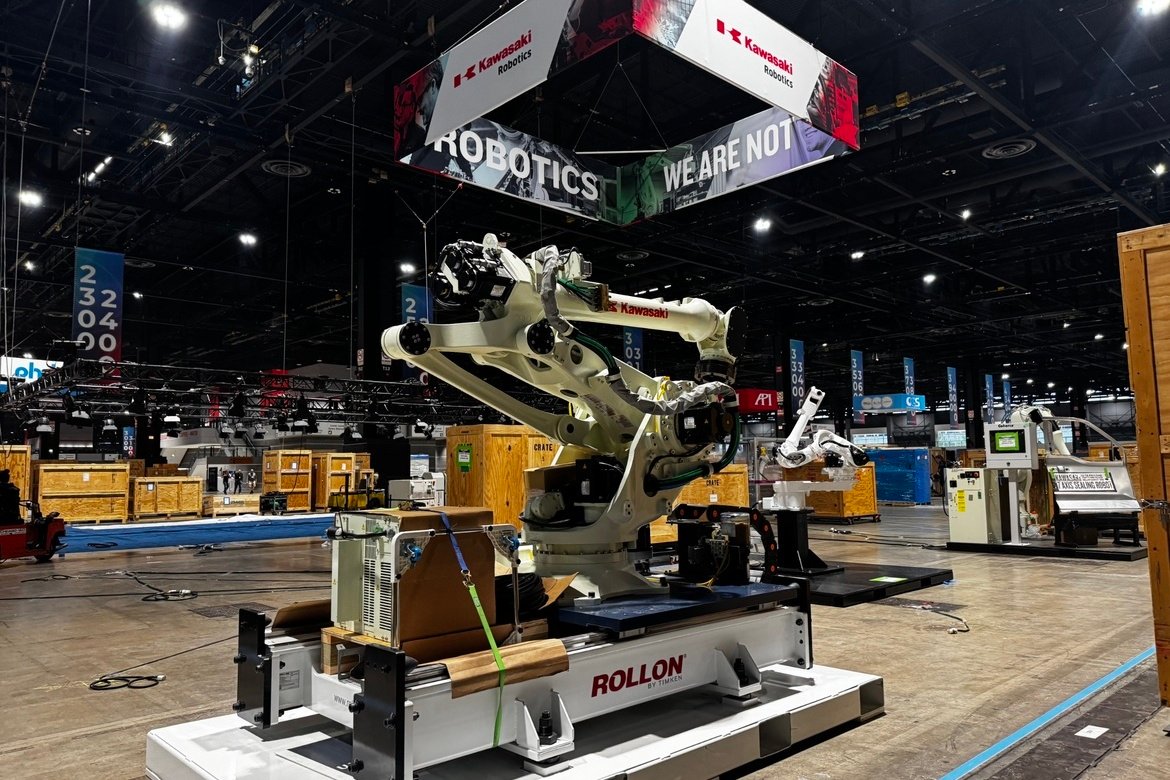

Kawasaki Robotics has debuted the RL030N at Automate 2026 in Chicago, describing it as the industry’s first 8-degree-of-freedom robot platform designed specifically for physical AI applications. The robot combines high-speed motion, lightweight construction, and real-time external orchestration capability through Kawasaki’s open KRNX control API, enabling AI software, ROS environments, machine learning systems, and third-party orchestration platforms to control the robot directly in real time.
The event runs June 22-25 at McCormick Place. Alongside the RL030N, Kawasaki is demonstrating patented Pulseboard weld inspection technology, a closed-loop adhesive dispensing system developed with Coherix, and two new industrial robots – the BA013L arc welding robot and the MXP360L heavy-duty handling platform.
The RL030N’s Physical AI Architecture
Conventional 6-axis industrial robots are optimized for repeatable, pre-programmed motions in structured environments. The RL030N adds a seventh and eighth articulation axis, providing dexterity and flexibility suited to dynamic and confined-space environments where adaptive motion planning, obstacle avoidance, and complex manipulation are required.
The robot’s KRNX open control API is the component that makes physical AI integration practical. Rather than requiring robot-specific programming for each AI application, the open API allows external systems – vision platforms, machine learning models, and orchestration software – to command the robot directly in real time. This architecture positions the RL030N as a hardware layer within a broader physical AI stack rather than a standalone automation tool.
Pulseboard: 10x Faster Weld Inspection
Kawasaki is demonstrating its patented Pulseboard technology in a live robotic weld inspection system developed with Fives DyAG. Conventional inspection systems require robots to stop repeatedly for image capture, introducing delays and limiting throughput. Pulseboard continuously synchronizes image acquisition in real time with the robot’s tool-tip displacement during motion – including during acceleration and deceleration – enabling high-resolution imaging without stopping.
The result is up to 10x faster weld inspection with precise defect localization and no sacrifice in accuracy. The system combines a Kawasaki RS013N robot, a laser 3D profile camera, and Kawasaki’s high-speed motion synchronization technology to handle complex weld geometries and curved surfaces that challenge conventional inspection approaches.
“The solution accelerates inspections, identifies defects, and maintains the highest level of quality without slowing or sacrificing production time,” said Wade Rickard, CEO of Fives DyAG Corp.
Closed-Loop Dispensing and New Platform Additions
A third demonstration developed with Coherix shows the BU015X 7-axis robot applying sealant to a Ford F-150 door skin while measuring and automatically adjusting adhesive bead placement in real time at speeds of up to 400 corrections per second. The closed-loop system uses machine learning and real-time process control to reduce defects, material waste, and rework at full production-line speeds.
The BA013L arc welding robot, also debuting at the show, features a 50mm hollow wrist for internal cable routing, support for high-current welding torches, and axis speeds reaching 730 degrees per second with a 2,093mm reach. The MXP360L handles payloads of up to 360 kilograms for heavy-duty material handling applications.
Together, the Automate 2026 lineup reflects Kawasaki Robotics’ positioning at the intersection of established industrial automation and the emerging physical AI layer – a combination of hardware reliability and open control architecture that enables AI-driven orchestration without replacing the underlying manufacturing infrastructure that its customers depend on.
Disclaimer: RobotsBeat is an independent media brand owned and operated by NuvexMedia LLC, publishing news, research, and insights on artificial intelligence, emerging technologies, automation, and related industries. NuvexMedia LLC invests in and collaborates with companies across the AI, Robotics, technology, software, and digital innovation sectors. These relationships do not influence RobotsBeat's editorial coverage, and the publication maintains full editorial independence to provide accurate, timely, and objective information. © 2026 NuvexMedia LLC. All rights reserved. This content is for informational purposes only and should not be considered legal, tax, investment, financial, or other professional advice.