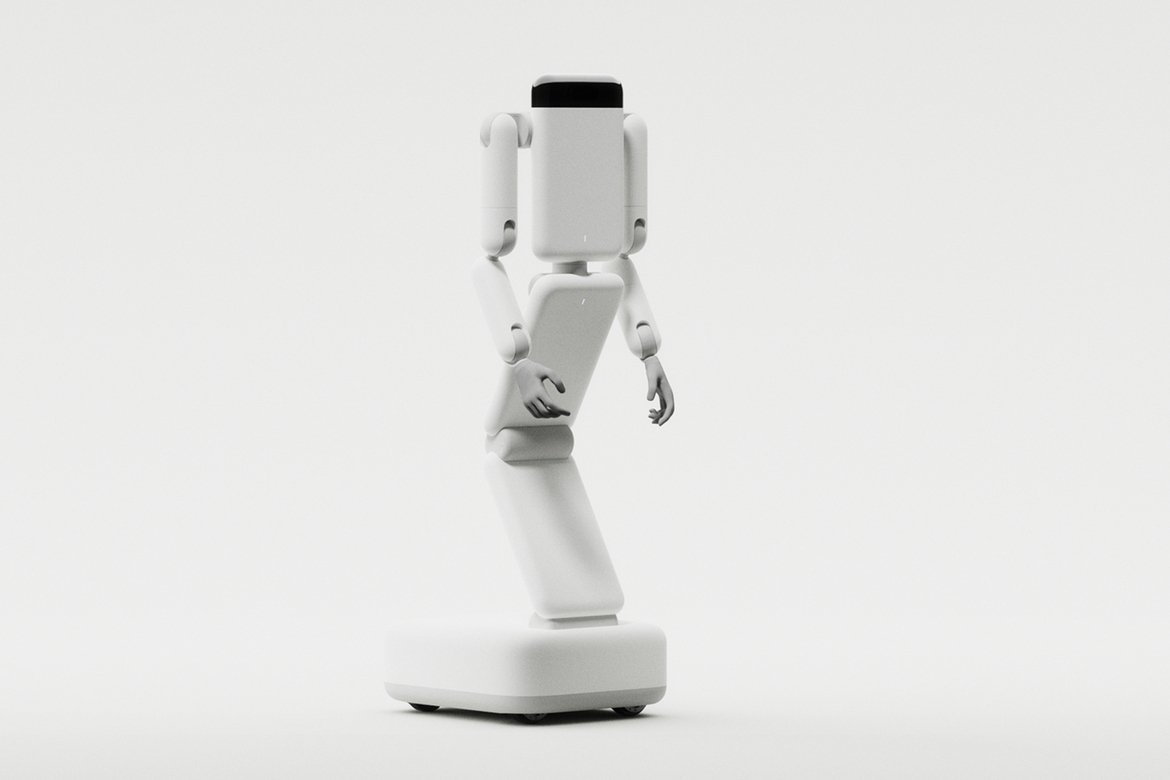

Genesis AI has unveiled Eno, its first general-purpose robot, designed around what the company describes as a philosophy of essentiality: every design element serves a functional purpose, and the robot deliberately avoids mimicking human appearance in favor of extending human capability. Eno rises from a wheeled base into a minimalist tower of articulated panels that adjust height and reach in real time and fold flat for compact storage when not in use. At the center of the system are proprietary dexterous robotic hands that match the form and function of human hands, enabling interaction with the tools, objects, and environments already built with human dimensions in mind.
Production and targeted customer deployments are planned for the end of 2026, beginning with manufacturing, logistics, and laboratory customers before expanding to hotels, hospitals, and eventually consumer home and outdoor applications.
Design Philosophy
The choice to reject bipedal humanoid form is deliberate. Genesis AI argues that matching human appearance without matching human mobility creates robots optimized for the wrong variable. Eno’s wheeled base provides reliable locomotion in structured environments without the balance complexity of bipedal systems. The height-adjustable tower expands the robot’s operational reach beyond fixed-height humanoid proportions. The dexterous hands retain the dimensional compatibility that matters for operating in human-scale environments – the ability to use the same tools, handles, and workstations as human workers – without requiring the rest of the system to mimic human anatomy.
“When designing Eno, we started with the question of what it needed to be,” said Daniel Hundt, Head of Design at Genesis AI. “We reduced the form to its essential elements so that every detail serves a purpose.”
The GENE Foundation Model as the Operating Brain
Eno was designed in parallel with GENE, Genesis AI’s robotics-native foundation model, so that the hardware and AI are optimized as a single integrated system rather than matched after independent development. GENE allows Eno to function as a physical agent rather than a command executor: given a high-level goal, the robot understands context, retains memory across a task, reasons through changing conditions, and dynamically plans multi-step workflows over extended periods.
In practice, this means Eno can manage entire operational sequences – keeping production lines stocked, preparing facilities between shifts, coordinating with surrounding systems and people – rather than executing isolated pre-defined motions. The optional screen version of Eno includes a cognitive interface that displays the robot’s intent, reasoning, and operational state in real time, designed to build trust through transparency in human-robot working environments.
Market Entry and Investor Context
Genesis AI has raised $105 million in seed funding backed by Eclipse, Khosla Ventures, Bpifrance, and HSG, alongside investors including Eric Schmidt, Xavier Niel, AI researcher Daniela Rus, and Vladlen Koltun. The Eno unveil coincides with the company’s announcement of a strategic partnership with LG CNS to deploy Eno across LG Group manufacturing and logistics operations, providing an initial enterprise deployment pathway.
“The combination of agentic intelligence, intuitive interaction, and the ability to operate alongside people in the physical world creates a system that can help individuals and organizations accomplish more,” said Eric Schmidt. “The breakthrough is not replacing human expertise, but amplifying it.”
The introduction of Eno is described as the first step in a broader product roadmap, with additional robot embodiments currently in development. The company’s production timeline – deployments starting before year-end – will be the first test of whether its full-stack hardware and AI approach translates from GENE-26.5 demonstrations into robots operating reliably in live industrial environments.
Disclaimer: RobotsBeat is an independent media brand owned and operated by NuvexMedia LLC, publishing news, research, and insights on artificial intelligence, emerging technologies, automation, and related industries. NuvexMedia LLC invests in and collaborates with companies across the AI, Robotics, technology, software, and digital innovation sectors. These relationships do not influence RobotsBeat's editorial coverage, and the publication maintains full editorial independence to provide accurate, timely, and objective information. © 2026 NuvexMedia LLC. All rights reserved. This content is for informational purposes only and should not be considered legal, tax, investment, financial, or other professional advice.