

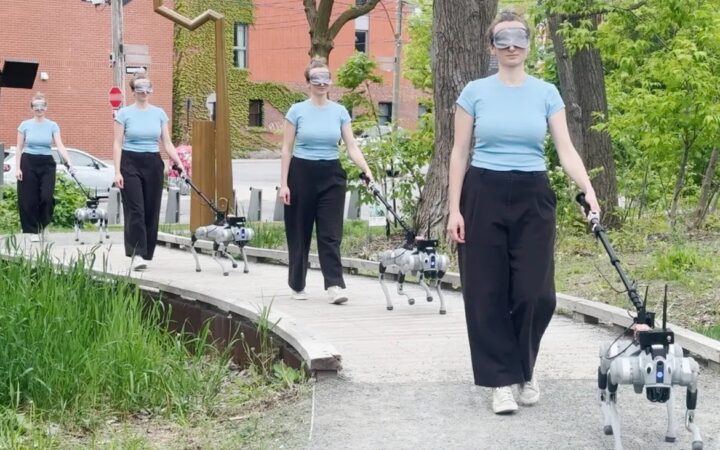
Mistral has launched Robostral Navigate, an 8 billion parameter AI model for robotic navigation that achieves state-of-the-art performance on the R2R-CE benchmark using only a single ordinary RGB camera. The model takes plain-language navigation instructions and moves a robot through complex environments autonomously – offices, residential buildings, commercial spaces, and outdoor settings – without requiring LiDAR, depth sensors, or multiple cameras.
Robostral Navigate achieves a 76.6% success rate on the R2R-CE validation unseen set, which tests performance in environments held out from training. It outperforms the best single-camera approach by 9.7 percentage points and the best system using depth or multiple cameras by 4.5 points – despite using neither. On the validation seen benchmark it achieves 79.4%.
Why Single-Camera Navigation Is Significant
The dominant approach to robot navigation has required rich sensor stacks: LiDAR for spatial mapping, depth cameras for obstacle detection, and multiple RGB cameras for wide environmental coverage. These sensors are expensive, add weight and complexity, and create integration challenges across different robot hardware platforms. A model that delivers comparable or superior navigation performance from a single commodity RGB camera removes those constraints simultaneously.
Robostral Navigate runs on wheeled, legged, and flying robots, and generalizes across robot sizes and different camera configurations without retraining. Robustness to variations in camera intrinsics – the optical properties that differ between camera models – means the same model can deploy across different hardware without camera-specific adaptation.
How the Model Works
The navigation approach is based on pointing: given a task instruction and a history of observations, the model infers the image coordinates of where the robot should move next, together with the desired arrival orientation. This pointing-based method is naturally robust to changes in camera intrinsics and world scale. When the target location lies outside the current camera field of view, the model falls back to local coordinate frame displacements.
Robostral Navigate is built entirely in-house and does not use existing open-source vision-language models as a base. It is initialized from Mistral’s own vision-language model specialized in grounding tasks – pointing, counting, and object localization. Navigation emerges as an extension of those grounding capabilities: a model that understands where things are can learn how to move toward them.
The training dataset contains approximately 400,000 trajectories collected across 6,000 simulated scenes, generated entirely in simulation through an efficient data pipeline that enabled rapid iteration. A prefix-caching training algorithm compresses an entire navigation episode into a single sequence, reducing training tokens by 22 times compared to per-timestep training while preserving all learning signals. Training runs that would otherwise take months complete in days.
Online reinforcement learning using the CISPO algorithm further improved performance after supervised training, allowing the model to learn from failures and develop exploratory navigation behaviors. This post-training stage alone contributed a 3.2 percentage point improvement in success rate. Mistral noted no performance plateauing, indicating continued gains are expected with additional training.
The Roadmap
Mistral describes Robostral Navigate as the first step toward a unified embodied agent. The company positions navigation as a foundational capability for general-purpose robotics, with the current model establishing that state-of-the-art embodied navigation is achievable with a compact model and a single camera. The model is targeted at manufacturing, delivery, logistics, and hospitality applications – use cases the company identified as representing the highest near-term customer demand for autonomous navigation capability.
Disclaimer: RobotsBeat is an independent media brand owned and operated by NuvexMedia LLC, publishing news, research, and insights on artificial intelligence, emerging technologies, automation, and related industries. NuvexMedia LLC invests in and collaborates with companies across the AI, Robotics, technology, software, and digital innovation sectors. These relationships do not influence RobotsBeat's editorial coverage, and the publication maintains full editorial independence to provide accurate, timely, and objective information. © 2026 NuvexMedia LLC. All rights reserved. This content is for informational purposes only and should not be considered legal, tax, investment, financial, or other professional advice.