Qualcomm and NEURA Robotics Form Alliance to Advance Physical AI Platforms

Qualcomm and NEURA Robotics have announced a strategic collaboration to develop next-generation robotics platforms, combining edge AI processors with full-stack robotics systems to accelerate the deployment of cognitive robots.

By Daniel Krauss | Edited by Kseniia Klichova Published: Updated:
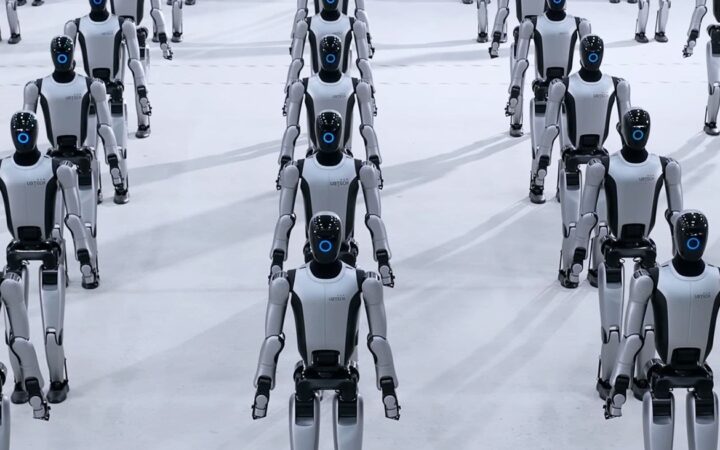
Humanoid robots developed by NEURA Robotics are showcased as part of the company’s vision for cognitive robotics platforms designed to work safely alongside humans in industrial and everyday environments. Photo: NEURA Robotics

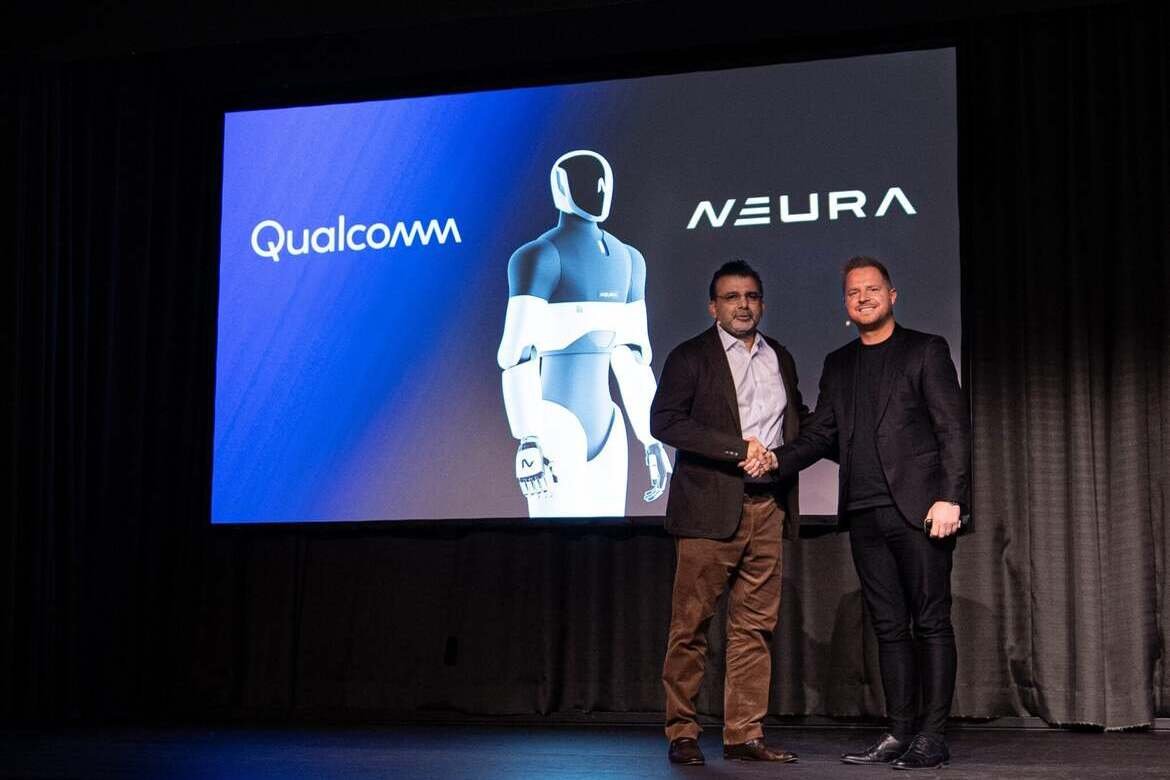
The race to build general-purpose robots capable of operating alongside humans is increasingly becoming a partnership-driven effort. Semiconductor company Qualcomm and German robotics developer NEURA Robotics have announced a long-term strategic collaboration aimed at accelerating the development of physical AI and cognitive robotics systems.

The partnership combines Qualcomm’s edge AI computing platforms with NEURA’s full-stack robotics hardware and embodied AI software, with the goal of enabling scalable robots that can operate safely in industrial, service, and household environments.

The announcement reflects a growing convergence between semiconductor companies and robotics developers as the industry works to move physical AI from experimental prototypes to commercially deployable machines.

Building the “Brain and Nervous System” of Robots

At the center of the collaboration is a joint effort to develop what the companies describe as a “brain plus nervous system” architecture for robots.

In this framework, high-level cognitive functions such as perception, reasoning, and planning operate alongside real-time control systems responsible for motion and interaction with the physical world.

Qualcomm’s role in the partnership focuses on providing the computing layer. Its Dragonwing robotics processors and edge AI platforms are designed to handle demanding workloads locally on robotic systems, allowing machines to make decisions instantly without relying on cloud connectivity.

NEURA Robotics will integrate those processors into its robotics platforms and embodied AI software stack, which powers a range of robotic systems including industrial manipulators, mobile robots, service robots, and humanoid machines.

The companies say the goal is to create standardized reference architectures that simplify how robotics developers design and deploy intelligent machines.

Moving Robotics from Research to Deployment

While robotics research has advanced rapidly in recent years, many systems remain difficult to scale commercially due to fragmented hardware and software ecosystems.

By combining computing platforms with standardized robotics architectures, Qualcomm and NEURA say they hope to accelerate commercialization of robots capable of operating reliably in real-world environments.

Robotics presents one of the most demanding edge AI workloads. Unlike many cloud-based AI applications, robots must process sensory data and make decisions instantly to ensure safe interaction with people and objects.

Nakul Duggal, executive vice president and general manager for automotive, industrial, and embedded IoT at Qualcomm Technologies, said the collaboration reflects a broader shift toward bringing intelligence directly onto devices.

“Robotics represents one of the most demanding edge AI use cases, where decisions must happen instantly, reliably, and locally,” Duggal said.

The companies plan to develop deployment standards that allow AI workloads to be updated and validated across fleets of robots while maintaining the deterministic performance required for safety-critical environments.

Creating a Shared Robotics Ecosystem

Another component of the collaboration is a developer ecosystem designed to encourage third-party robotics applications.

NEURA’s cloud platform, called Neuraverse, will serve as an environment for training, simulation, and lifecycle management of robotic systems running on Qualcomm’s processors.

The platform is designed to connect robots into a shared network where improvements learned by one system can be distributed across others.

In theory, such architectures could allow fleets of robots to continuously improve their capabilities through shared data and software updates, accelerating development cycles for robotics companies.

The partners also aim to create a marketplace for robotics applications, enabling developers to build software once and deploy it across multiple robot platforms.

What the Partnership Signals for the Robotics Industry

The collaboration highlights a broader trend in the robotics sector: the increasing importance of computing infrastructure and ecosystem development.

For decades, robotics progress was largely driven by advances in mechanical engineering and control systems. Today, artificial intelligence and high-performance computing are becoming equally central to how robots perceive their surroundings, make decisions, and interact with humans.

As a result, chipmakers are beginning to play a more direct role in shaping the robotics industry.

For NEURA Robotics, which is pursuing the development of general-purpose cognitive robots including humanoid systems, access to scalable computing platforms could accelerate its path to commercialization.

For Qualcomm, the partnership represents an opportunity to extend its edge AI and connectivity technologies into what many consider one of the next major computing platforms: intelligent machines operating in the physical world.

If successful, collaborations of this type could help define the architecture behind the next generation of robots, linking AI computing, software ecosystems, and physical machines into unified platforms.

AtkinsRéalis and Oxford Robotics Institute Partner to Deploy Autonomous Robots in Nuclear Sites

AtkinsRéalis and the University of Oxford’s Oxford Robotics Institute have formed a partnership to commercialize autonomous inspection and manipulation robots for nuclear decommissioning and energy sector applications, building on deployments already active at Sellafield.

By Laura Bennett | Edited by Kseniia Klichova Published:
An autonomous mobile robot conducting inspection and radiation mapping in a hazardous industrial facility, operating without direct human presence in the environment. Photo: AtkinsRéalis

AtkinsRéalis, the engineering and project management firm, has formed a partnership with the University of Oxford’s Oxford Robotics Institute to accelerate the deployment of autonomous robots in nuclear and wider energy sector environments. The collaboration formalizes and scales a body of work already active in the UK, where ORI-developed systems have been integrated into AtkinsRéalis platforms for autonomous navigation, mapping, and radiation hotspot detection at nuclear sites including Sellafield.

The partnership’s initial focus is on converting those proven UK deployments into commercial products available to international customers. Systems currently operating as mobile inspection vehicles and manipulation platforms will be refined in ORI’s laboratory infrastructure before transitioning into field-ready applications through AtkinsRéalis’ nuclear engineering capabilities.

Why Nuclear Is a Demanding Test Environment

Nuclear decommissioning and inspection represent one of the most constrained deployment contexts in industrial robotics. Human access is limited by radiation exposure limits, physical endurance, and safety protocols that restrict time on-site. Autonomous robots that can navigate, map, and detect radiation anomalies without continuous human presence directly address those constraints, extending operational capability into areas and durations that human crews cannot sustain.

Reducing personnel exposure to hazardous conditions is the core operational driver. Beyond safety, autonomous systems can potentially accelerate decommissioning work that would otherwise be paced by human radiation limits – a meaningful economic consideration given the multi-decade timescales and substantial costs associated with nuclear site closure programs.

The partners described the work as part of the emerging field of physical AI – the coupling of simulation, AI-enabled perception, decision-making, and real-world validation to enable reliable autonomous operation in safety-critical environments.

AtkinsRéalis’ Broader Robotics Ecosystem

The ORI partnership extends an ecosystem AtkinsRéalis has been assembling across robotics and AI over the past year. The company has a proposed trial of remote robot operation with Sellafield Ltd, an extended partnership with Canadian robotics manufacturer Kinova, and an active collaboration with NVIDIA on simulation and autonomy tools. Together, these alliances position AtkinsRéalis as an integrator across the physical AI stack for nuclear applications – from simulation and perception to manipulation hardware and regulatory compliance.

The deal gives AtkinsRéalis deeper access to ORI’s academic research and specialist testing infrastructure in perception, navigation, manipulation, and digital twin development. First public demonstrations of related technology in the UK are expected in the coming months as trials with nuclear site operators progress.

“This partnership allows us to rapidly move autonomous robotics from research to operational deployment on nuclear power plants around the world,” said Sam Stephens, head of digital for AtkinsRéalis’ nuclear division.

The longer-term objective is a validated suite of autonomous inspection and manipulation platforms deployable across decommissioning, operations, and monitoring tasks at nuclear sites internationally – a market where regulatory requirements, site-specific complexity, and safety standards create high barriers to entry but also durable demand for proven systems.

Business & Markets, News, Robots & Robotics, Science & Tech

SusHi Tech Tokyo 2026 Opens with 770 Exhibitors, Targeting 10,000 Business Negotiations

SusHi Tech Tokyo, Asia’s largest startup convention, opened Monday at Tokyo Big Sight with 770 exhibitions across AI, robotics, resilience, and entertainment, targeting 10,000 business negotiations over three days.

By Rachel Whitman | Edited by Kseniia Klichova Published:
Startup exhibitors and investors engaging at an international technology convention in Tokyo, showcasing AI and robotics innovations at a large exhibition hall. Photo: SusHi Tech Tokyo 2026

SusHi Tech Tokyo, Asia’s largest startup convention, opened Monday at Tokyo Big Sight in Koto Ward for its fourth annual edition, running April 27 to 29. The event features 770 exhibitions across four thematic areas – AI, robotics, resilience, and entertainment – and is expected to draw approximately 60,000 attendees over the three days, with the first two days reserved for business participants and Wednesday open to the general public.

Tokyo Governor Yuriko Koike opened the event Monday morning, framing the conference’s focus on sustainable urban technology against a backdrop of geopolitical volatility, climate disruption, and accelerating AI development. Prime Minister Sanae Takaichi joined Koike on stage in the afternoon to address the role of startups in driving national economic transformation.

Business Matching at Scale

The convention’s primary function is connecting startups with large corporations, institutional investors, and venture capital. Last year, approximately 6,000 business negotiations were facilitated through the event, with 45% of survey respondents reporting that conversations led to collaboration or funding outcomes. This year’s organizers are targeting 10,000 negotiations, supported by the introduction of an AI-powered business matching app that allows participants to connect directly through the platform and receive AI-generated recommendations for relevant contacts and companies.

The Tokyo Metropolitan Government has placed particular emphasis on drawing large Japanese corporations looking to actively engage with and invest in startups, alongside international investors seeking access to Japan’s technology ecosystem.

Robotics and AI on the Exhibition Floor

Robotics features prominently across the exhibition floor and panel program. Demonstrations include an anthropomorphic heavy machine designed for high-altitude work, reflecting Japan’s interest in deploying robotic systems in construction and infrastructure maintenance – sectors directly affected by the country’s labor shortage. Drone soccer demonstrations represent the entertainment and sports technology dimension of the robotics track.

The convention’s four-theme structure – AI, robotics, resilience, and entertainment – reflects Tokyo’s strategic priorities as it positions itself as a technology hub capable of competing with other global startup ecosystems. With 21 international city pavilions represented at the event, the organizers are also reinforcing the global dimension of the conference, providing Japanese startups with direct exposure to international capital and potential partners.

Of the 158 panel sessions scheduled over three days, a significant portion addresses AI and robotics applications in urban environments – a topic of particular urgency in Japan given the combination of record inbound tourism, a shrinking domestic workforce, and government pressure to accelerate automation across both public and private sector operations.

Artificial Intelligence (AI), News, Science & Tech, Startups & Venture

Japan Airlines to Trial Unitree Humanoid Robots for Baggage Handling at Haneda Airport

Japan Airlines will begin a trial deployment of Unitree humanoid robots for baggage and cargo handling on the tarmac at Tokyo’s Haneda Airport from May, targeting labor shortages driven by record inbound tourism and a shrinking domestic workforce.

By Laura Bennett | Edited by Kseniia Klichova Published:
A humanoid robot moving luggage and cargo on an airport tarmac during a ground operations trial alongside a commercial passenger aircraft. Photo: Kseniia Klichova / RobotsBeat

Japan Airlines will introduce humanoid robots on a trial basis at Tokyo’s Haneda Airport from the beginning of May, deploying them to move traveler luggage and cargo on the tarmac. The trial, conducted in partnership with Japan Airlines GMO Internet Group, runs through 2028. The robots are manufactured by Hangzhou-based Unitree and stand 130 centimeters tall.

Haneda handles more than 60 million passengers annually. The trial is designed to address acute labor shortages in ground operations – a segment that remains heavily dependent on physical human labor despite the broader automation of airport passenger-facing services.

The Labor Pressure Behind the Decision

Japan is navigating simultaneous pressure from record inbound tourism and a declining domestic workforce. More than 7 million people visited the country in the first two months of 2026, following a record 42.7 million arrivals last year. One estimate projects Japan will need more than 6.5 million foreign workers by 2040 to sustain its growth targets as the indigenous workforce continues to contract.

Ground handling operations at major airports are among the roles most acutely affected. Physically demanding, shift-intensive, and difficult to staff at scale, baggage and cargo handling represents a natural early deployment target for humanoid robots that can perform repetitive physical tasks in structured outdoor environments.

“While airports appear highly automated and standardised, their back-end operations still rely heavily on human labour and face serious labor shortages,” said Tomohiro Uchida, president of GMO AI and Robotics.

Operational Parameters and Scope

In a media demonstration this week, the Unitree robot was shown pushing cargo onto a conveyor belt beside a JAL passenger aircraft. The current units operate continuously for two to three hours before requiring recharging – an operational constraint that will shape how the trial structures shift coverage alongside human workers.

JAL Ground Service president Yoshiteru Suzuki said the deployment is intended to reduce the physical burden on employees rather than replace the workforce, and confirmed that safety management tasks will remain human-operated. The companies also plan to expand the robots’ task scope to include aircraft cabin cleaning during the trial period.

Broader Context

The Haneda trial is one of the more operationally demanding humanoid robot deployments announced to date. Airport tarmac environments involve variable weather, moving vehicles, aircraft proximity, and strict safety protocols – conditions that introduce complexity beyond controlled warehouse or factory floor deployments. How the Unitree robots perform under those conditions over the two-year trial period will provide meaningful data on the readiness of current humanoid platforms for high-stakes outdoor logistics environments.

Japan’s combination of severe labor constraints, strong robotics infrastructure, and institutional willingness to pilot automation in public-facing services makes it a significant test market for humanoid deployment at the operational level – distinct from the manufacturing and logistics deployments that have defined most of the sector’s progress to date.

News, Robots & Robotics, Science & Tech

South Korea to Deploy 18 Firefighting Robots as Part of National Disaster Response Overhaul

South Korea’s National Fire Agency has announced a plan to expand its unmanned firefighting robot fleet from four to 22 units over two years, shifting toward an AI and robotics-centered response system for large-scale and hazardous fires.

By Daniel Krauss | Edited by Kseniia Klichova Published:
An unmanned firefighting robot operating in a large industrial fire environment, remotely deployed to suppress flames in areas inaccessible to personnel. Photo: Kseniia Klichova / RobotsBeat

South Korea’s National Fire Agency has announced a comprehensive overhaul of its disaster response system, with unmanned firefighting robots at the center of its near-term equipment expansion. The agency plans to add 18 robots over the next two years, bringing the total fleet from four to 22 units, before gradually extending deployment to fire headquarters across cities and provinces nationwide.

NFA Commissioner Kim Seung-ryong outlined the plan at a press briefing in Sejong on Thursday, his first public statement since taking office in October. The measures respond to an increase in large-scale, hard-to-access disasters – including fires at logistics facilities involving toxic gases and explosion risks – where personnel safety constraints limit how close human firefighters can operate.

Shifting to a Robot-Centered Response Model

The agency’s stated objective is to transition from a personnel-dependent response model to one centered on AI and robotics, reducing exposure of on-site staff in the most hazardous scenarios. Unmanned firefighting robots are designed to enter environments that would require human crews to operate at unsafe proximity to flames, structural collapse risk, or chemical hazard zones.

Alongside the robot expansion, the NFA will extend its high-capacity foam discharge system – used for large-scale incidents such as oil tank fires – to the Honam and metropolitan regions, adding geographic coverage for a class of industrial fire that has grown more common as logistics and warehousing infrastructure has expanded.

The preventive inspection system is also being strengthened. The agency is evaluating a shift from fire-station-only inspections to a government-wide joint system involving agencies responsible for construction, electricity, and gas. High-risk facilities with repeated fire incidents will be designated as key fire safety management targets and subjected to intensified public oversight through joint drills and safety investigations.

Emergency Transport Reform

The overhaul extends beyond firefighting into emergency patient transport. The NFA plans to strengthen the Central Emergency Medical Situation Control Center’s authority to intervene directly when regional centers cannot place patients, arranging hospital admissions nationwide rather than within regional boundaries. For high-risk cases including emergency obstetric patients, 119 emergency services will transport directly to facilities with neonatal intensive care capacity regardless of provincial jurisdiction.

For long-distance transport, the agency intends to expand use of its 33 air ambulances currently operating nationally.

Regulatory Reform

The agency is also initiating a regulatory overhaul of the firefighting industry. It will shift to a negative regulatory framework – permitting everything not explicitly prohibited by law – and has announced a Fire Prevention Regulation Rationalization Task Force combining industry, academic, and research expertise. Major firefighting laws including the Fire Facilities Act and the Hazardous Substances Safety Management Act will be reviewed from the ground up to remove unnecessary administrative constraints.

The announcement follows a line-of-duty deaths investigation stemming from a fire at a seafood processing facility in South Jeolla Province. A 26-member joint fire investigation team is conducting a detailed analysis, with institutional reforms to follow based on its findings.

News, Robots & Robotics

BMW and PepsiCo Partner Sereact Raises $110 Million Series B to Scale AI Robotics Software Across Industrial and Humanoid Robots

Stuttgart-based AI robotics software company Sereact has raised $110 million in a Series B led by Headline, with customers including BMW and Daimler Truck already running its vision-language-action models in live production environments.

By Rachel Whitman | Edited by Kseniia Klichova Published:
A robot using AI-powered vision and action planning to identify, assess, and pick objects in an industrial warehouse fulfillment environment. Photo: Sereact

Sereact, the Stuttgart-based AI robotics software company, has raised $110 million in a Series B round led by Headline, the international venture firm with offices in Berlin, San Francisco, and Paris. New investors Bullhound Capital, Felix Capital, and Daphni joined alongside existing backers. The round is more than four times the size of the €25 million Series A Sereact closed fifteen months ago, and brings total funding to over $140 million since the company’s 2021 founding. Valuation was not disclosed.

The capital will be used to develop Sereact’s core AI model and to scale deployment across logistics, manufacturing, and humanoid robot platforms.

The Technical Approach

Sereact was founded by Ralf Gulde and Marc Tuscher, both former AI researchers at the University of Stuttgart. The company’s software is built around Vision Language Action Models – AI systems that combine computer vision, natural language understanding, and action planning into a single model. Rather than programming robots for specific object types or environmental configurations, the approach allows robots to perceive their surroundings, interpret instructions, and plan physical tasks adaptively.

The practical implication is that a robot can evaluate whether a planned grip will damage a fragile object before its gripper closes – simulating the consequences of an action before executing it. That capability addresses a structural limitation of conventional industrial robotics, which operate on pre-programmed sequences designed for controlled, predictable environments. Warehouses and manufacturing floors are neither: objects arrive in unpredictable orientations, packaging varies continuously, and edge cases are constant. Sereact’s software is designed to handle that variation without requiring engineers to reprogram the system for each new object type or layout change.

Production Customers at Automotive Scale

The commercial record behind the Series B is substantive. Customers include BMW Group, Daimler Truck, Dutch e-commerce fulfillment company Bol, and logistics specialists MS Direct and Active Ants. The BMW and Daimler Truck deployments are not pilots – they are live production environments where a robot failure carries the economic cost of a line stoppage. Reaching production at that tier of customer is a meaningful distinction in a market where the majority of AI robotics companies are still operating at the demonstration stage.

PepsiCo is also among Sereact’s logistics customers, reflecting deployment across both manufacturing and consumer goods fulfillment use cases.

The Software-First Investment Thesis

Sereact’s positioning – a software intelligence layer deployable across any hardware platform – mirrors the thesis that has made Mobileye valuable in autonomous vehicles and that NVIDIA is pursuing through its Isaac robotics platform. The highest-margin position in robotics is not the robot itself but the intelligence running it.

“Most AI robotics companies are currently hardware-first,” said Johan Brenner of Creandum at the Series A. “What sets Sereact apart is their software-first, foundational approach, which means they have the potential to become the brain of any robot that requires vision and autonomous capabilities.”

The $110 million round makes Sereact’s stated intention to expand into humanoid robot platforms commercially credible. The global humanoid robot market is projected to exceed $38 billion by 2030, and platforms from Tesla, Figure AI, Boston Dynamics, and Unitree moving from controlled tests into commercial production will require adaptable robotics intelligence software at scale. Sereact’s VLAM architecture is designed to run across hardware platforms, positioning it to supply that intelligence layer regardless of which humanoid hardware wins the market.

Exit mobile version