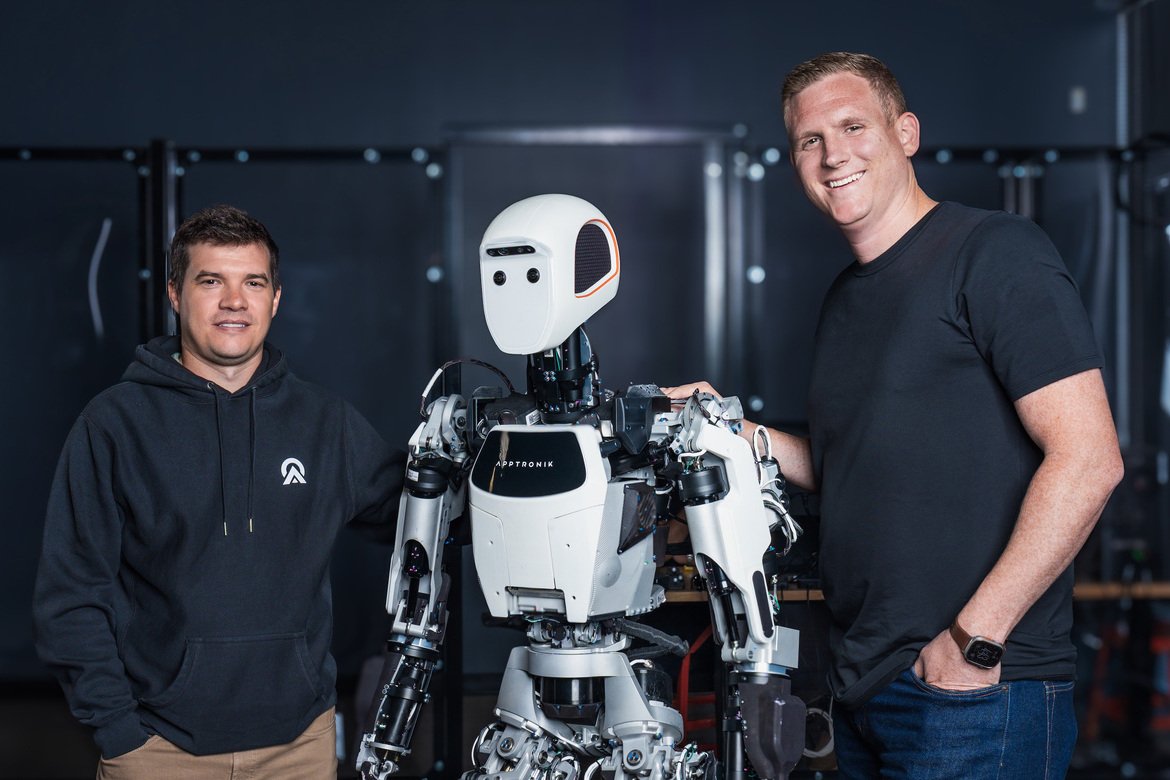

Apptronik has secured more than $935 million in Series A financing, positioning the Austin-based startup among the most heavily funded humanoid robotics companies globally as it moves from pilot programs toward scaled production.
The company announced a $520 million extension to its previously oversubscribed $415 million Series A round, bringing total capital raised to nearly $1 billion. The extension includes participation from existing backers such as B Capital, Google, Mercedes-Benz and PEAK6, alongside new investors including AT&T Ventures, John Deere and the Qatar Investment Authority.
The size of the raise, particularly at what the company described as a significantly higher valuation than its initial Series A, reflects intensifying investor conviction that humanoid robotics is entering a commercialization phase rather than remaining a research-driven category.
From Demonstration to Deployment
Apptronik plans to use the capital to ramp up production of Apollo, its flagship humanoid robot, and expand commercial and pilot deployments across manufacturing and logistics environments. The company also intends to invest in dedicated training and data collection facilities, underscoring how embodied AI systems increasingly depend on large-scale operational data to refine performance.
Apollo is designed for physically demanding industrial tasks such as transporting components, sorting materials and kitting operations. Rather than targeting fully autonomous environments, the company emphasizes collaborative deployment alongside human workers.
The funding round suggests that investors view industrial humanoids as an emerging labor infrastructure layer, particularly in sectors facing workforce shortages and rising automation demands.
Strategic Backers Signal Industrial Alignment
The investor roster highlights Apptronik’s positioning at the intersection of robotics and heavy industry. Mercedes-Benz and GXO Logistics have already partnered with the company to explore deployments in manufacturing and supply chain operations, while Jabil has engaged in pilot programs.
The inclusion of John Deere and AT&T Ventures in the extension round broadens the strategic footprint into agriculture and telecommunications infrastructure, sectors that could benefit from adaptable, mobile robotic labor.
Apptronik also maintains a high-profile partnership with Google DeepMind aimed at integrating advanced AI models into its humanoid systems. The collaboration is intended to bring next-generation embodied intelligence into Apollo’s control stack, reflecting a broader industry convergence between large-scale AI model developers and hardware-focused robotics firms.
A Crowded but Capital-Intensive Race
Humanoid robotics has become one of the most capital-intensive segments of the broader robotics industry. Startups and established players alike are racing to prove that general-purpose, bipedal machines can deliver consistent economic value in structured work environments.
The nearly $1 billion raised by Apptronik places it in the top tier of humanoid funding rounds. The scale of investment underscores both the technical complexity of building reliable humanoids and the expectation that early leaders could capture significant market share if they reach production scale first.
Unlike industrial robotic arms, humanoids must integrate advanced locomotion, manipulation, perception and safety systems into a single mobile platform. Scaling manufacturing while maintaining reliability presents additional challenges that require substantial capital investment.
Commercialization as the Next Test
The central question for Apptronik and its peers is no longer whether humanoid robots can perform controlled demonstrations, but whether they can operate continuously in real-world industrial settings with acceptable uptime, safety and cost profiles.
By allocating new capital toward production capacity and deployment infrastructure, Apptronik is signaling that it believes the market is ready for broader rollout. The company has indicated that a new version of Apollo is expected in 2026, suggesting ongoing hardware and software iteration even as initial deployments expand.
Investor enthusiasm indicates confidence that embodied AI is transitioning from experimental prototypes to enterprise tools. Whether that optimism translates into sustained revenue growth will depend on how effectively companies like Apptronik convert pilot projects into long-term industrial contracts.
For now, the funding milestone reinforces a broader industry narrative: humanoid robotics is no longer a speculative frontier but an increasingly structured race to scale.