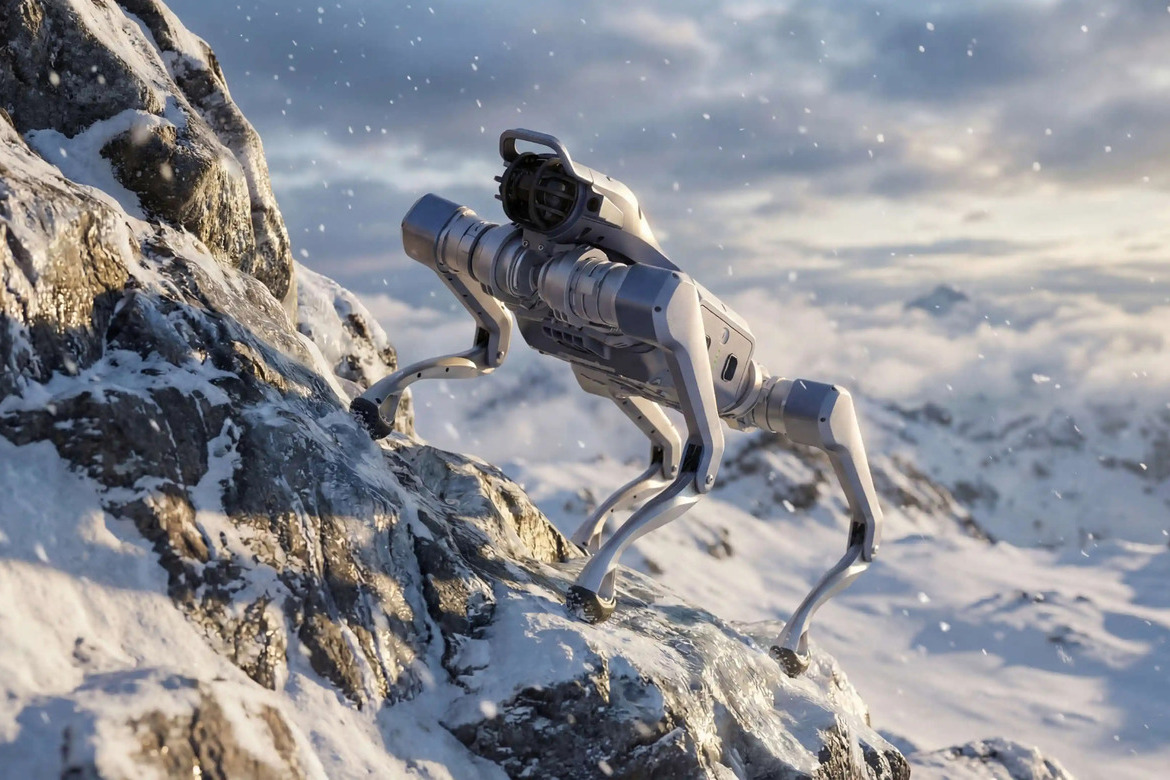
Unitree Robotics has unveiled the AS2, a high-performance quadruped robot designed to balance speed, payload strength, and AI-driven autonomy. The new model expands the Chinese company’s portfolio of robotic platforms aimed at industrial inspection, logistics, research, and outdoor operations.
Weighing approximately 18 kilograms with its battery installed, the AS2 can achieve peak speeds approaching 5 meters per second, or roughly 11 miles per hour. It also supports a standing payload capacity of up to 65 kilograms in its education-focused configuration, positioning it among the more capable quadrupeds currently on the market.
The launch reflects a broader push in the robotics industry to move legged robots beyond demonstration environments into practical deployment scenarios.
Engineering for Mobility and Load Capacity
The AS2 is powered by high-torque inner rotor motors delivering up to 90 newton-meters of joint torque. With 12 degrees of freedom and dual encoders per joint, the system is designed for precision control and dynamic stability.
Industrial-grade bearings and an optimized torque-to-weight ratio allow the robot to carry meaningful loads while maintaining agility. Under continuous walking conditions, it can transport approximately 15 kilograms for extended periods, while unloaded runtime exceeds four hours, covering distances of more than 20 kilometers.
Battery configurations vary by model, with higher-end versions equipped with a 15,000mAh lithium pack supporting longer endurance and fast charging. The robot’s IP54 rating and operating temperature range from -20°C to 50°C position it for use in harsh environments, including industrial sites and outdoor terrain.
Mobility metrics indicate the robot can climb stairs up to 25 centimeters, handle 40-degree slopes, and traverse uneven surfaces. These capabilities are increasingly important for inspection and maintenance tasks where wheeled systems struggle.
AI and LiDAR Integration Expand Autonomy
Beyond mechanical performance, the AS2 integrates advanced sensing and computing capabilities. Higher-end models include industrial-grade LiDAR systems with up to 128 lines, enabling real-time mapping and obstacle detection.
The robot runs on an 8-core CPU and, in its developer-focused EDU version, supports optional expansion with NVIDIA Jetson Orin NX modules. This allows users to deploy embodied AI applications, integrate autonomous navigation stacks, and develop custom robotics software.
Connectivity options include Wi-Fi 6, Bluetooth 5.2, and optional 4G and GPS modules. The system also features onboard cameras, microphones, and speakers, supporting inspection, teleoperation, and human-robot interaction.
An intelligent side-follow system enables centimeter-level positioning and stable following behavior, useful for scenarios such as equipment inspection or mobile payload transport.
Quadrupeds Move Toward Industrial Utility
Quadruped robots have gained global attention over the past several years, but commercial adoption has remained concentrated in niche applications such as security patrols, research, and infrastructure inspection.
The AS2’s combination of speed, endurance, and payload suggests a focus on expanding those applications into more demanding industrial environments. As robotics companies compete to deliver practical legged systems, performance benchmarks such as torque, range, and load capacity are becoming increasingly central to differentiation.
Unitree’s approach emphasizes open development and integration flexibility, allowing researchers and industrial partners to customize applications. This aligns with broader industry trends toward modular robotics platforms that support third-party AI software and hardware expansion.
While pricing details have not been disclosed, the company positions the AS2 as a high-performance system suited for real-world tasks rather than purely experimental use.
As legged robots continue to evolve, platforms like the AS2 illustrate how advances in actuation, sensing, and embedded AI are pushing quadrupeds closer to sustained industrial deployment.
Disclaimer: RobotsBeat is an independent media brand owned and operated by NuvexMedia LLC, publishing news, research, and insights on artificial intelligence, emerging technologies, automation, and related industries. NuvexMedia LLC invests in and collaborates with companies across the AI, Robotics, technology, software, and digital innovation sectors. These relationships do not influence RobotsBeat's editorial coverage, and the publication maintains full editorial independence to provide accurate, timely, and objective information. © 2026 NuvexMedia LLC. All rights reserved. This content is for informational purposes only and should not be considered legal, tax, investment, financial, or other professional advice.