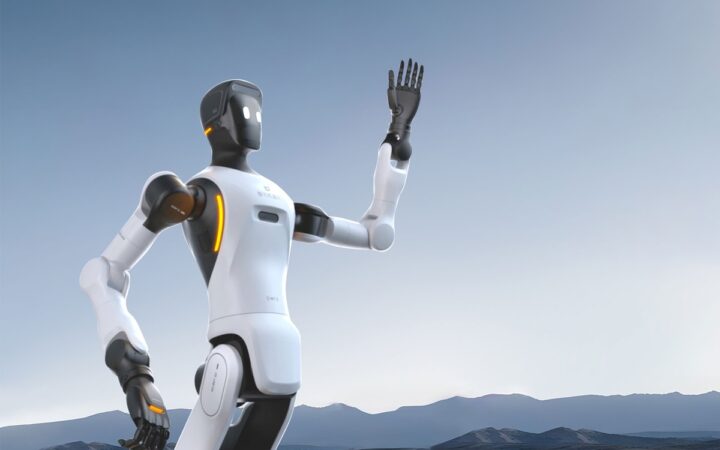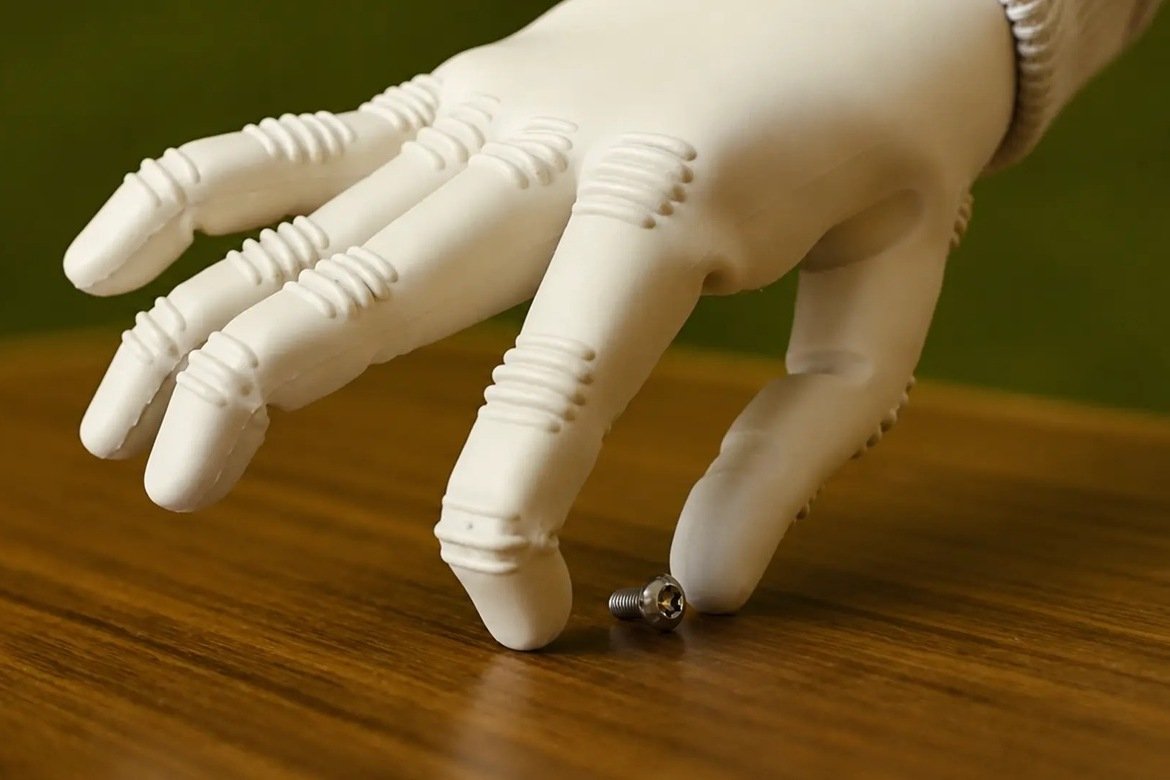
1X Technologies has unveiled NEO Hands, a robotic hand system developed for its NEO home humanoid robot, designed to address what the company describes as the primary barrier to practical humanoid deployment: the ability to manipulate the diverse, fragile, and variably shaped objects that human environments contain. The system features 25 degrees of freedom, a tendon-driven transmission architecture, distributed tactile sensors, and AI-assisted control that adapts grip strategy based on object geometry and contact feedback in real time.
The announcement builds on 1X’s launch of full-scale NEO production at its Hayward, California facility, where the company began shipping to California customers in summer 2026 with a U.S. rollout planned through 2027.
The Design Architecture
NEO Hands use a tendon-inspired transmission rather than rigid mechanical joints at each finger. Artificial tendons distribute movement across the hand in a manner analogous to biological tendons transferring force from muscles to fingers. The design reduces overall weight, minimizes inertia, enables quieter operation, and improves compliance – the ability of the hand to yield appropriately when contact forces exceed a threshold. The result is smoother, more coordinated finger motion than direct-drive joint designs typically produce.
The 25 degrees of freedom support independent finger flexion and extension, thumb opposition, object reorientation, multi-finger coordination, precision pinch grips, and power grasps – the primary grasp patterns used in daily human manipulation. The hand continuously adjusts finger positions based on object geometry and contact feedback rather than executing pre-programmed grip patterns.
Tactile Intelligence
Distributed tactile sensors across the fingers monitor contact location, grip pressure, object slippage, surface interaction, and force distribution in real time. The sensory feedback allows NEO Hands to automatically modulate grip force across the range from fragile objects that would be crushed by excessive pressure to heavy or smooth objects that require maintained grip force to prevent slipping. This tactile intelligence is essential for the residential use case, where object diversity is far higher than in manufacturing or logistics settings.
The AI Layer
The mechanical system is paired with AI-driven perception and control that integrates visual input, tactile sensing, motion planning, force feedback, and reinforcement learning. After learning to grasp one type of object, the system applies that knowledge to variations in shape, size, and material through transfer learning rather than requiring separate programming for each new object type. The system’s grasping strategies improve continuously as the robot encounters more object variety in deployment.
Market Context
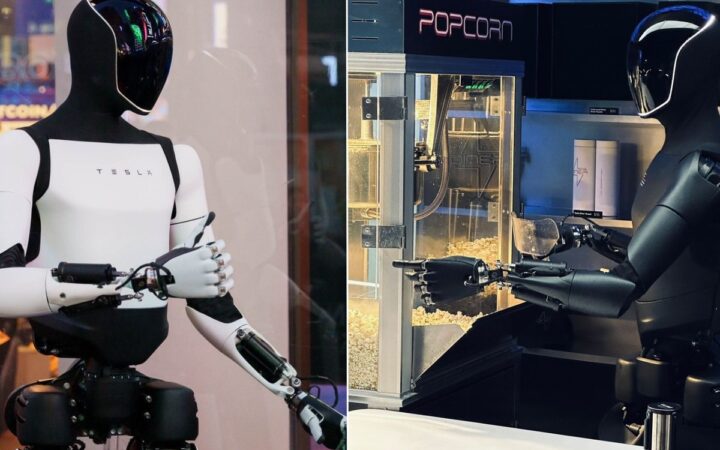
The hand is the defining unsolved problem in consumer humanoid robotics. A robot that can navigate, plan, and reason but cannot grip reliably cannot perform the household tasks that justify its cost. 1X is not alone in prioritizing the manipulation problem – Genesis AI unveiled its GENE-26.5 foundation model demonstrating human-level dexterous manipulation in May, Linkerbot raised at a $6 billion valuation target on the strength of its high-DoF hand platform, and Tesla has publicly acknowledged that hand development accounts for more than half of its Optimus engineering effort.
NEO Hands’ specifications – 25 DoF, tendon-driven mechanics, distributed tactile sensing, and fast actuation loops – represent a competitive hardware package for a home-focused platform at the $1,288 to $1,322 price point that 1X is targeting, where the cost of the hand system is a significant fraction of the total robot bill of materials.
Disclaimer: RobotsBeat is an independent media brand owned and operated by NuvexMedia LLC, publishing news, research, and insights on artificial intelligence, emerging technologies, automation, and related industries. NuvexMedia LLC invests in and collaborates with companies across the AI, Robotics, technology, software, and digital innovation sectors. These relationships do not influence RobotsBeat's editorial coverage, and the publication maintains full editorial independence to provide accurate, timely, and objective information. © 2026 NuvexMedia LLC. All rights reserved. This content is for informational purposes only and should not be considered legal, tax, investment, financial, or other professional advice.