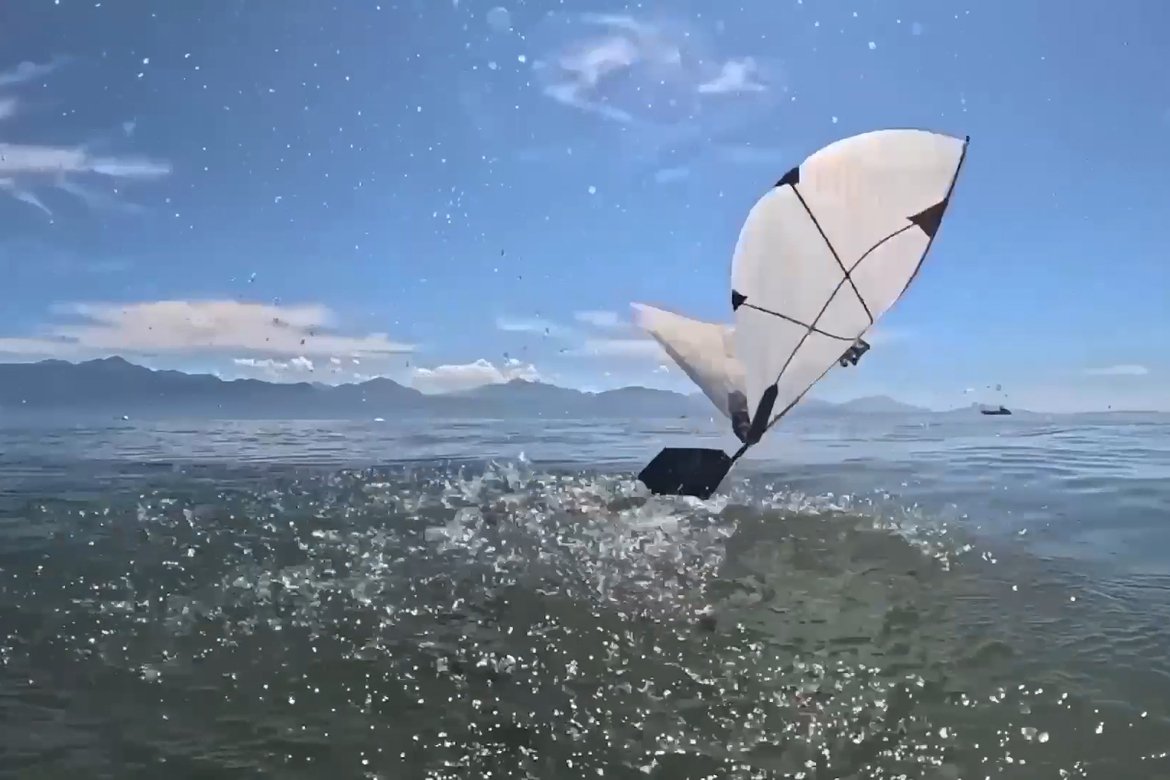
Engineers at MIT and EPFL in Lausanne, Switzerland, have developed a flapping-wing aerial-aquatic vehicle that can swim underwater and transition into flight through the water surface without any paddling maneuver, a capability that most diving birds require feet to accomplish. The robot weighs less than 300 grams and is inspired by the flight mechanics of puffins, petrels, kingfishers, and other diving bird species. The research was published in the journal Science.
The FAAV – flapping-wing aerial-aquatic vehicle – has a central fuselage, two flexible wings coated with hydrophobic nanoparticles to repel water, and a motorized steerable tail. Its wings are interchangeable across three sizes: 60, 80, and 100 centimeters wide. A waterproof electric motor drives a crankshaft that pumps the wings at preset frequencies.
The Physics Problem
Water is approximately 1,000 times denser than air, meaning that flight mechanics useful in one medium actively work against the robot in the other. The challenge for any aerial-aquatic vehicle is achieving the transition between the two without specialized structures for each – feet for water takeoff, wings optimized separately for air and water – that would add weight and complexity.
The MIT AURA Lab team led by Raphael Zufferey surveyed the scientific literature on puffins, petrels, and kingfishers to understand how diving birds manage this transition. They found smaller diving birds flap at approximately 10 times per second in air and four times per second in water; larger birds have lower frequencies in both mediums due to wider wingspans.
The Results
In experiments in a water tank and on Lake Geneva, the team found that medium-sized 80-centimeter wings – flexible enough to minimize flapping amplitude underwater and firm enough to maintain lift in air – enabled reliable transitions. The robot swam at nearly 1 meter per second underwater at around 5 hertz flapping frequency, and flew at approximately 6 meters per second in air at a similar frequency – both comparable to actual diving bird performance.
To transition from water to air, the robot must be pitched at 70 degrees – a steep angle that keeps wingtips clear of the water surface during the upward flap. Steeper than 70 degrees and the robot tips back into the water.
Notably, the robot successfully made the water-to-air transition without paddling. “If you look at birds, most birds need to paddle at the surface to take off. And the question was, do we need the same for robots? And it turns out we don’t,” said Zufferey, assistant professor of mechanical engineering at MIT and lead author of the study.
The Application Vision
The research team envisions the FAAV enabling oceanographic missions to locations too dangerous or remote for conventional vessels. “Our dream vision is for oceanographers, marine biologists and members of coastal communities to launch this robot from a boat, or from shore, and it would fly close to the area of interest – such as an iceberg or a port facility, or over a pod of whales,” Zufferey said. “It would dive into the water to take a measurement or collect a sample, and fly back to deliver the data at a fraction of the cost of traditional methods.”
Current work focuses on enabling the wings to turn in addition to flapping, and testing performance under turbulent conditions including choppy water and wind. The team expects to deploy the robot for ocean science data collection in future work, with the potential for high-frequency sampling – hourly rather than weekly – that current ocean monitoring methods cannot achieve.
Disclaimer: RobotsBeat is an independent media brand owned and operated by NuvexMedia LLC, publishing news, research, and insights on artificial intelligence, emerging technologies, automation, and related industries. NuvexMedia LLC invests in and collaborates with companies across the AI, Robotics, technology, software, and digital innovation sectors. These relationships do not influence RobotsBeat's editorial coverage, and the publication maintains full editorial independence to provide accurate, timely, and objective information. © 2026 NuvexMedia LLC. All rights reserved. This content is for informational purposes only and should not be considered legal, tax, investment, financial, or other professional advice.