
The U.S. Navy is expanding its use of robotics to monitor and maintain its fleet, awarding Gecko Robotics its largest defense contract to date as the military seeks to reduce maintenance delays and improve ship readiness.
The Pittsburgh-based robotics company announced a five-year agreement with the U.S. Navy and the U.S. General Services Administration to deploy its inspection robots and software across naval vessels. The deal begins with an initial $54 million award and has a potential ceiling of $71 million.
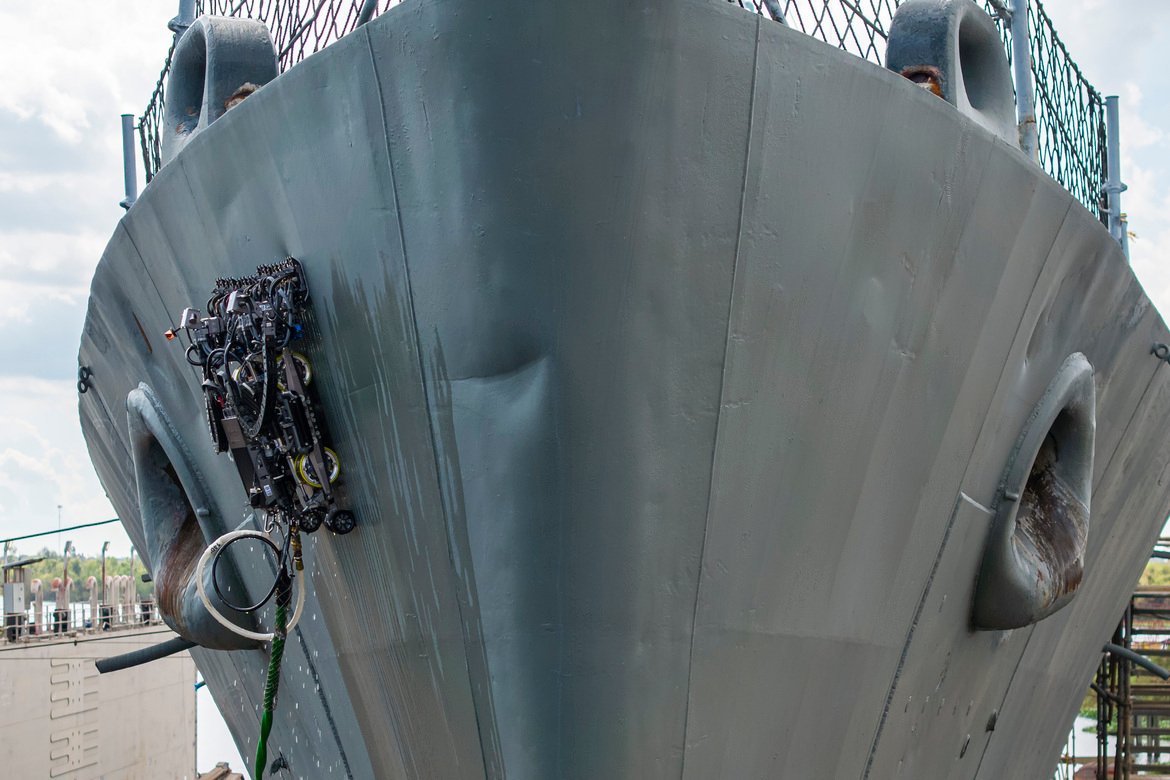
Under the agreement, Gecko’s robots will begin inspecting ships in the Navy’s Pacific Fleet, initially covering 18 vessels. The machines are designed to crawl across ship surfaces and enter confined areas to gather detailed structural data that human inspectors often struggle to access safely.
The data collected by the robots feeds into software that creates digital replicas of each vessel, enabling engineers to track the condition of critical systems and identify maintenance issues before they lead to failures.
Digital Twins for Ship Maintenance
A central element of the project is the creation of digital twins – continuously updated digital models that represent the real-world condition of complex assets.
Gecko’s robots use sensors and imaging systems to scan ship structures, capturing measurements related to corrosion, coating degradation, and structural wear. That information is used to generate a detailed model of the vessel’s condition.
According to Gecko founder and CEO Jake Loosararian, the digital models allow maintenance teams to understand the health of ships in far greater detail than traditional inspection methods.
Once a ship’s digital representation exists, engineers can monitor changes over time and plan repairs more precisely. The goal is to reduce the amount of time ships spend in maintenance yards while preventing unexpected failures that could disrupt operations.
The approach reflects a broader shift across industrial sectors toward predictive maintenance systems that combine robotics, sensor networks, and digital modeling.
Addressing Fleet Readiness Challenges
For the Navy, maintenance efficiency has become a critical operational issue.
Officials have set a goal of achieving roughly 80 percent fleet readiness by 2027. Currently, however, maintenance cycles leave a large portion of ships unavailable at any given time. Aging vessels, complex systems, and lengthy inspection processes contribute to the challenge.
Maintenance for the Navy’s fleet costs an estimated $13 billion to $20 billion annually, and delays in repair schedules can cascade across shipyards and deployment timelines.
By using robotic inspection systems, the Navy hopes to gather more comprehensive data while reducing the time required for manual inspections. Robots can operate in confined spaces and hazardous environments, allowing inspections to occur more frequently and with less disruption to operations.
Gecko Robotics has been working with the Navy for several years prior to the new agreement. The relationship began when a Navy engineer requested an evaluation of the company’s technology, leading to pilot programs that demonstrated the robots’ ability to capture detailed structural data.
The new contract expands that collaboration into a broader deployment across naval assets.
Robotics Expands into Infrastructure Monitoring
The Navy contract highlights a growing role for robotics in monitoring large-scale infrastructure.
Gecko Robotics originally developed its systems to inspect industrial assets such as power plants, refineries, and heavy manufacturing facilities. Many of these environments share characteristics with naval vessels, including difficult-to-access structures and high safety requirements.
The company’s long-term vision is to create continuously updated digital models of critical infrastructure, enabling operators to detect problems early and schedule repairs without waiting for major failures.
For defense organizations responsible for maintaining complex fleets, such predictive systems could reshape how maintenance cycles are managed.
If the approach proves effective at scale, inspection robots and digital twin platforms may become a standard component of asset management not only for military fleets but also for power generation, transportation infrastructure, and industrial facilities.