
Just Eat Takeaway.com has launched a UK trial of autonomous ground delivery robots in Bristol and Milton Keynes, marking its most visible step yet into physical AI-driven last-mile logistics.
The move places the Amsterdam-listed company alongside rival Uber Eats, which began deploying delivery robots in Leeds late last year through a partnership with Starship Technologies. Together, the pilots signal a broader push among food delivery platforms to test automation as order volumes fluctuate and labor costs remain under pressure.
The initial trial comes ahead of the Valentine’s Day weekend, a peak ordering period that companies often use to stress-test operational capacity. Just Eat said the addition of robotic couriers is intended to increase delivery throughput during high-demand windows.
From Pilot to Multi-City Testing
Just Eat’s UK rollout builds on earlier experimentation in Switzerland, where the company conducted a pilot program that completed close to 1,000 robot deliveries. The group has also tested drone-based delivery in Ireland, indicating a multi-modal approach to automation.
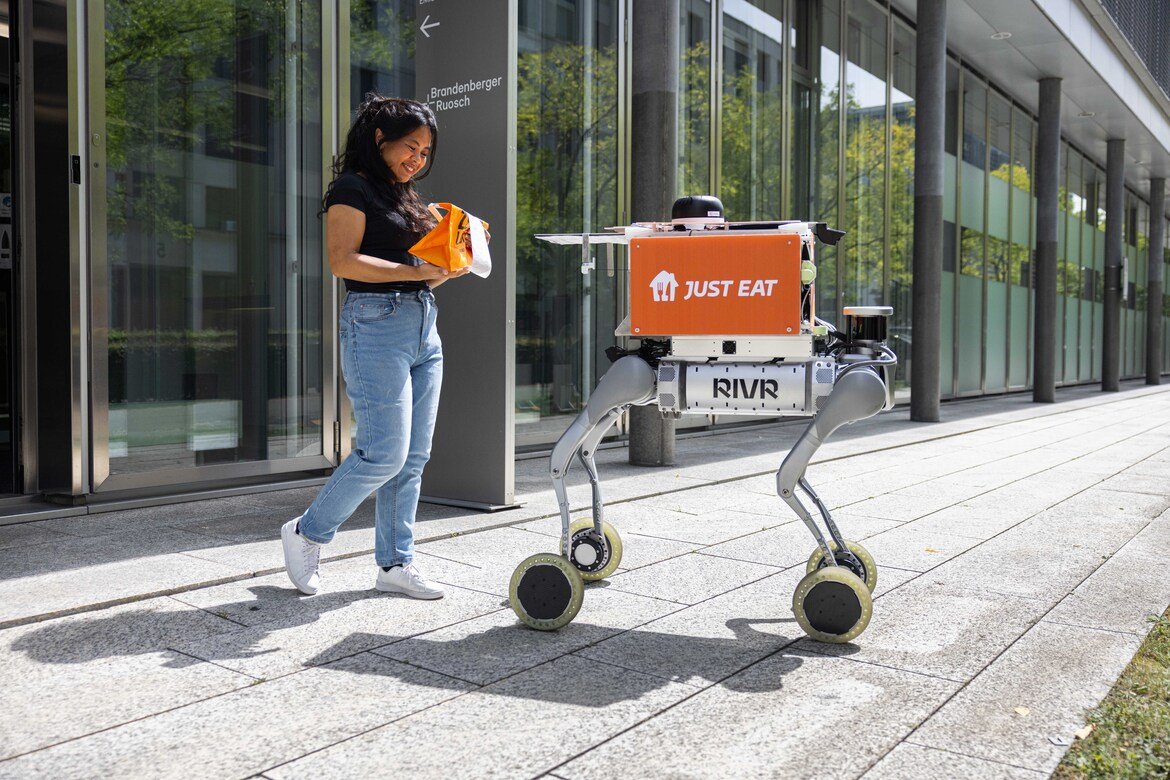
In Bristol, the company is working with Delivers.AI, while the Milton Keynes deployment is being conducted with RIVR, a robotics firm focused on doorstep automation. The robots operate at street level, transporting meals from local restaurants directly to customers’ homes.
“We’re always innovating to improve the delivery experience for our customers,” said Mert Öztekin, chief technology officer at Just Eat. He described the robotics trial as part of a broader effort to collaborate with specialist partners while maintaining service quality.
Executives at both robotics partners framed the initiative as a step toward scaling autonomous delivery across European cities. RIVR’s chief executive, Marko Bjelonic, said automating the final leg to the customer’s doorstep is aimed at reducing friction in the delivery process.
Economics of the Last Mile
Food delivery remains one of the most logistically complex consumer services, with thin margins and heavy reliance on gig-economy couriers. Ground robots offer a potential path to reducing labor dependency for short-distance orders, particularly in dense urban neighborhoods.
However, autonomous delivery systems face practical constraints. They typically operate within limited geographic zones, require regulatory approval, and must navigate pedestrian traffic safely. For now, robots supplement rather than replace human couriers.
In the case of Uber Eats, customers in some UK cities have already encountered robot deliveries that cannot accept tips, underscoring how automation alters the economic model of gig-based platforms.
For delivery companies, the appeal lies in predictability. Robots do not require shift scheduling, surge pricing, or variable compensation. But they introduce new costs related to hardware, maintenance, remote monitoring, and fleet management.
Physical AI Moves Into Consumer Services
The expansion of robotic delivery reflects a broader trend in physical AI: systems that were once confined to research labs or industrial warehouses are moving into consumer-facing environments.
Unlike warehouse robotics, sidewalk delivery requires machines to operate in semi-structured public spaces. That makes perception, obstacle avoidance, and real-time route adaptation critical capabilities.
By testing in cities such as Bristol and Milton Keynes, Just Eat is effectively evaluating whether ground robotics can integrate into existing urban infrastructure without degrading service reliability.
The competitive dynamic with Uber Eats adds urgency. As platforms compete on speed, cost, and novelty, automation may become a differentiator in markets where brand loyalty is limited and switching costs are low.
For now, the UK trials remain limited in scope. But if operational metrics prove favorable, food delivery could become one of the most visible public use cases for everyday robotics in Europe.