Lucid Bots, a U.S. robotics company focused on automating exterior cleaning work, has raised $20 million in a Series B funding round as demand grows for robots capable of performing physically demanding industrial tasks.
The round, co-led by Cubit Capital and Idea Fund Partners, brings the Charlotte-based company’s total funding to $34 million. The capital will be used to expand manufacturing capacity, develop new autonomous systems and scale the company’s robotics platform across the United States.
Lucid Bots has built a business around a simple premise: many industries need automation not for digital workflows but for repetitive physical labor. Exterior cleaning – including window washing and pressure washing on large commercial buildings – has emerged as an early target.
Robots for Dangerous and Labor-Intensive Work
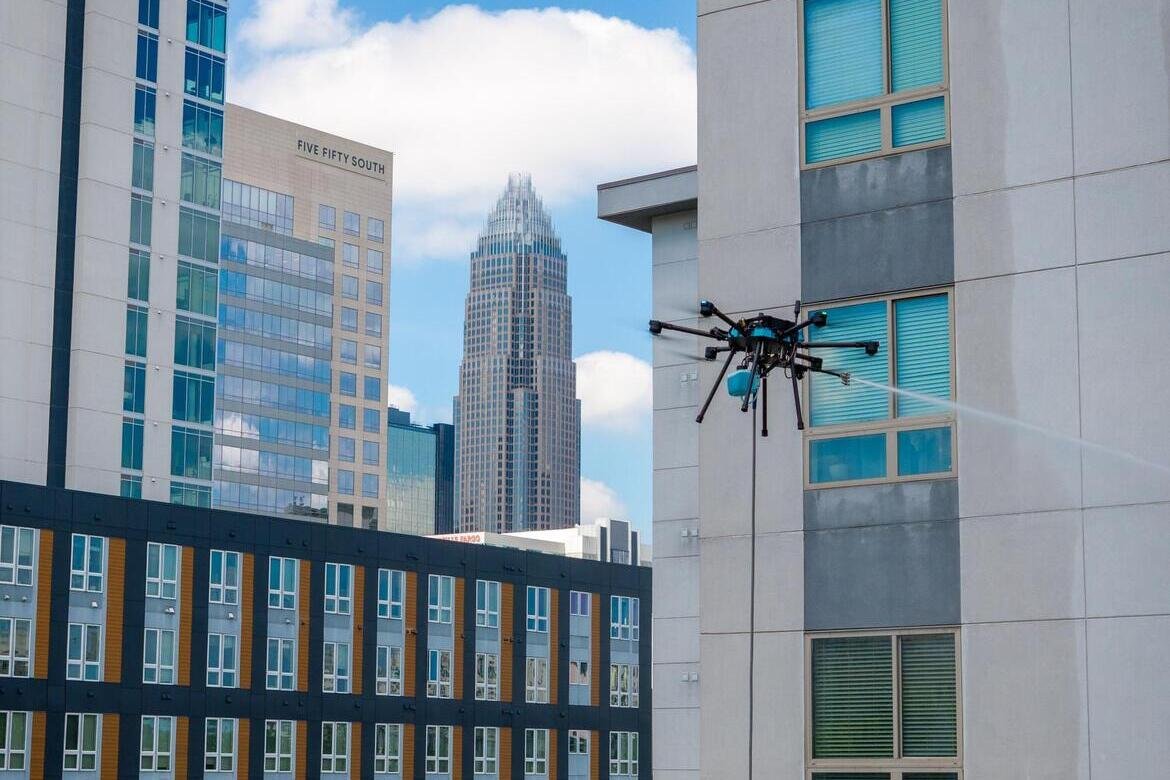
The company’s flagship product, the Sherpa drone, is designed to clean building exteriors using a spraying system that allows operators to wash windows and facades without scaffolding or rope access.
Lucid Bots says the drone can complete jobs two to five times faster than traditional cleaning methods, reducing both labor costs and safety risks for workers.
The company recently expanded its portfolio with Lavo AI, an autonomous pressure-washing robot designed to operate on ground-level surfaces such as sidewalks, parking structures and industrial facilities.
Together the systems form the foundation of Lucid’s broader platform for automated exterior maintenance.
Instead of selling robots outright, the company offers its technology through a subscription service called Lucid Refresh, which bundles robots, software, operator training and support into a single robotics-as-a-service package.
For cleaning companies, the model allows them to take on projects that would otherwise require significant capital investment or specialized equipment.
Building a Robotics Platform Around Data
Lucid Bots’ growth reflects a broader shift in robotics toward platforms that combine hardware with operational data and cloud software.
The company says its robots have collectively logged hundreds of thousands of hours of real-world cleaning operations across different building types, weather conditions and materials.
That operational dataset feeds into the company’s AI systems, allowing robots to improve their performance over time as they encounter new scenarios.
The result, Lucid argues, is a compounding advantage in autonomy. As more robots are deployed and more jobs are completed, the underlying models become more effective at adapting to real-world conditions.
The company says its network of operators has already completed more than $75 million in cleaning jobs using Lucid systems.
Industrial Robotics Expands Beyond Factories
Lucid Bots’ expansion highlights how robotics is moving into industries historically considered difficult to automate.
While industrial robots have long dominated manufacturing lines, many service industries still rely heavily on manual labor. Tasks such as cleaning building exteriors involve complex environments, variable surfaces and changing weather conditions that are difficult for traditional automation systems.
Recent advances in sensors, autonomy software and cloud-connected robotics platforms are beginning to change that equation.
Lucid Bots now has nearly 1,000 robots deployed nationwide, serving customers ranging from independent cleaning operators to large commercial facilities and organizations including Disney and Sunbelt Rentals.
The company manufactures its systems at a 25,000-square-foot facility in Charlotte, North Carolina, positioning itself to meet growing demand from customers seeking domestically produced robotic equipment.
For investors, the company’s traction suggests that industrial service robotics may become one of the next large markets for embodied AI systems.
Rather than replacing workers outright, the technology is often framed as augmenting human labor by automating the most hazardous or physically demanding tasks.
As industries continue searching for ways to address labor shortages and improve safety, robots that perform real-world physical work may increasingly become a core part of the automation landscape.