Nvidia’s latest earnings report underscores a rapidly expanding market for physical AI, the category of artificial intelligence designed to operate in real-world machines such as autonomous vehicles and humanoid robots. The chipmaker reported quarterly revenue of $68 billion, exceeding expectations and nearly doubling its performance from the same period a year earlier.
Alongside its record results, Nvidia disclosed that its emerging physical AI segment generated $6 billion in fiscal 2026 revenue. The category includes computing systems used to train and operate robotics platforms such as robotaxis and humanoid robots, including projects developed by companies like Tesla and Waymo.
The figures highlight how robotics and autonomous systems are becoming a growing driver of demand for advanced AI infrastructure.
Physical AI Requires Massive Computing Resources
Unlike conversational AI systems that operate entirely in digital environments, physical AI must interact with complex real-world conditions. Robots and autonomous vehicles must process large volumes of sensor data, simulate physical environments, and learn from real-world experiences.
This process requires significantly greater computing resources for training and simulation. Autonomous driving systems, for example, rely on massive datasets generated by vehicles operating in real-world conditions. Similarly, humanoid robots must train models capable of coordinating movement, perception, and decision-making across complex environments.
Nvidia has positioned its GPUs and AI computing platforms as the backbone of this development cycle. Robotics developers use these systems to train neural networks in simulation and to process real-world data collected from fleets of vehicles and robots.
As robotics and autonomous systems expand, this infrastructure layer is becoming increasingly important.
Tesla’s Optimus Program Highlights Robotics Opportunity
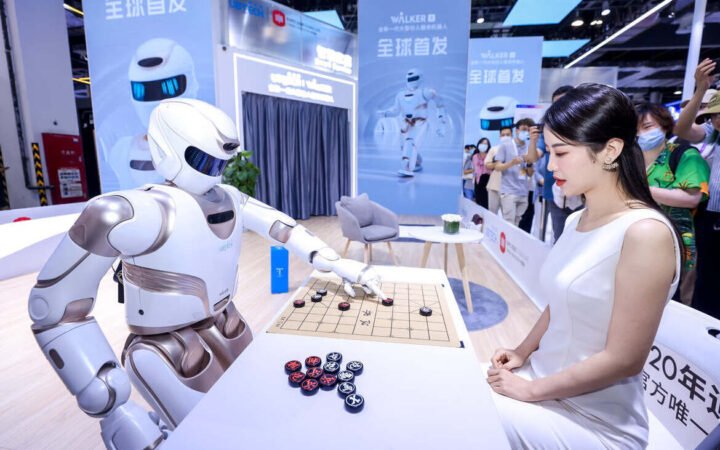
Tesla represents one of the most visible applications of physical AI. The company is developing the Optimus humanoid robot alongside its autonomous vehicle technology, both of which rely on large-scale AI training.
Tesla CEO Elon Musk has described robotics as a potential multi-trillion-dollar industry. The company plans to begin commercial sales of Optimus robots in 2026, with long-term ambitions to scale production to as many as one million units annually.
If that level of production is achieved, and robots are sold at roughly $25,000 per unit, the business could generate approximately $25 billion in annual revenue. That would represent a significant new growth engine for Tesla beyond its automotive operations.
However, manufacturing humanoid robots at scale remains technically challenging. Musk has acknowledged that early production will likely ramp slowly before reaching industrial-scale output.
Robotics Growth Creates a New AI Infrastructure Market
The connection between Nvidia and Tesla illustrates a broader shift in the AI industry. While much of the recent focus has been on generative AI models used for text and image generation, the next wave of AI deployment may increasingly involve physical machines.
Robotics systems require large-scale simulation, sensor processing, and machine learning training environments, all of which depend on high-performance computing infrastructure.
Nvidia CEO Jensen Huang has described robotics as one of the most promising opportunities for AI expansion, as machines capable of interacting with the physical world could dramatically expand the scope of automation.
Companies developing robotaxis, industrial robots, and humanoid systems are already among the largest users of AI computing resources.
Competition Intensifies in the Robotics Race
Despite the strong outlook for physical AI, the robotics market remains highly competitive. Tesla faces growing competition from robotics companies in both the United States and China that are investing heavily in humanoid robot development.
Chinese manufacturers in particular are scaling production rapidly, potentially putting downward pressure on prices as the industry matures.
At the same time, investor enthusiasm for robotics has driven significant gains in the share prices of companies connected to the sector. Both Nvidia and Tesla have seen strong stock performance over the past year as investors bet on the long-term potential of AI-powered machines.
Whether those expectations are realized will depend on how quickly robotics systems can move from experimental deployments to reliable, large-scale commercial use.
For Nvidia, however, the immediate impact is clear: as robots and autonomous vehicles become more capable, the demand for computing infrastructure powering physical AI is likely to grow alongside them.