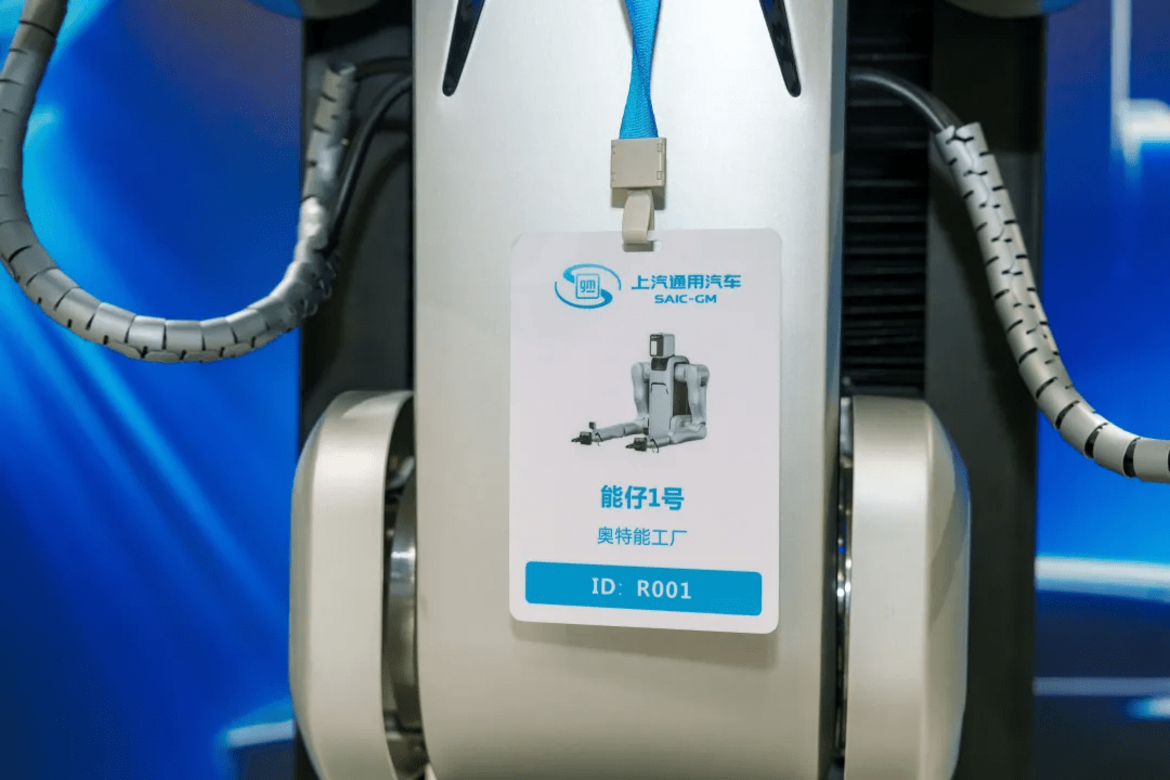
SAIC-GM has deployed humanoid robots on a battery assembly line for Buick vehicles, marking one of the first known integrations of embodied intelligent machines into automotive production in China.
The robots, developed jointly with Shanghai-based startup Agibot, are currently operating on the production line for the Buick Electra E7, a plug-in hybrid SUV scheduled for release this year. The deployment represents a pilot phase as the automaker evaluates how humanoid systems can function within existing manufacturing workflows.
Unlike traditional industrial robots, which are typically fixed in place and designed for repetitive tasks, the new system introduces a more flexible, mobile form of automation.
A Different Approach to Factory Robotics
The robot, named Nengzai No. 1, uses a wheeled base rather than legs, allowing it to move efficiently across the factory floor while maintaining stability for precision tasks.
Equipped with dual robotic arms and a visual perception system, it can identify battery components, plan grasping paths and execute loading operations without relying entirely on pre-programmed sequences.
SAIC-GM says the robot achieves positioning accuracy within 0.1 millimeters, while operating at a pace of roughly two seconds per task, aligning with the speed requirements of a mass-production environment.
The system also occupies significantly less space than conventional automated workstations, using less than 15 percent of the typical footprint. This compact design allows manufacturers to increase production density without expanding factory floor space.
The decision to deploy the robots on battery assembly lines reflects the complexity and precision required in handling battery cells, where both accuracy and consistency are critical.
From Fixed Automation to Embodied Systems
The pilot signals a broader shift in manufacturing automation.
Traditional automotive factories rely heavily on fixed robotic arms programmed for specific tasks. While efficient, these systems lack flexibility and require reconfiguration when production lines change.
Humanoid and mobile robots, by contrast, are designed to adapt to different tasks and environments. Their ability to navigate spaces and manipulate objects more dynamically could make them suitable for a wider range of applications within factories.
SAIC-GM’s approach combines mobility with humanoid-style manipulation, suggesting a hybrid path toward more flexible automation.
The company says it has tested the robots across more than 100 potential workstations before selecting battery assembly as the first deployment scenario.
Expanding the Role of Humanoid Robots
The current deployment is limited in scope, but SAIC-GM plans to expand the use of embodied robots across additional areas of production and logistics.
The company is also exploring bipedal humanoid robots alongside wheeled systems, indicating that different robot forms may coexist depending on the requirements of specific tasks.
The move comes as automakers globally are experimenting with humanoid robotics. Companies including Tesla and BMW have begun testing similar systems for manufacturing tasks, while Chinese manufacturers are accelerating development of embodied AI platforms.
For SAIC-GM, the integration of humanoid robots into a live production line suggests that the technology is beginning to move beyond demonstration and into early industrial application.
If the pilot proves successful, it could signal a gradual transition toward more adaptive, AI-driven automation in automotive manufacturing, where robots are no longer confined to fixed positions but operate as flexible workers within the production environment.