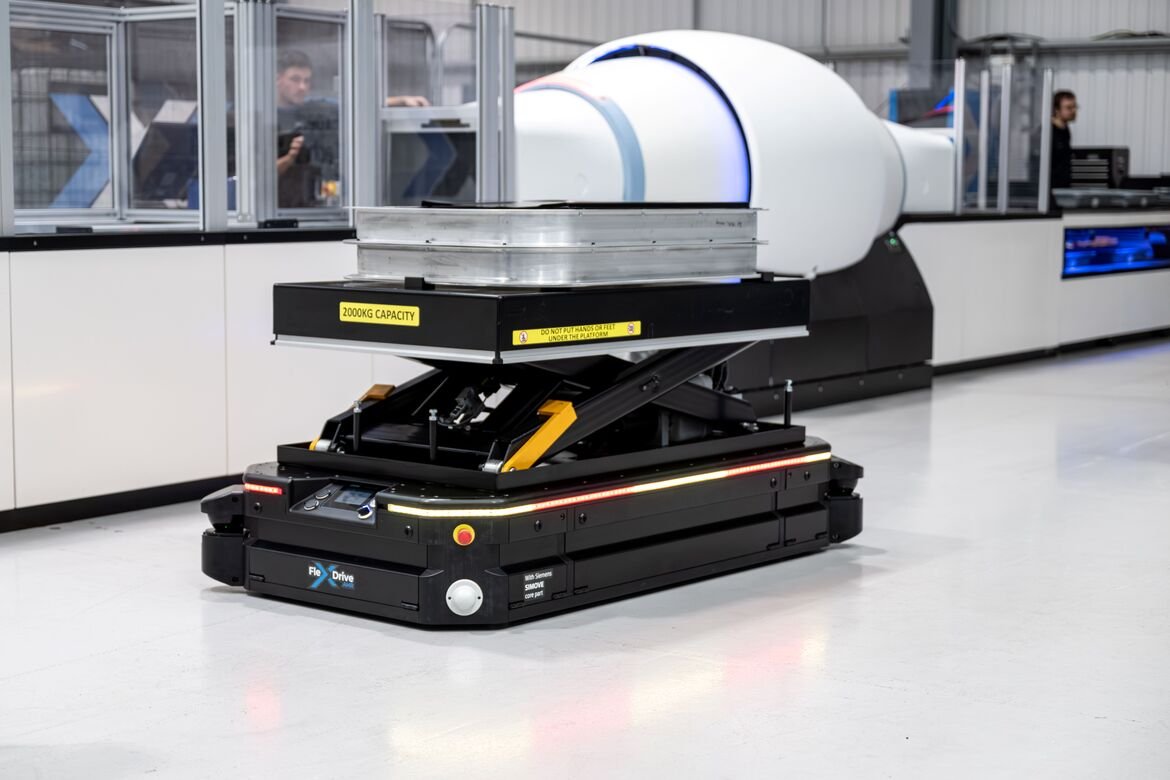
Siemens has partnered with Expert Technologies Group and RMGroup to create the United Kingdom’s first manufacturing capability dedicated to fully customizable autonomous mobile robots (AMRs). The initiative aims to provide domestic manufacturers with flexible automation systems designed to improve factory logistics and material handling.
The collaboration marks a strategic effort to strengthen the UK’s industrial automation ecosystem by developing robotics systems locally rather than relying on imported technologies. By combining Siemens’ automation software with robotics integration expertise from the two partner companies, the project creates an end-to-end platform for deploying AMR systems in manufacturing and warehouse environments.
Autonomous mobile robots are increasingly used to move materials within factories and distribution centers, offering an alternative to traditional automated guided vehicles that rely on fixed tracks or dedicated infrastructure.
Flexible Robotics for Modern Manufacturing
AMRs differ from earlier factory transport systems by navigating environments using onboard sensors, real-time mapping, and intelligent path planning. This allows them to move dynamically through busy industrial settings while avoiding obstacles and adapting to layout changes.
The robots produced through the new partnership are designed to be customizable for different industrial environments. Manufacturers can configure systems to support tasks such as delivering components to assembly lines, transporting finished goods to storage areas, or supplying materials to production cells.
The technology platform integrates Siemens’ SIMOVE control software, which enables robots to coordinate movements and manage logistics operations across facilities. Expert Technologies Group contributes its FlexDrive AMR platform, providing modular drive systems and navigation capabilities. RMGroup adds robotics integration and safety systems designed for industrial environments.
Together, these technologies allow factories to deploy robotics fleets tailored to their operational requirements, rather than adapting workflows to standardized equipment.
Building Domestic Robotics Capability
The partnership reflects growing interest in strengthening domestic robotics manufacturing in the UK. Many automation systems used in British factories are imported, which can create challenges related to integration, maintenance, and technical support.
By building robots locally and supporting them with domestic engineering teams, the collaboration aims to provide manufacturers with more reliable deployment and long-term support. The partners say this approach addresses a common problem in automation projects where overseas suppliers cannot provide sufficient integration support.
Local development also allows robotics systems to be adapted more easily to specific industry requirements, including aerospace, automotive, food processing, and logistics operations.
In addition to robotics hardware, the system incorporates wireless connectivity technologies such as industrial Wi-Fi and 5G to support real-time communication between robots, factory infrastructure, and digital management systems.
Autonomous Logistics Becomes Central to Industrial Automation
Material movement inside factories and warehouses represents a significant operational challenge for manufacturers. Traditionally, these tasks rely heavily on manual labor or fixed automation systems that are difficult to modify when production changes.
Autonomous mobile robots offer a more adaptable solution by enabling dynamic logistics operations. Fleets of AMRs can coordinate movements, optimize routes, and respond to changing workloads without requiring major infrastructure modifications.
These capabilities also allow manufacturers to scale automation gradually, starting with small deployments and expanding fleets as operational needs grow.
As manufacturing becomes more digital and data-driven, AMRs are increasingly integrated with digital twin simulations and factory management systems. This allows companies to analyze workflows, optimize operations, and improve productivity.
The Siemens-led collaboration represents a step toward building a domestic robotics ecosystem capable of supporting these advanced manufacturing technologies. By combining automation software, robotics hardware, and integration expertise, the partnership aims to help UK manufacturers deploy flexible, intelligent logistics systems as automation becomes an essential component of modern industrial production.