A Chinese research team has demonstrated what it says is the first instance of space-based artificial intelligence directly controlling robots on Earth, linking satellite computing systems with ground robotics through natural language commands.
The experiment, conducted by aerospace technology company ADASPACE in collaboration with the Shanghai Jiao Tong University Space Computing Joint Laboratory, tested a closed-loop system that allows operators to issue commands that are processed by AI models running on orbiting satellites before being executed by robots on the ground.
The demonstration suggests a future in which space-based computing infrastructure could support autonomous machines operating on Earth, particularly in environments where terrestrial networks or data centers are unavailable.
From Natural Language to Satellite AI
During the experiment, human operators issued voice commands that were processed by OpenClaw, an AI agent framework used to interpret natural language instructions.
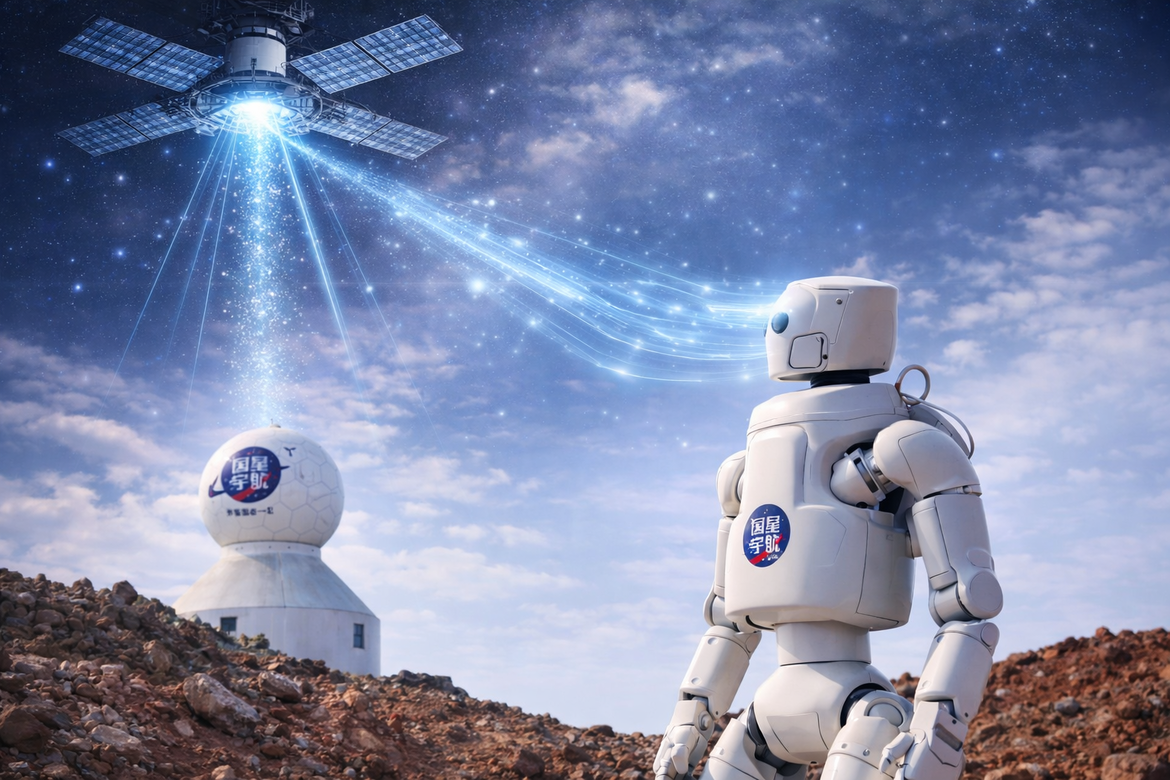
The commands were then transmitted to the “Star Computing” satellite computing network, where a large AI model performed inference using onboard processing resources. The resulting decisions were sent back to Earth, where the system translated them into actions executed by a humanoid robot.
According to the researchers, this workflow represents the first complete closed-loop architecture linking human commands, satellite-based AI processing, and physical robotic execution.
In practical terms, the system functions as a distributed AI pipeline: human instructions are converted into machine reasoning in orbit, and the resulting output drives robotic behavior on the ground.
Space Computing as a New AI Infrastructure Layer
The project highlights a growing interest in space-based computing as an extension of the global AI infrastructure.
Satellites equipped with advanced processors could potentially provide computing services to systems operating in remote or bandwidth-limited environments. Robots deployed in disaster zones, remote industrial facilities, or autonomous vehicles operating outside traditional network coverage could theoretically access space-based AI inference when local computing resources are insufficient.
ADASPACE described the experiment as an early step toward what it calls “Space Computing as a Service,” where orbiting infrastructure supplies AI capabilities to machines on Earth.
The system also tested token-based AI service invocation in space, demonstrating how software agents could request computing resources from satellite networks in real time.
Security and Control Challenges
Researchers involved in the project also emphasized potential security advantages of space-based computing architectures.
By processing sensitive data in orbit rather than transmitting it across public internet infrastructure, the system could theoretically reduce exposure to certain cybersecurity risks. The architecture relies on encrypted communication protocols and isolated computing environments designed to limit access to raw data.
At the same time, the experiment underscores the complexity of integrating AI agents with physical machines through distributed computing networks.
OpenClaw-based agents must balance capability and control, ensuring that robots execute instructions safely while limiting the privileges granted to autonomous systems. Managing these permissions becomes even more complicated when AI reasoning occurs remotely.
Despite these challenges, the successful demonstration suggests that robotics may increasingly rely on distributed computing environments that extend beyond traditional data centers.
If space-based AI infrastructure continues to develop, it could become part of a new global network supporting autonomous systems operating across land, sea, air, and eventually space itself.