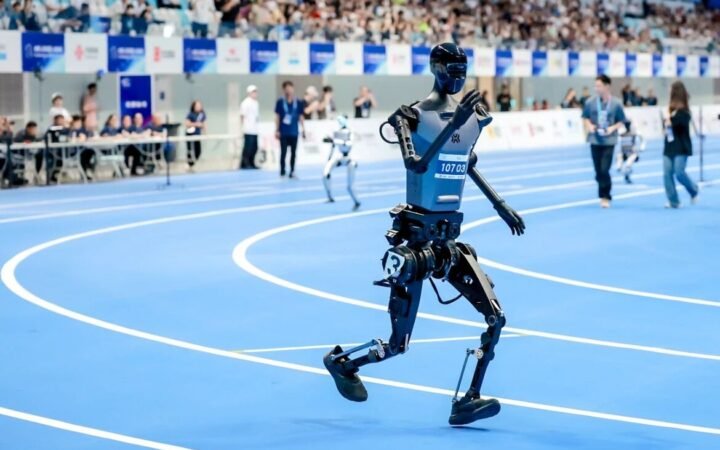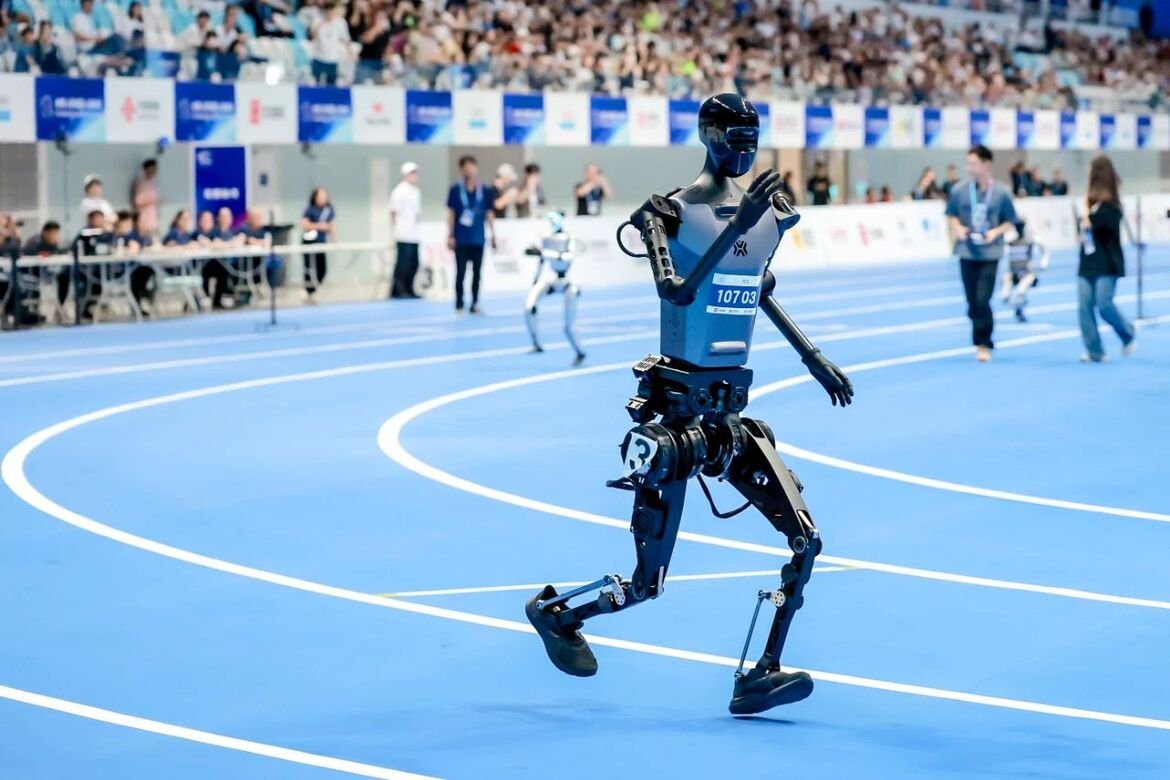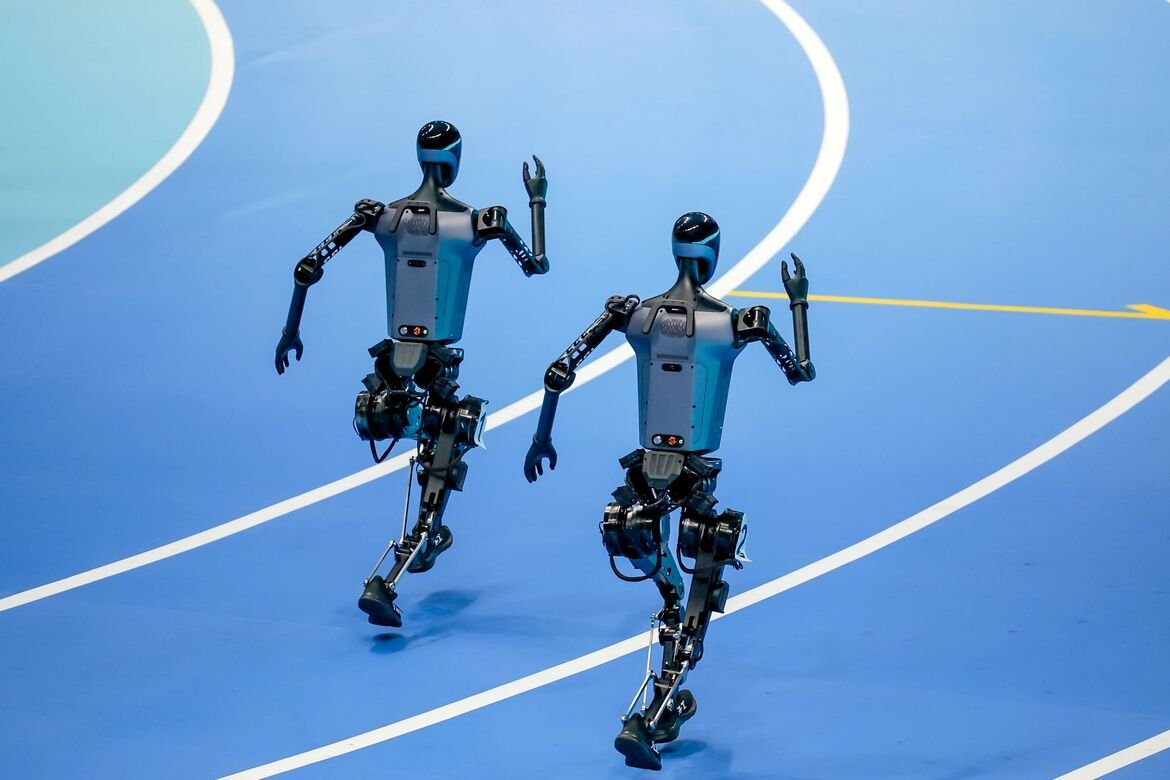
Humanoid robots will return to Beijing next month for the world’s second half marathon designed specifically for androids, as developers push robotic locomotion toward levels once considered uniquely human.
Organizers say the event will bring together multiple robotics teams aiming to significantly improve performance compared with last year’s competition. Some developers have even suggested that robots may eventually challenge the pace of elite human runners.
The race has become an unusual but revealing testing ground for humanoid robotics. Unlike short demonstrations or controlled laboratory trials, long-distance running places sustained stress on nearly every component of a robot’s design – from motors and batteries to control algorithms and thermal management systems.
A Race to Close the Speed Gap
The inaugural humanoid half marathon in Beijing last year was won by Tiangong Ultra, a robot developed by the Beijing Humanoid Robot Innovation Center, which completed the course in two hours, 40 minutes, and 42 seconds.
That time remains far behind the human half-marathon world record of 57 minutes and 20 seconds, but robotics developers say progress has accelerated rapidly.
Tang Jian, chief technology officer of the company behind last year’s winning robot, said teams have upgraded both hardware and software ahead of this year’s race. Improvements include stronger joint torque, higher explosive power, and redesigned cooling systems intended to maintain stable performance during extended high-speed movement.
Developers have also refined motion control algorithms to produce a gait closer to human running mechanics, improving energy efficiency and reducing mechanical strain over long distances.
Battery technology has also advanced. Some robots competing this year may be able to complete the race without stopping for recharging, a significant improvement over earlier endurance tests.
From Controlled Experiments to Autonomous Racing
Another major change this year involves how the robots navigate the course.
During the previous race, some machines relied on human pacemakers or remote control to guide their movement along the track. For the upcoming event, teams are shifting toward greater autonomy.
Participants are expected to use onboard perception systems combined with electronic mapping tools to interpret the environment and plan their own routes in real time.
This shift mirrors broader trends in robotics development, where autonomy and environmental awareness are becoming as important as raw mechanical capability.
The course itself is also expected to be more complex than last year’s route, introducing terrain variations that will test robots’ ability to adapt their movement dynamically.
Endurance as a Test for Real World Robots
While the idea of robots running a marathon may appear symbolic, developers argue that endurance competitions provide valuable engineering insights.
Long-distance running tests the stability of locomotion systems, the reliability of sensors and controllers, and the efficiency of power management. These are the same factors that determine whether humanoid robots can eventually operate reliably in workplaces and public environments.
Developers say that sustained movement under real-world conditions can reveal weaknesses that shorter demonstrations fail to expose.
The event also highlights how quickly robotic athletic capabilities are advancing. Some robotics researchers believe humanoid robots could soon approach human-level sprint performance as well.
Unitree Robotics founder Wang Xingxing recently suggested that humanoid robots may eventually run a 100-meter sprint in under 10 seconds, a pace that would rival elite human athletes.
Whether robots can reach such milestones remains uncertain. But as competitions like Beijing’s android marathon continue to evolve, they are increasingly serving as real-world laboratories for the development of faster, more capable humanoid machines.