The idea of robots operating inside the human body has long been associated with science fiction. But recent advances in DNA-based nanotechnology are beginning to translate that vision into early-stage experimental systems, where programmable molecular machines can move, sense, and interact with biological environments.
Researchers are now designing DNA “robots” capable of delivering drugs directly to diseased cells and identifying viral threats within the bloodstream. While these systems remain far from clinical deployment, they represent a shift in how robotics is defined – extending from mechanical systems into the molecular domain.
Reimagining Robotics at the Molecular Scale
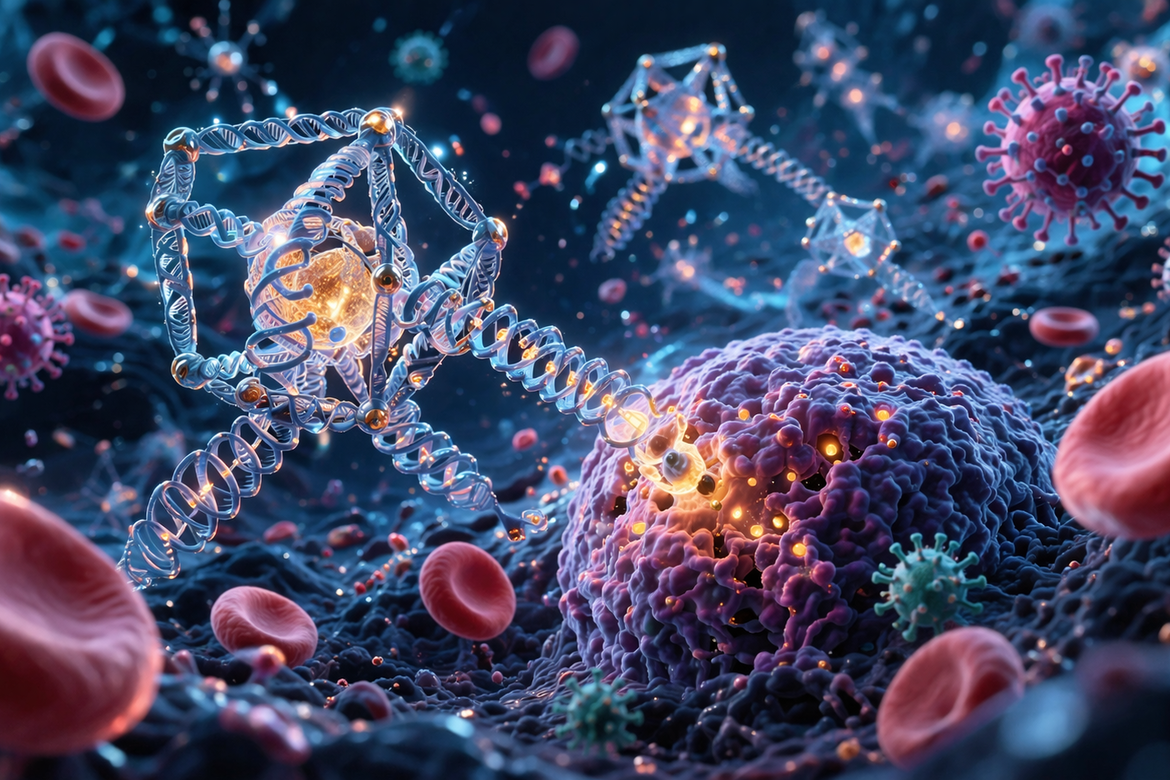
Unlike conventional robots built from metal, electronics, and actuators, DNA robots are constructed from strands of nucleic acids that can be folded, connected, and programmed into functional structures. Using techniques inspired by origami, scientists can create rigid joints, flexible linkages, and dynamic components that mimic mechanical systems at a nanoscale.
This approach adapts established principles from traditional robotics – including rigid-body motion and compliant mechanisms – into a biochemical context. The result is a new class of machines that operate not through motors or gears, but through chemical interactions and structural transformations.
Controlling these systems presents a fundamental challenge. At the molecular level, motion is dominated by random thermal fluctuations, known as Brownian motion, which can disrupt precise behavior. To address this, researchers rely on biochemical programming methods such as DNA strand displacement, where specific sequences act as triggers to initiate movement or change configuration.
External signals, including light, magnetic fields, and electric fields, can also be used to guide these nanorobots, providing an additional layer of control in otherwise unpredictable environments.
Medical Applications Remain Experimental
The most immediate interest in DNA robotics lies in medicine, where the ability to operate at cellular or even molecular resolution could enable highly targeted interventions. In experimental settings, DNA robots have been designed to locate specific cell types, release therapeutic payloads, and potentially capture or neutralize viruses.
Such systems could function as “nano-surgeons”, delivering drugs with far greater precision than conventional treatments and reducing side effects associated with systemic therapies. Researchers are also exploring their potential to detect and bind to viral particles, including pathogens similar to COVID-19, as a step toward autonomous diagnostic or therapeutic platforms.
Beyond medicine, DNA robots may also serve as tools for nanoscale manufacturing. By positioning molecules and nanoparticles with sub-nanometer precision, they could enable new forms of computing and materials engineering that are difficult to achieve with existing fabrication techniques.
However, most current systems remain proof-of-concept demonstrations. They typically operate in controlled laboratory conditions and lack the robustness required for real-world biological environments.
From Proof of Concept to Scalable Systems
The transition from experimental prototypes to practical applications presents several challenges. In addition to environmental unpredictability, researchers face limitations in modeling and design. There is currently no comprehensive database of DNA mechanical properties, and simulation tools for predicting nanorobot behavior remain underdeveloped.
Scaling these systems will likely require advances across multiple domains, including bio-manufacturing, materials science, and artificial intelligence. Proposed approaches include the development of standardized DNA component libraries and the use of AI-driven design tools to optimize structures and predict performance.
The broader implication is that robotics may increasingly extend beyond traditional hardware into programmable biological systems. DNA robots, if successfully scaled, could redefine automation at the smallest possible level – enabling machines that operate not in factories or warehouses, but within cells and molecules themselves.
For now, the technology remains in its formative stage. But its trajectory suggests that the next phase of robotics innovation may be less about building larger, more capable machines, and more about engineering systems that can function where conventional robots cannot reach.