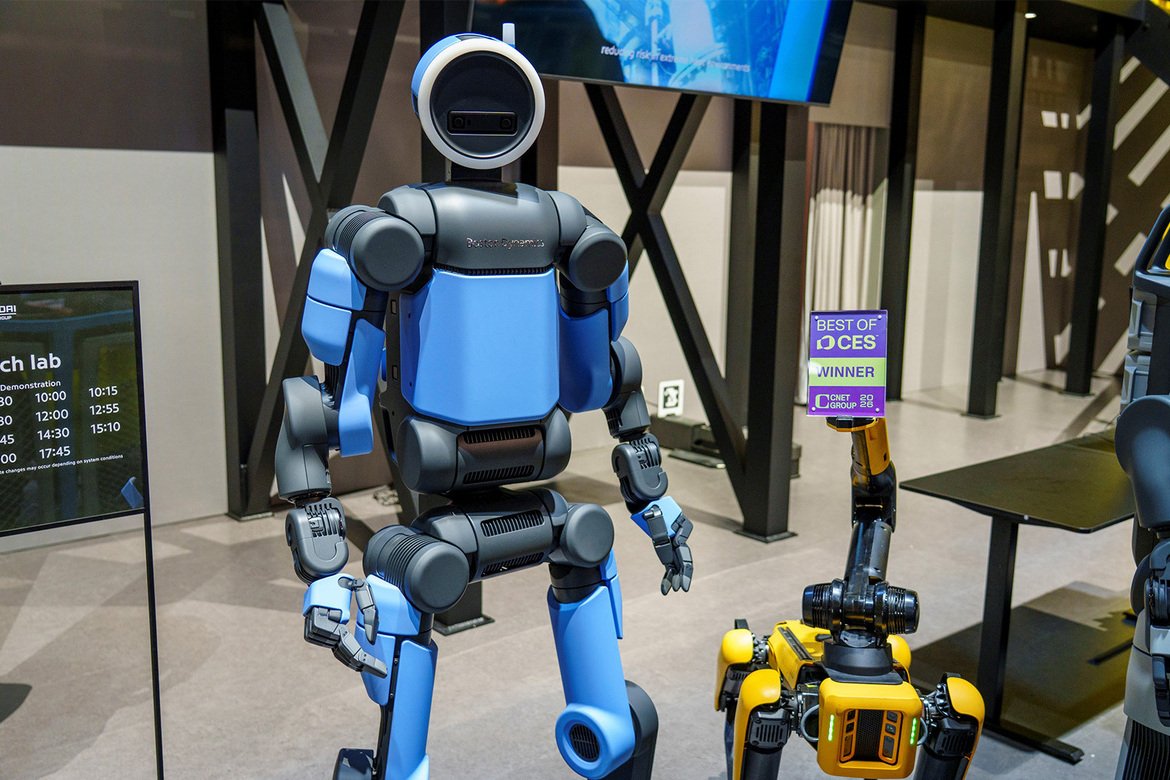
Boston Dynamics released a video on May 6 showing its production-ready Atlas humanoid robot performing a handstand and transitioning into an L-sit – a static hold in which the robot supports its full body weight on its hands alone. The footage marks the first live demonstration of the mass-produced version of Atlas in motion, a distinction that separates it from earlier research prototype demonstrations of backflips and parkour.
The release comes as Hyundai, which acquired Boston Dynamics in 2021, faces mounting pressure to deliver humanoid robots at industrial scale. Hyundai shares closed 2% higher in Seoul on May 6 and are up more than 85% in 2026, driven in part by the Atlas iteration unveiled at CES in January.
Balancing commercial goals and robotics research can be tricky, but with Atlas we're making it work. pic.twitter.com/GHcnR1yPmv
— Boston Dynamics (@BostonDynamics) May 5, 2026
Hardware Specifications
The production-ready Atlas features human-scale hands with tactile sensing and fully rotational joints. It can lift up to 50 kilograms and operate across a temperature range of minus 20 to 40 degrees Celsius – a thermal envelope designed to cover the conditions found in automotive manufacturing environments. The fully rotational joints allow the robot to achieve positions beyond the limits of human skeletal anatomy, which is what enables the handstand and L-sit movements demonstrated in the video.
The maneuver is not presented as a commercial use case but as a demonstration of balance precision and joint control – capabilities that translate directly into the stability and repeatability required for complex industrial assembly tasks.
Commercial Deployment Timeline
Hyundai plans to deploy Atlas at its manufacturing plants beginning in 2028, including at its facility in the U.S. state of Georgia. The company has invested billions of dollars into its robotics business, and the commercialization of Atlas is central to Hyundai’s broader repositioning as a mobility solutions provider amid tariff pressure and intensifying competition from Chinese automakers.
Yoo Jiwoong, an analyst at DAOL Investment and Securities, described the video as the clearest evidence yet that Hyundai is approaching commercial scale for humanoid production. Boston Dynamics is currently producing approximately four Atlas robots per month, a figure that remains well below the 30,000-unit annual capacity it announced at CES – a gap that reflects the engineering and manufacturing challenges of the transition from research hardware to production volume.
Boston Dynamics acknowledged the difficulty of that transition in a post on X: “Balancing commercial goals and robotics research can be tricky, but with Atlas we’re making it work.”
Competitive Context
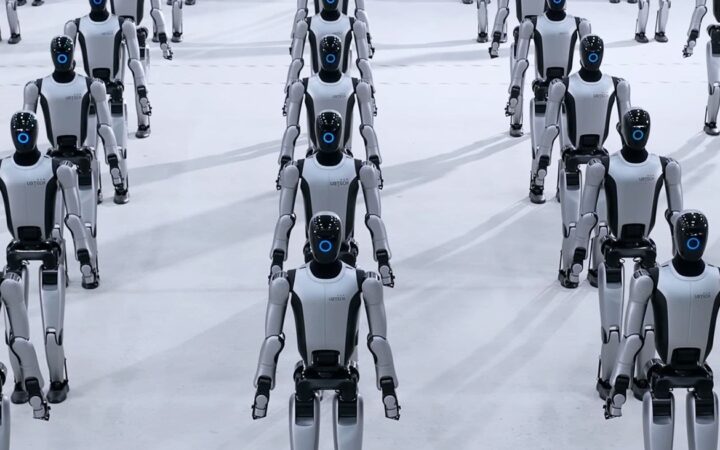
The humanoid robot market that Hyundai and Boston Dynamics are entering is increasingly competitive. Chinese manufacturers currently lead in production volume and deployment scale, with companies including Agibot, Unitree, and UBTECH shipping thousands of units annually. Tesla’s Optimus program is targeting volume production from July 2026. For Boston Dynamics, which built its reputation on research robotics, the transition to commercial manufacturing at automotive scale represents a fundamental operational shift – one the May 6 video is designed, at least in part, to signal is underway.
Disclaimer: RobotsBeat is an independent media brand owned and operated by NuvexMedia LLC, publishing news, research, and insights on artificial intelligence, emerging technologies, automation, and related industries. NuvexMedia LLC invests in and collaborates with companies across the AI, Robotics, technology, software, and digital innovation sectors. These relationships do not influence RobotsBeat's editorial coverage, and the publication maintains full editorial independence to provide accurate, timely, and objective information. © 2026 NuvexMedia LLC. All rights reserved. This content is for informational purposes only and should not be considered legal, tax, investment, financial, or other professional advice.