San Francisco-based Framework Ventures has raised $400 million for its fourth fund, marking a formal expansion beyond crypto into what its founders describe as frontier technology including artificial intelligence, robotics, and energy. The firm, founded in 2019 and best known as an early backer of decentralized finance protocols including Aave and Chainlink, held $1.28 billion in assets under management as of December 2025 according to a Securities and Exchange Commission filing. Limited partners in the new fund were not named but include funds of funds, an Ivy League endowment, sovereign wealth funds, and nonprofits.
Co-founders Vance Spencer and Michael Anderson said the broader mandate follows their existing founder network rather than a strategic pivot, with Anderson noting that the firm has hosted weekend AI research paper reading sessions at its San Francisco office. Framework has already deployed approximately half of the new fund’s capital. Among its non-crypto bets is robotics data startup Mecka AI, which raised a $60 million Series A earlier this month, along with a stake in public mortgage issuer Better.com. The firm’s earlier funds raised $100 million in 2021 and $400 million in 2022, both focused on crypto.
The move places Framework alongside several other digital-asset investors that have broadened into robotics and AI as crypto market activity has cooled. Paradigm, one of the largest crypto-focused VCs, is reportedly raising as much as $1.5 billion for a fund that will cover AI and robotics alongside crypto. Haun Ventures, founded by a former Andreessen Horowitz crypto partner, raised $1 billion for a second fund that targets blockchain, AI, financial services, and alternative assets. The pattern reflects both the recent softness in digital-asset markets, with bitcoin approaching levels last seen in 2024, and the sustained valuation expansion at leading AI labs.
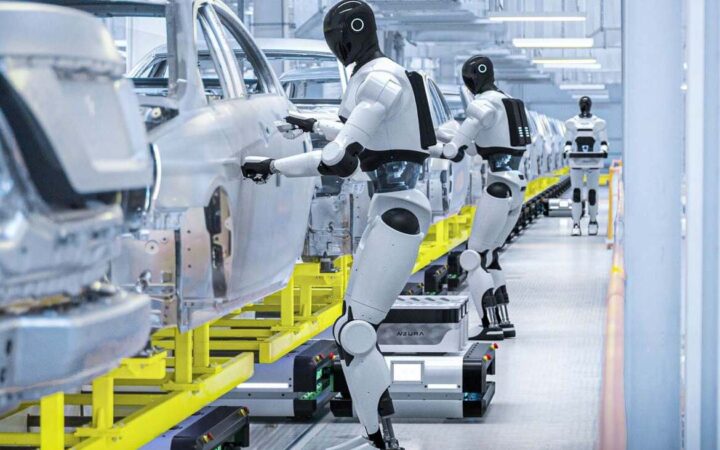
For the robotics sector, the migration of crypto-native capital represents an additional pool of risk-tolerant funding that can support early-stage physical AI and robotics infrastructure plays. Investors who built returns in volatile, hardware-light digital asset markets are now applying similar appetite to capital-intensive robotics startups, where deployment timelines and unit economics are very different. Whether crypto-trained allocators can underwrite the longer hardware development cycles characteristic of robotics will be a notable test, and is part of a broader rewiring of venture capital around physical AI as a defining theme of the current cycle.
Disclaimer: RobotsBeat is an independent media brand owned and operated by NuvexMedia LLC, publishing news, research, and insights on artificial intelligence, emerging technologies, automation, and related industries. NuvexMedia LLC invests in and collaborates with companies across the AI, Robotics, technology, software, and digital innovation sectors. These relationships do not influence RobotsBeat's editorial coverage, and the publication maintains full editorial independence to provide accurate, timely, and objective information. © 2026 NuvexMedia LLC. All rights reserved. This content is for informational purposes only and should not be considered legal, tax, investment, financial, or other professional advice.