CES 2026: Kodiak and Bosch Partner to Scale Autonomous Trucking Hardware

Kodiak has entered a strategic agreement with Bosch to scale production-grade autonomous trucking hardware, aiming to accelerate commercial deployment of driverless trucks.

By Daniel Krauss Published: Updated:

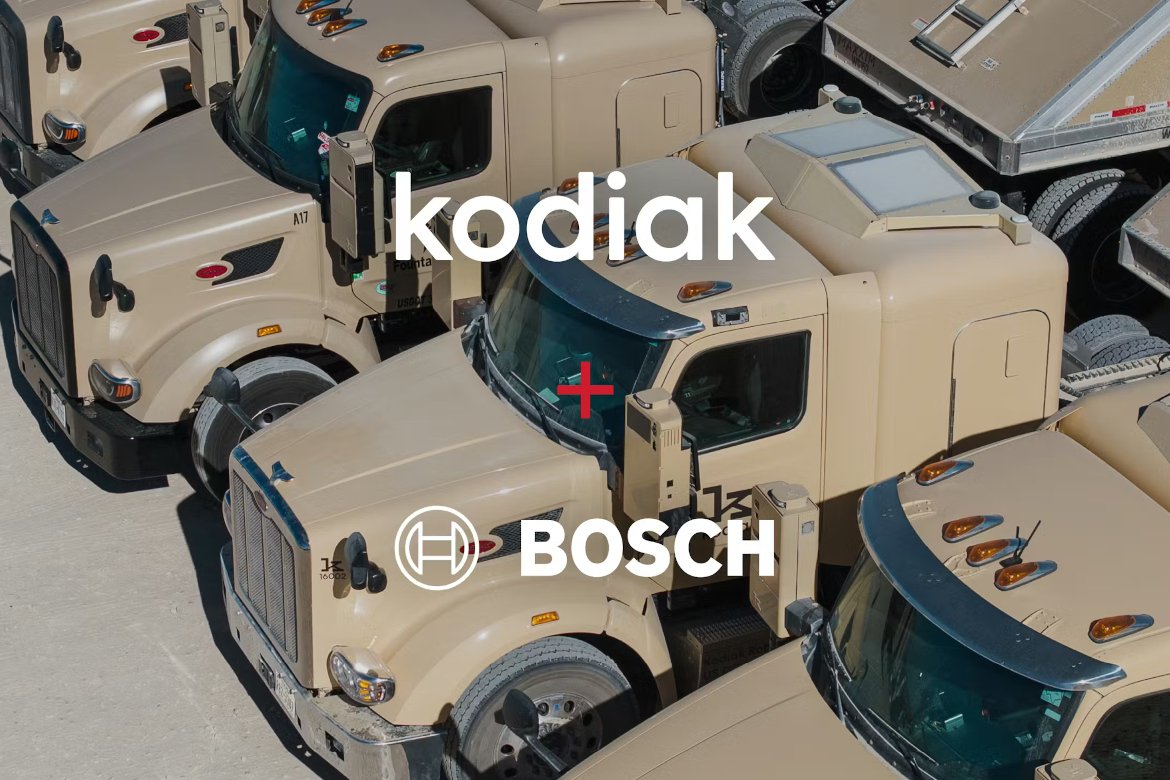
Kodiak AI has announced a strategic agreement with Bosch to scale the manufacturing of production-grade autonomous trucking hardware, marking a significant step toward large-scale deployment of driverless trucks. The collaboration was revealed ahead of CES 2026, where a Kodiak Driver-powered autonomous truck will be displayed at Bosch’s booth in Las Vegas.

The partnership focuses on building a redundant, automotive-grade platform that integrates hardware, firmware, and software interfaces required to deploy Kodiak’s AI-powered virtual driver at scale. By combining Kodiak’s autonomy software with Bosch’s manufacturing expertise and supply chain capabilities, the companies aim to move autonomous trucking beyond pilots and into sustained commercial operations.

Scaling Physical AI for Heavy-Duty Trucks

Kodiak’s autonomous system, known as the Kodiak Driver, is designed as a unified platform that blends AI-driven perception and planning software with modular, vehicle-agnostic hardware. The system can be integrated either directly on a truck production line or through aftermarket upfitters, giving fleet operators flexibility in how autonomous capability is deployed.

Under the agreement, Bosch will support the development of a redundant autonomous hardware platform, supplying key components such as sensors, steering systems, and other vehicle actuation technologies. These components are designed to meet automotive-grade reliability standards, a critical requirement for long-haul trucking applications where uptime and safety are paramount.

“Advancing the deployment of driverless trucks and physical AI requires not only robust autonomy software, but also manufacturing experience and a resilient supply chain,” said Don Burnette, founder and chief executive of Kodiak. He emphasized that Bosch’s industrial scale and system-level integration expertise are essential for commercial success.

From Commercial Pilots to Industrial Scale

Kodiak has already deployed trucks operating without human drivers in commercial service, positioning the company as one of the few autonomous trucking developers with real-world revenue-generating operations. The new agreement is intended to build on that foundation by enabling higher-volume production and standardized hardware configurations.

Bosch’s role extends beyond component supply. As the world’s largest automotive supplier, the company brings decades of experience in industrialization, quality assurance, and global manufacturing. This expertise is expected to help Kodiak transition from limited deployments to repeatable, scalable production suitable for fleet-wide adoption.

Paul Thomas, president of Bosch in North America and president of Bosch Mobility Americas, said the collaboration allows Bosch to deepen its understanding of real-world autonomous vehicle requirements while contributing production-grade systems to the broader autonomous mobility ecosystem.

CES 2026 and the Push Toward Autonomous Freight

Autonomous trucking emerged as a key theme at CES 2026, with increasing emphasis on commercialization rather than experimental prototypes. Kodiak and Bosch used the event to highlight how Physical AI systems are moving into operational environments where reliability, redundancy, and cost efficiency matter as much as technical performance.

The Kodiak Driver-powered truck on display demonstrates how the integrated platform brings together sensors, compute, and vehicle control into a single autonomous system. Unlike many earlier demonstrations, the focus is on readiness for deployment rather than future concepts.

Industry analysts view the partnership as a sign that autonomous trucking is entering a more mature phase, where partnerships with established automotive suppliers are essential to overcoming manufacturing and regulatory hurdles.

Broader Implications for Autonomous Logistics

For Kodiak, the deal supports its long-term vision of becoming a trusted provider of autonomous ground transportation across commercial and public-sector applications. The company has also positioned its technology for use in government and national security contexts, where reliability and safety standards are especially stringent.

The collaboration underscores a broader trend in robotics and automation, where autonomy developers increasingly rely on established industrial partners to bridge the gap between software innovation and large-scale deployment. As Physical AI systems move from test routes to highways and supply chains, the ability to manufacture and support hardware at scale becomes a decisive competitive advantage.

With CES 2026 as the backdrop, the Kodiak-Bosch agreement signals growing confidence that autonomous trucking is transitioning from experimentation to infrastructure, setting the stage for wider adoption in the years ahead.

Automation, Business & Markets, News, Robots & Robotics

South Korea to Deploy 18 Firefighting Robots as Part of National Disaster Response Overhaul

South Korea’s National Fire Agency has announced a plan to expand its unmanned firefighting robot fleet from four to 22 units over two years, shifting toward an AI and robotics-centered response system for large-scale and hazardous fires.

By Daniel Krauss | Edited by Kseniia Klichova Published:
South Korea to Deploy 18 Firefighting Robots as Part of National Disaster Response Overhaul
An unmanned firefighting robot operating in a large industrial fire environment, remotely deployed to suppress flames in areas inaccessible to personnel. Photo: Kseniia Klichova / RobotsBeat

South Korea’s National Fire Agency has announced a comprehensive overhaul of its disaster response system, with unmanned firefighting robots at the center of its near-term equipment expansion. The agency plans to add 18 robots over the next two years, bringing the total fleet from four to 22 units, before gradually extending deployment to fire headquarters across cities and provinces nationwide.

NFA Commissioner Kim Seung-ryong outlined the plan at a press briefing in Sejong on Thursday, his first public statement since taking office in October. The measures respond to an increase in large-scale, hard-to-access disasters – including fires at logistics facilities involving toxic gases and explosion risks – where personnel safety constraints limit how close human firefighters can operate.

Shifting to a Robot-Centered Response Model

The agency’s stated objective is to transition from a personnel-dependent response model to one centered on AI and robotics, reducing exposure of on-site staff in the most hazardous scenarios. Unmanned firefighting robots are designed to enter environments that would require human crews to operate at unsafe proximity to flames, structural collapse risk, or chemical hazard zones.

Alongside the robot expansion, the NFA will extend its high-capacity foam discharge system – used for large-scale incidents such as oil tank fires – to the Honam and metropolitan regions, adding geographic coverage for a class of industrial fire that has grown more common as logistics and warehousing infrastructure has expanded.

The preventive inspection system is also being strengthened. The agency is evaluating a shift from fire-station-only inspections to a government-wide joint system involving agencies responsible for construction, electricity, and gas. High-risk facilities with repeated fire incidents will be designated as key fire safety management targets and subjected to intensified public oversight through joint drills and safety investigations.

Emergency Transport Reform

The overhaul extends beyond firefighting into emergency patient transport. The NFA plans to strengthen the Central Emergency Medical Situation Control Center’s authority to intervene directly when regional centers cannot place patients, arranging hospital admissions nationwide rather than within regional boundaries. For high-risk cases including emergency obstetric patients, 119 emergency services will transport directly to facilities with neonatal intensive care capacity regardless of provincial jurisdiction.

For long-distance transport, the agency intends to expand use of its 33 air ambulances currently operating nationally.

Regulatory Reform

The agency is also initiating a regulatory overhaul of the firefighting industry. It will shift to a negative regulatory framework – permitting everything not explicitly prohibited by law – and has announced a Fire Prevention Regulation Rationalization Task Force combining industry, academic, and research expertise. Major firefighting laws including the Fire Facilities Act and the Hazardous Substances Safety Management Act will be reviewed from the ground up to remove unnecessary administrative constraints.

The announcement follows a line-of-duty deaths investigation stemming from a fire at a seafood processing facility in South Jeolla Province. A 26-member joint fire investigation team is conducting a detailed analysis, with institutional reforms to follow based on its findings.

News, Robots & Robotics

BMW and PepsiCo Partner Sereact Raises $110 Million Series B to Scale AI Robotics Software Across Industrial and Humanoid Robots

Stuttgart-based AI robotics software company Sereact has raised $110 million in a Series B led by Headline, with customers including BMW and Daimler Truck already running its vision-language-action models in live production environments.

By Rachel Whitman | Edited by Kseniia Klichova Published:
BMW and PepsiCo Partner Sereact Raises $110 Million Series B to Scale AI Robotics Software Across Industrial and Humanoid Robots
A robot using AI-powered vision and action planning to identify, assess, and pick objects in an industrial warehouse fulfillment environment. Photo: Sereact

Sereact, the Stuttgart-based AI robotics software company, has raised $110 million in a Series B round led by Headline, the international venture firm with offices in Berlin, San Francisco, and Paris. New investors Bullhound Capital, Felix Capital, and Daphni joined alongside existing backers. The round is more than four times the size of the €25 million Series A Sereact closed fifteen months ago, and brings total funding to over $140 million since the company’s 2021 founding. Valuation was not disclosed.

The capital will be used to develop Sereact’s core AI model and to scale deployment across logistics, manufacturing, and humanoid robot platforms.

The Technical Approach

Sereact was founded by Ralf Gulde and Marc Tuscher, both former AI researchers at the University of Stuttgart. The company’s software is built around Vision Language Action Models – AI systems that combine computer vision, natural language understanding, and action planning into a single model. Rather than programming robots for specific object types or environmental configurations, the approach allows robots to perceive their surroundings, interpret instructions, and plan physical tasks adaptively.

The practical implication is that a robot can evaluate whether a planned grip will damage a fragile object before its gripper closes – simulating the consequences of an action before executing it. That capability addresses a structural limitation of conventional industrial robotics, which operate on pre-programmed sequences designed for controlled, predictable environments. Warehouses and manufacturing floors are neither: objects arrive in unpredictable orientations, packaging varies continuously, and edge cases are constant. Sereact’s software is designed to handle that variation without requiring engineers to reprogram the system for each new object type or layout change.

Production Customers at Automotive Scale

The commercial record behind the Series B is substantive. Customers include BMW Group, Daimler Truck, Dutch e-commerce fulfillment company Bol, and logistics specialists MS Direct and Active Ants. The BMW and Daimler Truck deployments are not pilots – they are live production environments where a robot failure carries the economic cost of a line stoppage. Reaching production at that tier of customer is a meaningful distinction in a market where the majority of AI robotics companies are still operating at the demonstration stage.

PepsiCo is also among Sereact’s logistics customers, reflecting deployment across both manufacturing and consumer goods fulfillment use cases.

The Software-First Investment Thesis

Sereact’s positioning – a software intelligence layer deployable across any hardware platform – mirrors the thesis that has made Mobileye valuable in autonomous vehicles and that NVIDIA is pursuing through its Isaac robotics platform. The highest-margin position in robotics is not the robot itself but the intelligence running it.

“Most AI robotics companies are currently hardware-first,” said Johan Brenner of Creandum at the Series A. “What sets Sereact apart is their software-first, foundational approach, which means they have the potential to become the brain of any robot that requires vision and autonomous capabilities.”

The $110 million round makes Sereact’s stated intention to expand into humanoid robot platforms commercially credible. The global humanoid robot market is projected to exceed $38 billion by 2030, and platforms from Tesla, Figure AI, Boston Dynamics, and Unitree moving from controlled tests into commercial production will require adaptable robotics intelligence software at scale. Sereact’s VLAM architecture is designed to run across hardware platforms, positioning it to supply that intelligence layer regardless of which humanoid hardware wins the market.

Leaderdrive Founders Become Billionaires as Humanoid Robot Demand Drives 40% Stock Surge

Shares of Leaderdrive, China’s largest manufacturer of harmonic reducers for robotic joints, have risen 40% over the past year, making founders Zuo Yuyu and Zuo Jing billionaires as humanoid robot shipments surge globally.

By Laura Bennett | Edited by Kseniia Klichova Published:
Leaderdrive Founders Become Billionaires as Humanoid Robot Demand Drives 40% Stock Surge
Precision harmonic reducer gear components used as joints in humanoid robots and industrial robotic arms, manufactured at a Chinese robotics supply chain facility. Photo: Kseniia Klichova / RobotsBeat

The founders of Leader Harmonious Drive Systems, known as Leaderdrive, have become billionaires after shares in the Chinese robotic joint maker rose 40% over the past year. Chairman Zuo Yuyu, 56, and vice chairman Zuo Jing, 61, each hold a 17% stake in the company, giving both a net worth of approximately $1 billion at last Thursday’s closing price of 203.8 yuan, according to Forbes.

Leaderdrive is China’s largest manufacturer of harmonic reducers – precision gear systems that function as joints in robotic arms and humanoid machines – and holds between 30% and 40% of the domestic market, according to J.P. Morgan. Its clients include leading humanoid robot manufacturers Agibot and UBTECH Robotics.

Financial Performance

The company reported revenue of 570.7 million yuan in 2025, up 47% year-on-year, with net profit more than doubling to 124.4 million yuan. Leaderdrive attributed the growth to rapid expansion across both industrial robotics and humanoid robot markets, two segments that advanced simultaneously through 2025 as humanoid platforms moved from pilot deployments into early mass production.

Global humanoid robot shipments rose nearly 480% in 2025 to 13,318 units, according to research firm Omdia. The same firm projects that figure will reach 2.6 million units by 2035 – a trajectory that, if realized, would make harmonic reducer supply one of the most significant bottlenecks in the humanoid robot supply chain.

The Company’s Origins

Leaderdrive was founded in 2011 by Zuo Yuyu, a physics graduate of Nanjing University who began his career in mechanical engineering before pivoting to robotics in 2003. The company spent years developing harmonic reducers at a time when the key technologies were dominated by Japanese manufacturers. “If there’s a secret to our success, it’s the ability to endure and the willingness to invest the time,” Yuyu said in a 2020 interview. Zuo Jing joined as general manager in 2014, and the brothers took the company public on Shanghai’s STAR Market in 2020, raising approximately 1.1 billion yuan in its IPO.

A Broader Supply Chain Wealth Effect

The Zuo brothers are part of a growing cohort of Chinese entrepreneurs whose fortunes are rising with the robotics supply chain. Wang Xinyang, founder of image sensor maker Gpixel Changchun Microelectronics, and Howard Huang, founder of Shenzhen-based 3D vision camera company Orbbec, represent parallel examples of component-layer companies benefiting from the acceleration in humanoid robot demand.

The pattern reflects where value is accumulating in the current phase of the humanoid robot industry. While robot manufacturers compete on AI capability and deployment scale, the component makers supplying precision mechanical systems – reducers, sensors, actuators – face demand that scales with every robot shipped, regardless of which platform wins the market. Leaderdrive’s position as the dominant domestic harmonic reducer supplier places it directly in that supply chain layer.

Business & Markets, News, Robots & Robotics

Tesla Plans Optimus V3 Unveil Closer to Production, Targeting July-August Window

Elon Musk said Tesla will delay the Optimus V3 unveil until closer to its production date, targeting a July-August window, citing concerns that competitors are conducting frame-by-frame analysis of Tesla’s robotics demonstrations to replicate the technology.

By Daniel Krauss | Edited by Kseniia Klichova Published:
Tesla Plans Optimus V3 Unveil Closer to Production, Targeting July-August Window
A humanoid robot on a dedicated production line at an electric vehicle and robotics manufacturing facility. Photo: Tesla Optimus

Tesla CEO Elon Musk said on the company’s Q1 2026 earnings call that Tesla intends to unveil Optimus V3 closer to the robot’s production start date, targeting a July-August window. The decision represents a change in the company’s approach to product demonstrations, driven by concerns that competitors are replicating Tesla’s robotics technology through detailed analysis of publicly shared footage.

“We’ve found out our competitors literally do a frame-by-frame analysis and copy everything we’re doing,” Musk said. “I think there’s some value to not showing new technology until it’s close to production.”

A New Production Line

Musk noted that the Optimus production line has been rebuilt from scratch. The facility previously used to manufacture the Model S and Model X was repurposed, but Optimus required a fundamentally different manufacturing approach. “Optimus is a completely new product with a completely new production line,” he said.

The decision to consolidate the unveil and production timelines reflects a broader shift in how Tesla is managing its robotics program competitively. Earlier Optimus demonstrations were staged at significant lead times before any production capability existed, a practice that gave competitors extended observation windows. Moving the reveal closer to the production start compresses that window while also allowing Tesla to demonstrate a robot that more accurately reflects what will reach customers.

Investor Concerns and the Autonomy Question

The Optimus update came alongside earnings results that beat market expectations on revenue and free cash flow. However, investor sentiment on Tesla’s longer-term autonomy programs remained mixed. Investor Gary Black of The Future Fund said he expects Tesla’s valuation to come under pressure due to what he described as a slowdown in autonomous vehicle and robotaxi development timelines.

Investor Ross Gerber of Gerber Kawasaki raised a separate concern after Musk acknowledged that vehicles equipped with the Hardware 3 chip would not be capable of achieving unsupervised Full Self-Driving. The admission has implications for owners of older Tesla vehicles who purchased the FSD software option under the expectation that future software updates would eventually enable full autonomy on their hardware.

On the vehicle sales side, Tesla delivered 31,958 units in California in Q1 2026, a decline of more than 10,000 units from the 42,000 delivered in the same quarter of 2025. The Model Y remained the best-selling electric vehicle in the state despite the overall volume decline.

Competitive Context

The frame-by-frame copying accusation reflects the intensity of competition in the humanoid robot segment, where Chinese manufacturers in particular have made significant hardware and software advances over the past two years. Tesla has been among the most public in demonstrating Optimus capabilities, and Musk’s comments suggest the company now views that openness as a competitive liability. The July-August production timeline, if met, would make Optimus V3 one of the earlier next-generation humanoid platforms to enter volume production anywhere in the industry.

Business & Markets, News, Robots & Robotics

Gartner: Half of New Warehouses in Developed Markets Will Be Human-Optional by 2030

Gartner predicts that 50% of new warehouses built in developed markets by 2030 will be designed as robot-centric facilities where human labor is required only for exception handling, driven by labor shortages, cost pressure, and advances in AI-orchestrated intralogistics.

By Daniel Krauss | Edited by Kseniia Klichova Published:
Gartner: Half of New Warehouses in Developed Markets Will Be Human-Optional by 2030
An automated warehouse facility with robotic picking and sorting systems operating across storage aisles with minimal human presence. Photo: Kseniia Klichova / RobotsBeat

Gartner has forecast that 50% of new warehouses built in developed markets by 2030 will be designed as robot-centric facilities, where human workers are required only for exception handling rather than serving as the operational foundation. The prediction, published this month by the business and technology research firm, reflects sustained pressure from labor shortages, rising labor costs, and the accelerating capability of AI-orchestrated intralogistics systems.

The forecast marks a structural shift in how warehouse design is being approached, moving from retrofitting existing facilities with automation to building environments optimized from the ground up for robotic operation.

What Is Driving the Transition

The underlying pressures are labor-side rather than technology-side. Warehouse workers are increasingly unwilling to perform repetitive manual tasks, and many organizations cannot sustain operations through hiring alone as labor supply tightens and costs rise across most of the year. Chief supply chain officers are responding by accelerating adoption of intralogistics smart robotics – a category that encompasses autonomous mobile robots, robotic picking systems, and AI-driven fleet orchestration platforms.

“AI continuously optimizes warehouse environments in real-time, shifting them from static structures into agile systems that adapt as demand changes,” said Abdil Tunca, Senior Principal Analyst in Gartner’s Supply Chain practice. “This changes how CSCOs think about designing warehouses for scalability, from settings that primarily rely on human labor to environments that maximize the ability to orchestrate robotic fleets.”

Design and Operational Implications

Robot-centric warehouses differ from automated warehouses primarily in how human labor is positioned within operations. In existing automated facilities, robots augment human workers. In the human-optional model, humans handle only exceptions – anomalies, edge cases, and tasks that fall outside robotic capability – while robots manage the volume and routine workflows entirely.

This design shift enables operational advantages beyond labor cost reduction. Autonomous facilities can run with reduced lighting and climate control requirements, reconfigure workflows through software rather than physical infrastructure changes, and reallocate tasks dynamically between robots and humans as staffing levels or demand patterns fluctuate. Robotic pickers can be rerouted to higher-priority orders during peak periods without the scheduling constraints that human shift structures impose.

The intralogistics smart robotics market is highly fragmented, and Gartner notes that most organizations will need to deploy more than one robot type and a multiagent orchestration platform to coordinate heterogeneous fleets effectively. Managing interoperability across robot vendors – each with distinct software stacks and communication protocols – remains one of the primary integration challenges for organizations moving toward robot-centric operations.

Strategic Recommendations

Gartner recommends supply chain executives adopt digital twin and simulation models early in the design process to validate layouts and optimize robotic performance before construction begins. The firm also advises favoring scalable, software-defined robotics platforms over single-purpose automation to reduce obsolescence risk as the technology continues to develop rapidly, and establishing long-term vendor ecosystem partnerships to support future integration and expansion.

The upfront capital cost of robot-centric warehouse construction is higher than traditional facilities. Gartner frames this as a structural investment rather than an operational expense – one that offers compounding cost advantages as order volumes increase, because the marginal cost of additional throughput in an automated facility is substantially lower than adding headcount in a labor-dependent one.

Artificial Intelligence (AI), Automation, Business & Markets, News, Robots & Robotics