Hannover Messe 2026 opened this week with more than 3,000 exhibitors, and the central message from the world’s largest industrial technology trade show was consistent: AI systems are no longer in pilot phases. The conversation at this year’s event focused on measurable outcomes – throughput figures, cost reductions, and hours of autonomous operation – rather than capability demonstrations.
The convergence of physical AI, agentic software, and industrial robotics dominated the exhibition floor, with major technology firms presenting deployments already operating in live production environments.
Siemens, NVIDIA, and Humanoid on the Factory Floor
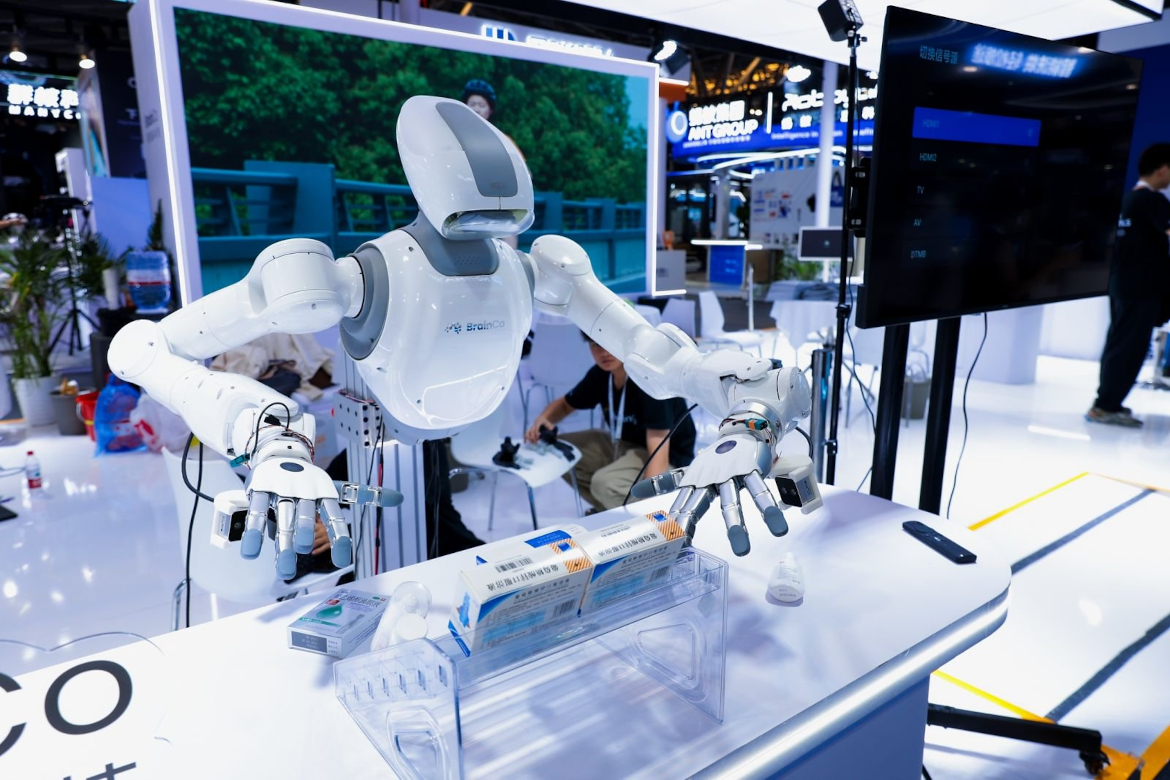
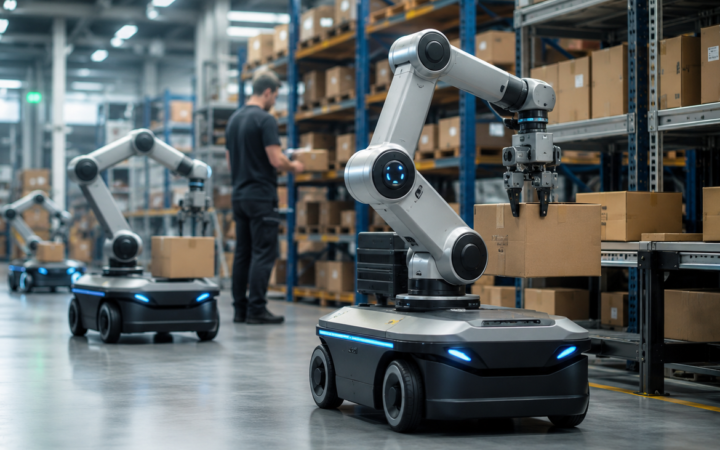
The most concrete demonstration of physical AI in manufacturing came from a collaboration between Siemens, NVIDIA, and robotics firm Humanoid. The HMND 01, a wheeled humanoid robot built on NVIDIA’s physical AI stack, has moved beyond testing and is performing autonomous logistics tasks at Siemens’ electronics factory in Erlangen, Germany.
At the show, the robot’s performance was framed around a specific operational metric: 60 tote moves per hour, handling the picking and placing of containers for human operators. The system integrates with Siemens’ Xcelerator portfolio, using a simulation-first training approach that allows skills developed in digital environments to transfer directly into production settings with real-time edge inference.
“Factories of the future demand robots that can perceive, reason and adapt autonomously alongside human workers,” said Deepu Talla, Vice President of Robotics and Edge AI at NVIDIA. “This deployment paves the way for humanoid robots meeting real production targets on a live factory floor.”
Schneider Electric and Microsoft Cut Engineering Time by Half
While Siemens focused on physical automation, Schneider Electric used the event to demonstrate agentic AI in engineering workflows. Its Industrial Copilot, built on Microsoft Azure AI, is already in production with customers including h2e POWER, an Indian green hydrogen supplier.
The h2e POWER deployment reported 6,000 hours of stable autonomous operation, a 10% reduction in the levelized cost of hydrogen, and an estimated €500,000 in savings. Schneider cited engineering time reductions of up to 50% for early adopters of the platform.
“This open architecture means we can redeploy intelligence across our entire installed base across multiple locations, without the lock-in that has constrained industrial innovation for decades,” said Siddharth Mayur, founder of h2e POWER.
Infrastructure as the Binding Constraint
Several exhibitors addressed the gap between AI capability and deployment readiness, arguing that computational infrastructure – not the AI itself – remains the primary barrier for most manufacturers.
Schneider and Dell presented a full-lifecycle AI deployment framework covering operational technology groundwork, digital twin planning via AVEVA and NVIDIA Omniverse, and modular prefabricated data centers for rapid scaling. Schneider also demonstrated its EcoStruxure Automation Expert running on AWS cloud infrastructure, using Amazon EC2 for virtualized control and AWS IoT Greengrass at the edge to enable consistent AI-driven automation across distributed sites.
Bernd Wagner, chief strategy officer of Schwarz Digits, the IT division of Schwarz Group, told attendees: “Robust IT infrastructures are now the foundation of global competitiveness.” The emphasis on data sovereignty alongside computational efficiency reflects a concern that is particularly acute for European manufacturers operating under stricter data governance frameworks than their U.S. and Chinese counterparts.
What Hannover Messe 2026 Signals
The cumulative picture from this year’s event is that the industrial AI stack – physical robots, agentic software, digital twins, and edge infrastructure – is maturing simultaneously across multiple layers. Deployments that would have been described as pilots two years ago are now being presented with operational data and return-on-investment figures. The open question is how quickly the economics of these systems reach manufacturers outside the large enterprise tier, where integration costs and infrastructure requirements remain prohibitive for most operators.