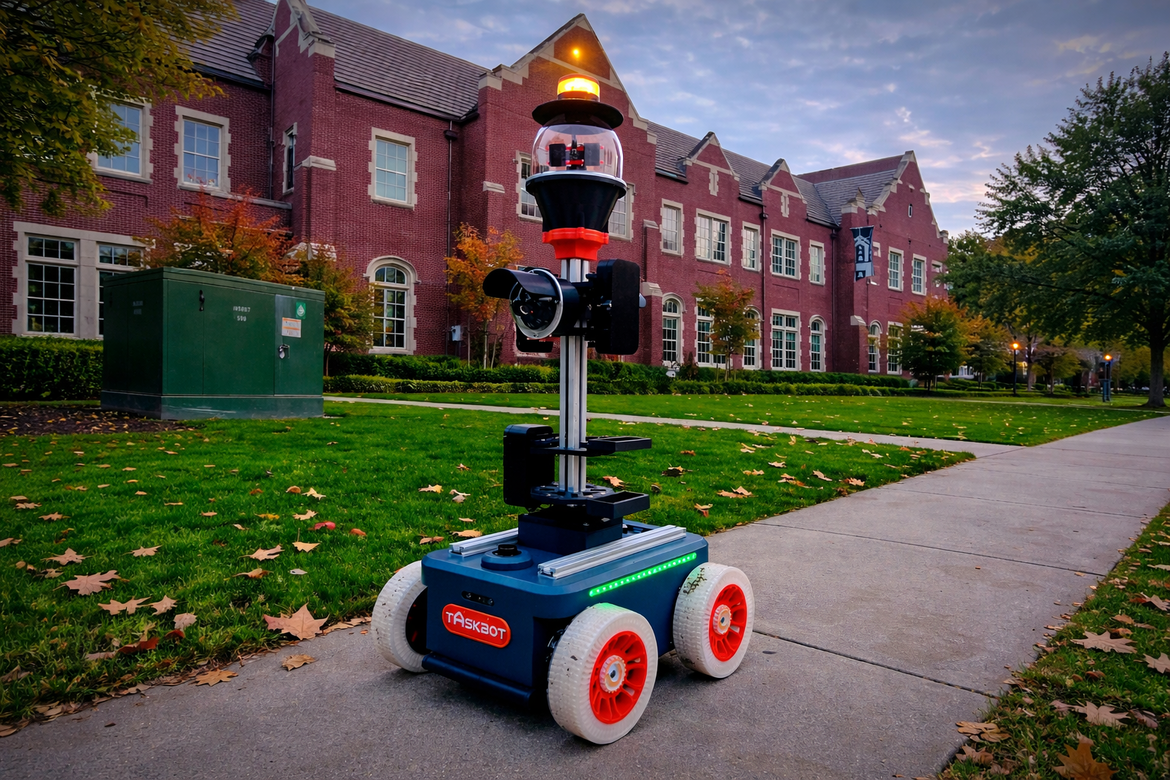

Revobots has introduced an all-weather version of its autonomous patrol robot, expanding its security robotics platform beyond indoor facilities and into outdoor environments.
The new system, called TASKBOT SCOUT XT, is engineered for exterior enforcement and monitoring tasks across campuses, parking lots, and mixed-use spaces. The Phoenix-based company says the robot is designed to address one of the longstanding limitations of autonomous patrol systems: reliable operation in unpredictable weather and uneven terrain.
The launch reflects growing demand for robotics solutions that can supplement security staffing in environments where labor shortages and operational costs continue to rise.
Hardware Upgrades for Outdoor Deployment
SCOUT XT builds on Revobots’ indoor patrol platform but incorporates significant hardware modifications to withstand environmental exposure.
The robot features an IP65-rated enclosure designed to protect against dust and water ingress. Its extended-wheelbase, all-wheel-drive chassis is intended to provide stability across uneven pavement, gravel, and surface transitions.
Outdoor-calibrated vision systems allow the robot to operate in variable lighting conditions, including bright daylight and low-light evening environments. Longer-range perception capabilities are designed to accommodate open spaces with fewer visual landmarks than indoor corridors.
All-terrain wheels further support navigation across cracked pavement, curb transitions, and mixed surfaces common in parking facilities and campus grounds.
Autonomous Operation with Human Oversight
SCOUT XT operates on Revobots’ existing backend infrastructure, including its Robots-as-a-Service subscription model and REVO Pilot human-in-the-loop oversight system.
By default, the robot navigates autonomously, using onboard AI to conduct patrol routes and monitor designated areas. When conditions exceed predefined thresholds – such as ambiguous detections or unusual environmental scenarios – the system can escalate to human supervisors for intervention.
This hybrid autonomy model is increasingly common in commercial robotics deployments, particularly in security applications where accountability and reliability are critical.
Campus Deployment Highlights Practical Use Case
Revobots said SCOUT XT recently completed pilot testing at Xavier University in Cincinnati. During the trial, the robot supported automated license plate recognition enforcement across multiple campus parking areas.
The deployment was designed to expand monitoring coverage without increasing staffing levels, a key consideration for educational institutions and other organizations managing large facilities.
Integration with existing campus infrastructure was supported through collaboration with Campus Innovation and its C-Park platform.
The university pilot demonstrates how outdoor patrol robots can supplement traditional security operations, particularly in structured environments such as campuses, business parks, and residential communities.
Expanding the Scope of Security Robotics
Autonomous security robots have typically been deployed indoors, where environmental variables are more predictable. Extending patrol capabilities outdoors introduces challenges including weather exposure, uneven terrain, and dynamic lighting.
By adapting its existing platform rather than building an entirely new system, Revobots is pursuing incremental expansion of its task-adaptive robotics model.
The broader security robotics market is evolving toward service-based deployment models, where customers subscribe to robotics coverage rather than purchase hardware outright. This approach lowers upfront costs and allows providers to maintain centralized oversight and software updates.
As robotics companies seek commercially viable applications, outdoor patrol represents a practical step toward broader real-world autonomy.
While fully autonomous security operations remain a long-term ambition, platforms like SCOUT XT illustrate how robotics companies are addressing specific operational gaps – expanding coverage, improving consistency, and reducing reliance on human patrol staffing in large, open environments.