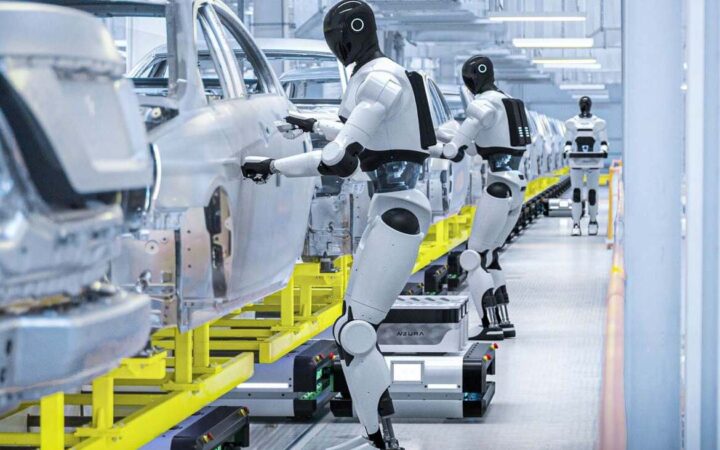

South Korea is positioned to become one of the most significant participants in global humanoid robot production, according to Goldman Sachs Research, which estimates Korean companies will account for 30% of global humanoid production by 2035 through direct manufacturing and component supply. Korean supply chains are forecast to support approximately 74,000 humanoid units by 2030 and 412,000 by 2035.
The projection is grounded in a specific structural advantage: South Korea’s deep automotive parts ecosystem – electric motors, sensors, control units, and precision engineering for electric power steering, braking systems, and autonomous vehicle technology – maps directly onto the actuators that serve as the muscles and joints of humanoid robots.
The Actuator Advantage
Several Korean automotive parts makers have already leveraged this existing expertise to position themselves among the leading non-Chinese suppliers of critical actuators for robotics. “Korea will eventually see a greater role in becoming the key supplier for ex-China related humanoids,” wrote Do Hyoung Kim, analyst at Goldman Sachs Research. He noted that Korean companies are already “on the radar” of U.S. humanoid robot developers seeking supply chain alternatives to Chinese component manufacturers.
South Korea also has a notable concentration of startups and listed companies developing dexterous robotic hands – a component Goldman Sachs identifies as one of the most technically challenging in humanoid hardware. Kim attributes this strength to Korea’s extensive industrial use of grippers in manufacturing, which has built both engineering expertise and a supplier ecosystem around the problem.
The Korean government is supporting the supply chain trajectory with 700 billion won – approximately $500 million – in 2026 investment through a national manufacturing alliance, alongside a target of producing 1,000 humanoid robots per year domestically by 2029.
The Data Bottleneck
Goldman Sachs Research also assessed the current state of humanoid AI capability, finding that vision-language models still fall short of human performance on simple physical tasks including object localization and task-driven grounding – the ability to identify objects in a scene and determine how to interact with them to complete a task.
“The bottleneck remains the scarcity of physical AI training data,” Kim wrote. A specialized VLM outperformed models from the largest U.S. AI companies on robotics benchmarks in recent research – a result the Goldman Sachs team attributed to better access to relevant physical interaction data rather than superior model architecture. The finding suggests that the relative lack of physical training data is currently the primary constraint on humanoid AI capability, ahead of model design.
China has built a significant data advantage through deployment scale. As of 2025, approximately 10,000 to 15,000 humanoid robots were deployed in China, compared to hundreds in the U.S. and Korea. That deployment gap generates a compounding data advantage: more robots in the field produce more training data, which improves AI capabilities, which enables broader deployment.
South Korea as Early Adopter
South Korea has the foundational conditions to close that gap faster than most markets. It already has the world’s highest industrial robot density – more robots per manufacturing employee than any other country – and correspondingly high public acceptance of robotics in industrial and everyday settings. The country’s track record as an early technology adopter strengthens the case for rapid humanoid deployment once commercial platforms reach sufficient maturity.
Goldman Sachs Research described the humanoid improvement cycle as self-reinforcing: more deployment generates more training data, which improves capabilities, which enables more deployment. For countries outside China, participating in that cycle requires accelerating adoption plans. “This is especially true for US companies,” Kim wrote, “given they have one of the best capabilities in software, but need an execution partner in terms of hardware.”
Disclaimer: RobotsBeat is an independent media brand owned and operated by NuvexMedia LLC, publishing news, research, and insights on artificial intelligence, emerging technologies, automation, and related industries. NuvexMedia LLC invests in and collaborates with companies across the AI, Robotics, technology, software, and digital innovation sectors. These relationships do not influence RobotsBeat's editorial coverage, and the publication maintains full editorial independence to provide accurate, timely, and objective information. © 2026 NuvexMedia LLC. All rights reserved. This content is for informational purposes only and should not be considered legal, tax, investment, financial, or other professional advice.