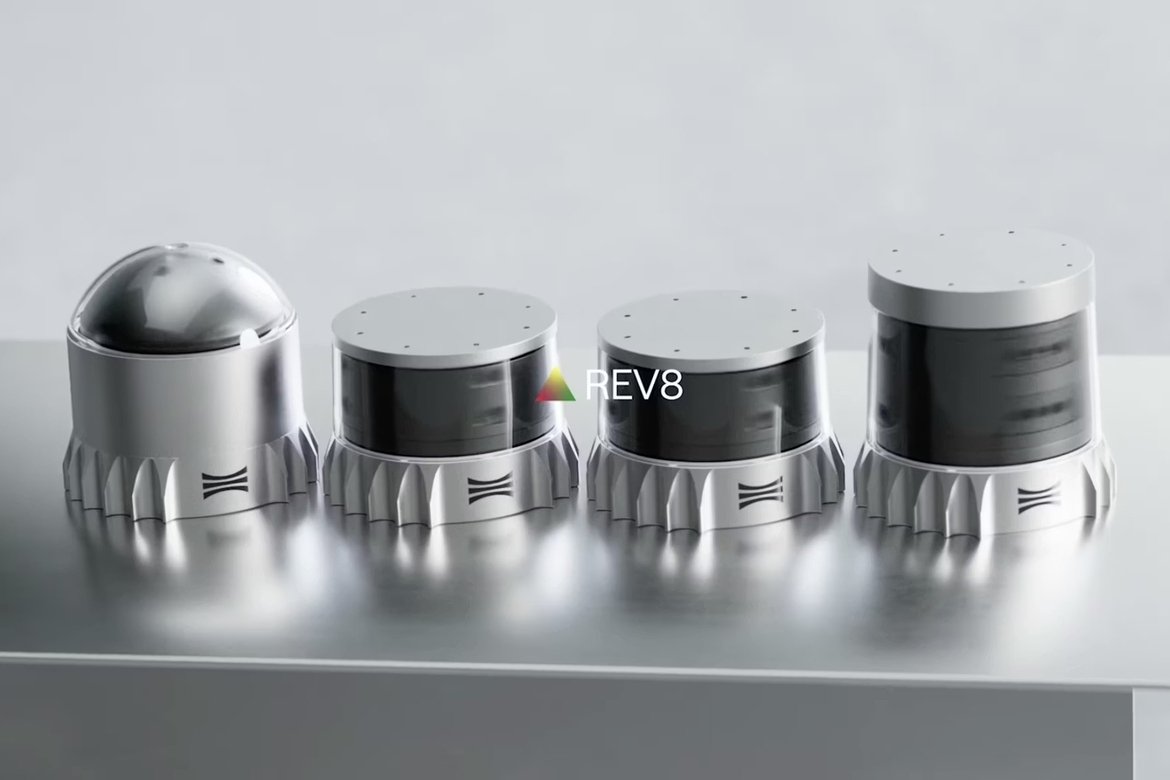
Ouster has launched Rev8, a family of lidar sensors it describes as the world’s first mass-produced native color lidar – devices that capture 3D spatial data and full-color information simultaneously using a single sensor and a single chip. Until now, autonomous vehicles and robots have relied on separate lidar and camera systems, with the two data streams requiring calibration before they could be used together. Rev8 eliminates that step by generating aligned 3D and color data at the point of capture.
The sensors are already in use by autonomous systems operators including Google and Volvo.
How Rev8 Works
Conventional lidar sensors emit laser pulses and measure return times to build a 3D point map, while color information requires a separate camera lens whose data must then be spatially calibrated against the lidar output. The calibration process is computationally demanding, introduces latency, and creates a margin for error in fusing the two data streams.
Rev8 sensors use single-photon avalanche diodes that detect both the laser returns for depth perception and ambient light for color information. The L4 Ouster Silicon chip inside builds the 3D map from laser returns and assigns corresponding color information to each point at the moment it is generated – the two are aligned by default rather than by post-processing.
The sensors can detect up to 20 trillion photons per second with picosecond timing precision, compared to a few million photons per second in typical commercial lidar. The most advanced model in the Rev8 family, the OS1 Max, has a detection range of up to 500 meters and a 45-degree field of view. The sensors offer 48-bit color depth and 116 decibels of dynamic range – significantly exceeding a professional DSLR camera’s approximately 69 dB – giving them tolerance to extreme lighting conditions.
Why This Matters for Robotics and Autonomous Vehicles
The practical benefit of native color lidar is faster, more reliable perception. A robot or autonomous vehicle using Rev8 can interpret road signs, identify brake lights, and recognize objects by color without the processing delay and potential misalignment of a separate camera system. For humanoid robots building world models – the neural network representations of physical environments used to train embodied AI systems – higher-quality aligned 3D color data improves training efficiency and real-world navigation accuracy.
“Native color lidar creates the potential for faster and more efficient perception systems that have a better understanding of their environment while also reducing the size, complexity and, potentially, the cost of autonomous sensing stacks,” said John Molloy, an autonomous sensing and AI safety expert at the University of York.
The Competitive Landscape
Ouster is not alone in pursuing this capability. China-based Hesai unveiled a sensor in April that also processes color and 3D depth data directly within the chip, but that product has not yet entered mass production. Rev8’s mass-production status is the distinction Ouster is leading with.
Research institutions are also advancing the underlying technology. Scientists from the University of Rochester and UC Davis revealed a penny-sized laser last year capable of emitting 20 quintillion pulses of light per second – a research-stage capability that suggests the performance ceiling for lidar sensing remains well above current commercial devices.
Disclaimer: RobotsBeat is an independent media brand owned and operated by NuvexMedia LLC, publishing news, research, and insights on artificial intelligence, emerging technologies, automation, and related industries. NuvexMedia LLC invests in and collaborates with companies across the AI, Robotics, technology, software, and digital innovation sectors. These relationships do not influence RobotsBeat's editorial coverage, and the publication maintains full editorial independence to provide accurate, timely, and objective information. © 2026 NuvexMedia LLC. All rights reserved. This content is for informational purposes only and should not be considered legal, tax, investment, financial, or other professional advice.