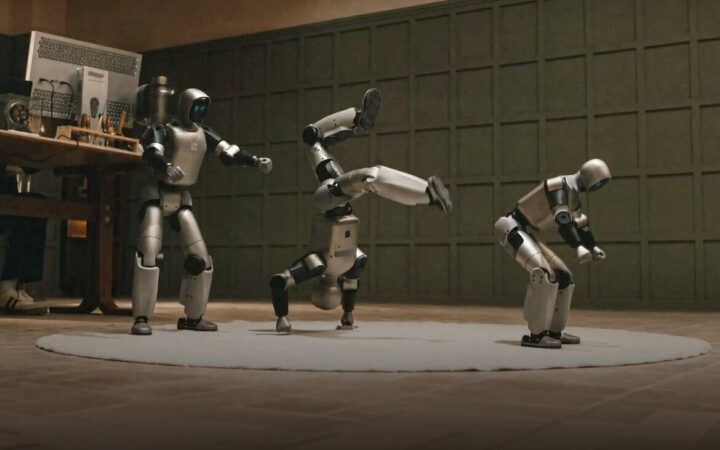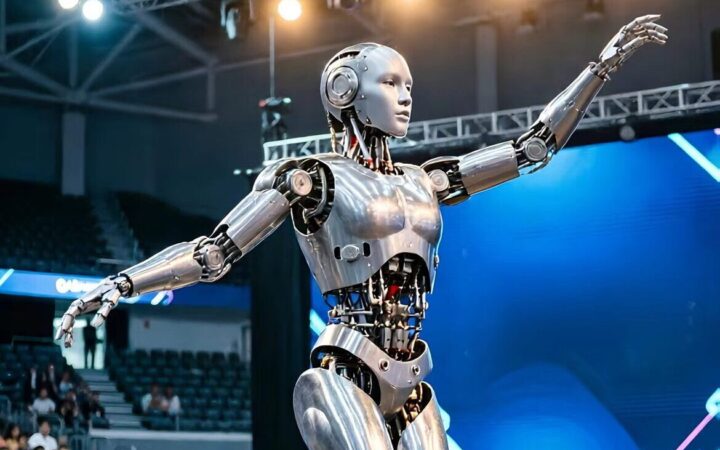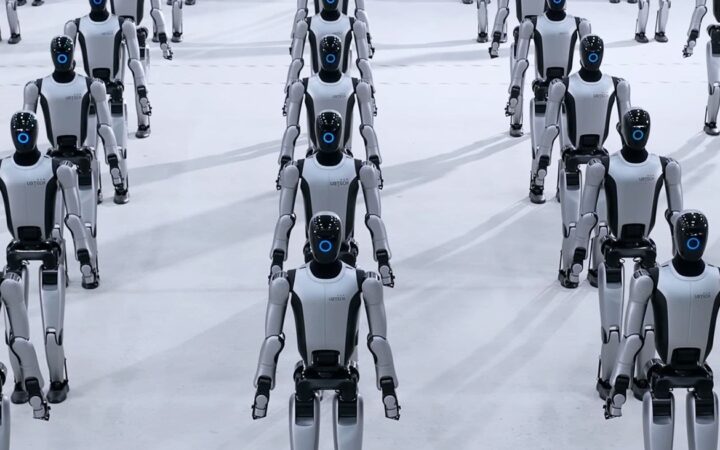

Chinese automaker Seres has unveiled Xiaosai, its first humanoid robot, as the company formally expands from electric vehicle production into embodied AI. The announcement was made by Seres Group director and vice president Kang Bo, who released a demonstration video and confirmed that additional embodied intelligence products are in development and scheduled for debut later this year. Specific technical specifications have not been disclosed, but the robot is equipped with visual recognition, autonomous greeting capability, and voice-based interaction.
The launch positions Seres within a rapidly growing cohort of Chinese automakers that view humanoid robotics as a natural extension of their manufacturing, AI, and supply chain capabilities.
Existing Robotics Infrastructure at Seres
Seres’ factory already operates a significant robotics footprint before the Xiaosai humanoid launch. Two specialized inspection robots – Xiaosai 01 and Xiaosai 02 – are currently active on the production floor. Xiaosai 01 performs quality inspections for chassis assembly, while Xiaosai 02 checks the exterior configuration of completed vehicles. The facility’s smart hub coordinates more than 1,600 intelligent devices, and over 3,000 industrial robots operate in synchronization throughout the plant.
The factory integrates IoT, big data, digital twins, 5G connectivity, and artificial intelligence across production operations – an infrastructure context that makes the addition of humanoid robots an incremental expansion rather than a greenfield deployment. Seres also has a cooperation agreement with Volcengine, a ByteDance subsidiary, covering intelligent robot decision-making systems, control technologies, and multimodal cloud-edge collaboration, signed in October 2024.
A Growing Field of Chinese Automaker Entrants
Seres joins a wave of Chinese electric vehicle companies moving into humanoid robotics. Xpeng CEO He Xiaopeng personally assumed leadership of the company’s robotics division earlier this month to accelerate the mass production of its IRON humanoid, targeting production by year-end and retail store deployment in Q1 2027. BYD confirmed it is developing humanoid robots in-house, with its own factories as the first deployment environment and plans to eventually sell through its dealer network. Chery-backed Aimoga has moved furthest toward commercialization, already selling humanoid robots directly to consumers at 285,800 yuan per unit.
The common thread across these automaker entries is the manufacturing infrastructure they already possess – precision assembly lines, supply chain relationships, quality control systems, and engineering workforces – that lower the barriers to producing robots at scale compared to pure-play robotics startups building those capabilities from zero.
The Seres announcement adds one more data point to a pattern that is reshaping the competitive structure of the humanoid robot industry: the companies best positioned to manufacture robots at scale may not be the companies that pioneered the technology.
Disclaimer: RobotsBeat is an independent media brand owned and operated by NuvexMedia LLC, publishing news, research, and insights on artificial intelligence, emerging technologies, automation, and related industries. NuvexMedia LLC invests in and collaborates with companies across the AI, Robotics, technology, software, and digital innovation sectors. These relationships do not influence RobotsBeat's editorial coverage, and the publication maintains full editorial independence to provide accurate, timely, and objective information. © 2026 NuvexMedia LLC. All rights reserved. This content is for informational purposes only and should not be considered legal, tax, investment, financial, or other professional advice.