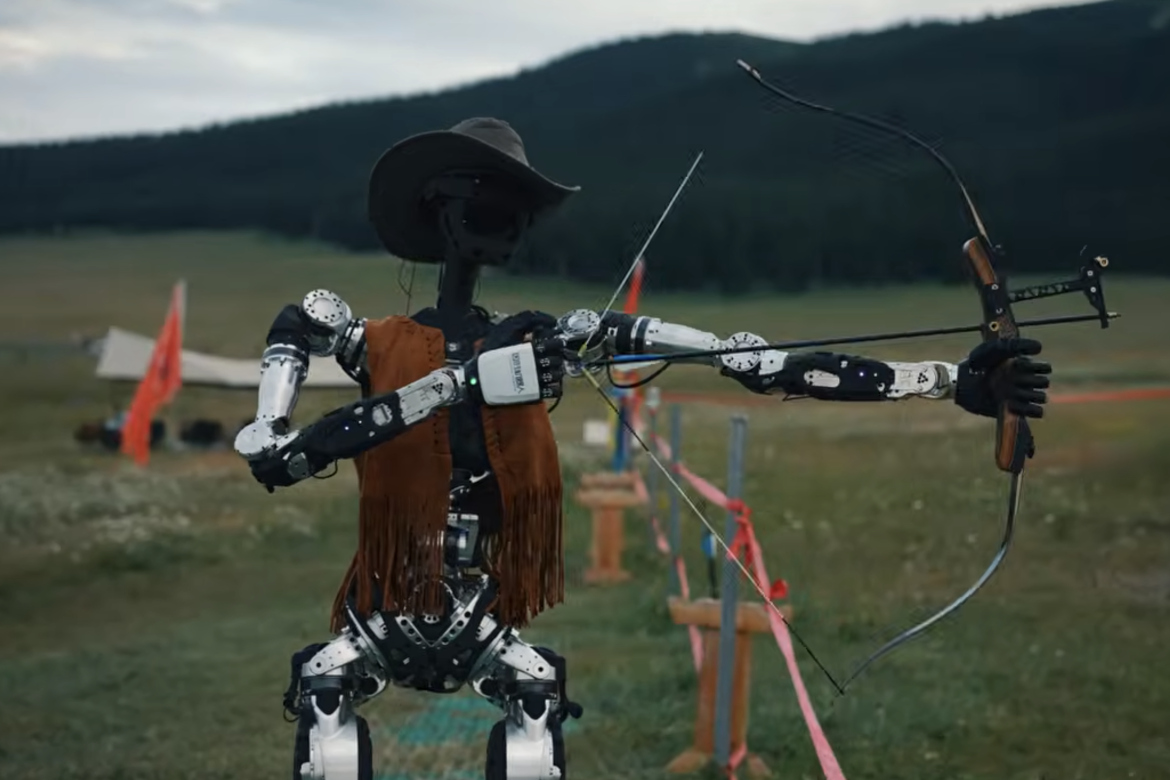

Chinese robotics startup PNDbotics has demonstrated its full-size Adam humanoid riding a robotic horse and firing an arrow at a target from 20 metres, in a video designed to showcase the machine’s balance, coordination, and ability to execute complex whole-body movements.
The short demonstration gives the humanoid a distinctly cinematic role. Adam sits astride a moving quadruped platform, raises a bow, draws the string, aims, and releases the arrow while maintaining its posture. PNDbotics also showed the robot performing other outdoor actions, including skipping stones, as part of the same display.
Although the cowboy-style presentation is built for social media, the underlying task is technically demanding. Archery from a moving platform requires the robot to coordinate its torso, shoulders, elbows, wrists, and hands while compensating for motion beneath its body. Even if the sequence was carefully programmed and performed under controlled conditions, the demonstration provides a visible measure of how far full-body humanoid control has progressed.
A Test of Whole-Body Coordination
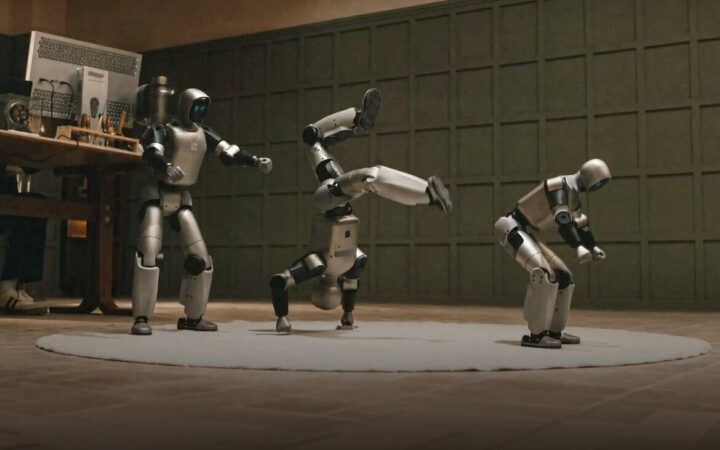
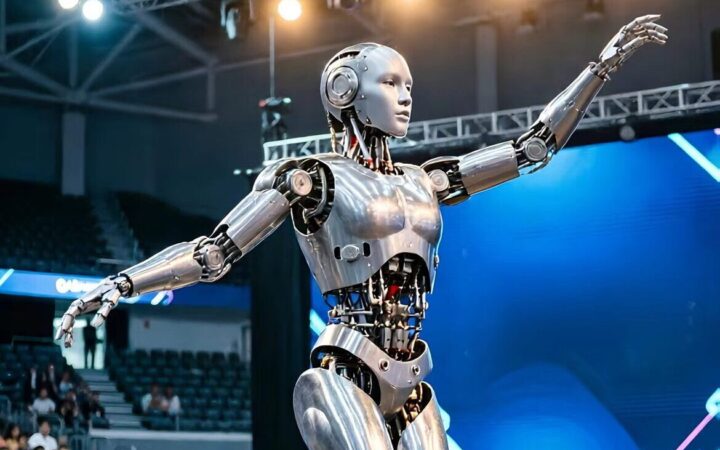
Adam is a 1.67-metre humanoid platform weighing about 62 kilograms. The robot uses dozens of actuated joints and PNDbotics’ modular drive systems to reproduce human-like movement. The company has previously demonstrated Adam walking, climbing onto elevated platforms, playing musical instruments, and performing other coordinated motions.
Riding adds another control problem because the humanoid is not balancing against a fixed floor. The robotic horse introduces repeated shifts in pitch, roll, and vertical movement, forcing Adam’s control system to preserve upper-body stability while the arms complete a precision task.
The bow also creates changing forces as the string is drawn and released. To complete the shot, the robot must keep the bow steady, generate sufficient pulling force, maintain hand alignment, and time the release without allowing the motion of the mount to disrupt its aim.
PNDbotics said the shot hit the target from 20 metres. The company did not disclose whether the motion was autonomous, teleoperated, or executed through a predefined control sequence. The video therefore demonstrates physical capability, but does not establish how independently Adam planned or adapted the action.
Robotics Companies Turn to Spectacle
Humanoid developers are increasingly using sports, dance, martial arts, and entertainment demonstrations to make improvements in locomotion easier for the public to understand. These performances are more visually compelling than factory trials, but they also function as stress tests for balance, force control, and coordination.
PNDbotics has followed that strategy with Adam. The humanoid appeared at a Chinese music festival in 2025, where it played a keytar during a live performance, and it has since been used in a series of increasingly elaborate demonstrations.
The latest display also reflects the rapid growth of China’s humanoid robotics market. Domestic startups are competing not only on hardware specifications, but also on how convincingly their machines can perform recognisable human actions. That competition is producing a steady stream of videos in which robots run, dance, fight, play sports, and handle tools.
Such demonstrations should not be confused with reliable commercial deployment. A successful staged performance does not prove that a humanoid can repeat the same task safely for hours in an unpredictable workplace. Still, Adam’s horseback archery sequence illustrates the expanding range of movements now available to full-size humanoids and the growing sophistication of the control systems behind them.
Disclaimer: RobotsBeat is an independent media brand owned and operated by NuvexMedia LLC, publishing news, research, and insights on artificial intelligence, emerging technologies, automation, and related industries. NuvexMedia LLC invests in and collaborates with companies across the AI, Robotics, technology, software, and digital innovation sectors. These relationships do not influence RobotsBeat's editorial coverage, and the publication maintains full editorial independence to provide accurate, timely, and objective information. © 2026 NuvexMedia LLC. All rights reserved. This content is for informational purposes only and should not be considered legal, tax, investment, financial, or other professional advice.