
Key Notes
- FANUC’s Robot division recorded ¥103.4 billion in July–September orders, up 12.6% year on year and 5.6% from the preceding quarter.
- Quarterly robot sales reached ¥98.2 billion, with growth in the Americas contrasting with a year-on-year decline in China.
- The October 23 update also reviews earlier physical AI demonstrations, connecting new software capabilities with established industrial robot hardware.
FANUC reported a 12.6% year-on-year increase in quarterly robot orders as demand for factory automation strengthened. Its October 23 results provide a useful counterpoint to humanoid demonstrations: established industrial robots are still attracting investment to perform defined production jobs.
Robot-division sales reached ¥98.2 billion in July–September, up 7.2% from a year earlier. Orders grew faster than sales, although neither measure translates directly into a count of machines installed or productive hours delivered to customers.
Robot Orders Show Stronger Momentum
The company’s results presentation puts robot orders at ¥103.4 billion for the quarter, also up 5.6% from the preceding three months. Sales rose 2.2% sequentially. These figures cover FANUC’s Robot division, rather than its entire business.
Orders offer a different view from revenue. An order signals a customer commitment to future equipment, while reported sales reflect the timing of delivery and recognition. A quarter in which orders exceed sales can indicate continuing demand without establishing how quickly every project will enter production.
Regional Results Show an Uneven Market
Robot sales in the Americas rose 11.8% year on year, while China declined 14.3%. FANUC nevertheless describes automation investment as strong, particularly in the Americas and China, and says automotive investment in the Americas is gaining momentum.
The apparent contrast is worth keeping: management’s assessment of investment conditions and the quarter’s recognized sales measure different things. A broad statement about demand should not erase the weaker Chinese robot-sales result.
For manufacturers, that unevenness matters more than a single global growth rate. Local project cycles, sector exposure and equipment delivery timing can produce different results across otherwise similar automation businesses.
Physical AI Builds on Existing Robot Hardware
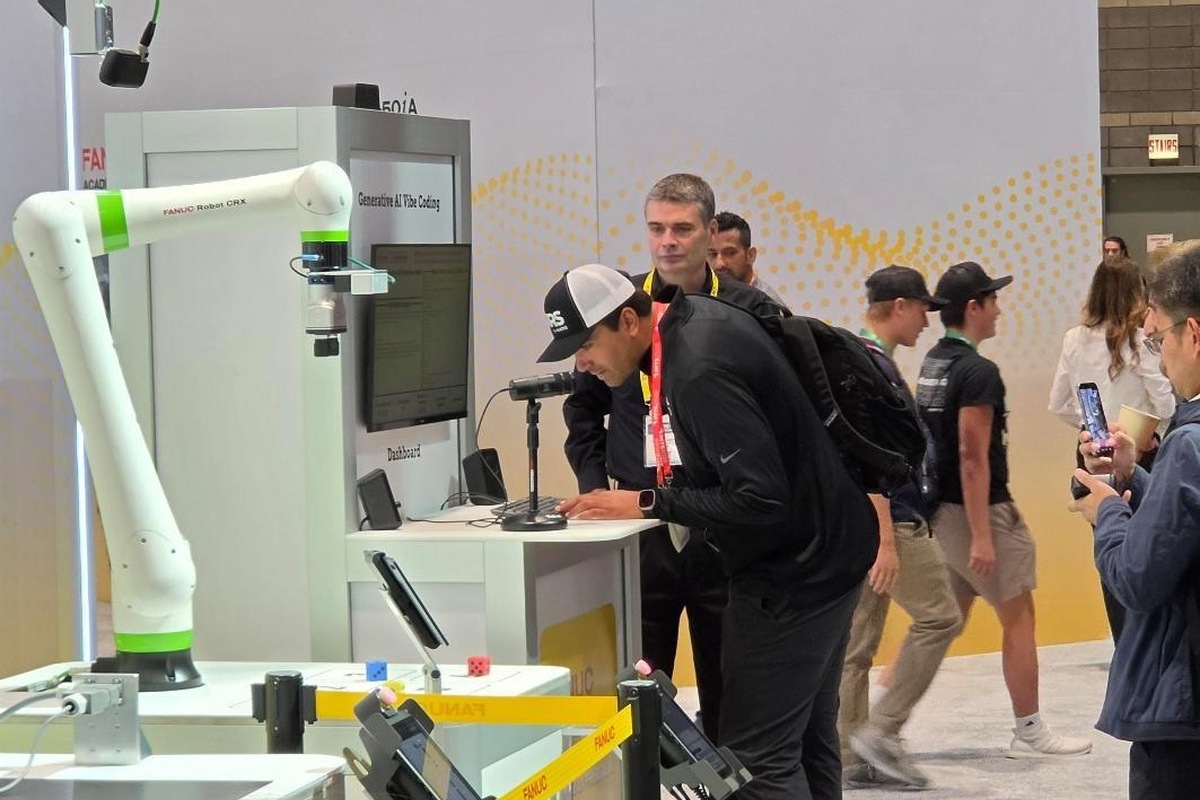
The same update reviews FANUC’s earlier IMTS exhibits, including AI-agent kitting, dual-arm connector assembly and natural-language task instructions. Those demonstrations took place at the September exhibition; the October report does not make them newly launched products.
These applications show where adaptable software can meet established industrial equipment. Kitting and connector handling require perception and coordinated movement, while a production deployment must also connect to fixtures, quality checks and the rest of the line.
RobotsBeat’s coverage of FANUC’s U.S. training center examines another part of that deployment challenge: giving people the skills to install, operate and maintain automation. Better robot software does not remove that requirement.
Factory Demand Extends Beyond Humanoids
The results reinforce a practical distinction in robotics: commercial demand can grow through conventional robot arms and specialized cells, even while general-purpose machines remain under development. Our coverage of Schaeffler’s new factory shows how established automation and newer humanoids can coexist within the same manufacturing investment.
For FANUC, the next test is converting incoming orders into sustained sales and working installations. For the wider industry, the figures show why industrial robotics remains central to the physical AI story.
Disclaimer: RobotsBeat is an independent media brand owned and operated by NuvexMedia LLC, publishing news, research, and insights on artificial intelligence, emerging technologies, automation, and related industries. NuvexMedia LLC invests in and collaborates with companies across the AI, Robotics, technology, software, and digital innovation sectors. These relationships do not influence RobotsBeat's editorial coverage, and the publication maintains full editorial independence to provide accurate, timely, and objective information. © 2026 NuvexMedia LLC. All rights reserved. This content is for informational purposes only and should not be considered legal, tax, investment, financial, or other professional advice.