Key Notes
- NEURA says its redesigned 4NE1 Gen 4 humanoid is 20% lighter, with upgraded hands, a textile exterior and limb-level reflexes intended to improve movement.
- The three-year TUM RoboGym initiative carries around €17 million in joint investment, including approximately €11 million from NEURA, with about 100 robots in 48 training cells.
- Gen 4 is being prepared for series production, while its launch announcement does not specify a price, confirmed customer delivery date or absolute weight.
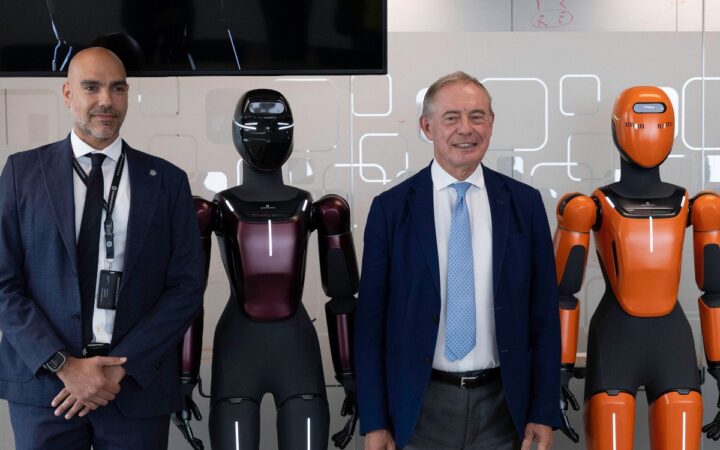
NEURA Robotics has unveiled 4NE1 Gen 4, a redesigned humanoid that the company says is 20% lighter than its predecessor. The German developer introduced the robot on October 22 alongside the opening of TUM RoboGym, a new training center near Munich Airport created with the Technical University of Munich.
The launch pairs new hardware with a place to develop practical skills. According to NEURA’s announcement, Gen 4 has a slimmer body, black textile covering and upgraded hands. Limb-level reflexes, branded Smart Limbs, are intended to improve responsiveness and movement.
A Lighter Body With Neuron AI
The humanoid runs Neuron AI, which combines visual, touch, force, sound and robot-state information to guide actions. NEURA says connected robots can share learned skills through its Neuraverse platform. Gen 4 is already operating in the company’s training facilities and is being prepared for series production.
The launch does not give a confirmed customer delivery date, price or absolute weight for the new generation. The 20% reduction is a manufacturer comparison, rather than an independently measured result. Older 4NE1 specifications should therefore not automatically be treated as Gen 4 specifications.
RobotsBeat previously covered Neuron AI. The new robot adds a hardware development to that software story: sensing, control and manipulation must work together when an object shifts or contact changes during a task.
Inside the New TUM RoboGym
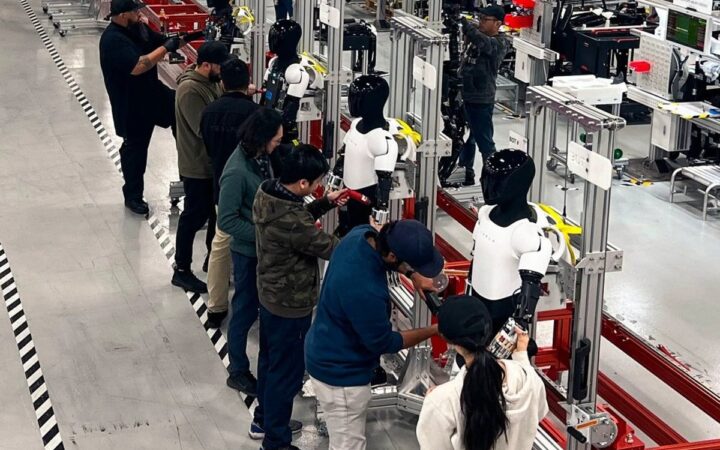
TUM says the center initially brings together around 100 humanoid and service robots in 48 training cells. That is the facility’s mixed fleet, not an order for 100 Gen 4 humanoids.
Training examples include folding boxes, assembling components and operating tools, with industrial applications and internal logistics the initial focus. The aim is to collect physical interaction data that is difficult to obtain from ordinary internet content.
In its facility overview, TUM describes a curated cloud data lake supporting robot learning and research into safer human-robot interaction. Researchers and companies can use realistic work settings to develop and test capabilities.
A €17 Million Partnership for Robot Training
NEURA and TUM say their joint initiative is initially set up for three years, with a total investment of around €17 million. NEURA contributes approximately €11 million, alongside robots, computing infrastructure and operating staff. TUM provides space, scientific expertise and research resources. The figure describes the joint initiative, rather than simply the price of a building.
The center occupies more than 2,300 square meters at LabCampus near Munich Airport. NEURA says partners have been training workflows there since September, using tasks such as handling boxes, filling bottles and moving wooden components.
Training combines recorded robot interactions, human demonstrations captured through motion tracking or teleoperation, and simulation. The practical aim is to vary a task during training and then check whether the resulting behavior transfers to real hardware. Companies can use the facility to assess applications before expanding use at their own sites.
From Training Facilities to Useful Work
The opening builds on the earlier RoboGym project and follows a wider push to collect robot experience at scale. RobotsBeat also covered Generative Bionics’ plans for an Italian training facility, which is scheduled for 2027.
For potential customers, the important next step is evidence from repeatable work. Handling success rates, intervention frequency and time needed to teach a new process will show more about commercial usefulness than a lighter body alone. The Munich facility provides a setting in which those questions can be tested.
Disclaimer: RobotsBeat is an independent media brand owned and operated by NuvexMedia LLC, publishing news, research, and insights on artificial intelligence, emerging technologies, automation, and related industries. NuvexMedia LLC invests in and collaborates with companies across the AI, Robotics, technology, software, and digital innovation sectors. These relationships do not influence RobotsBeat's editorial coverage, and the publication maintains full editorial independence to provide accurate, timely, and objective information. © 2026 NuvexMedia LLC. All rights reserved. This content is for informational purposes only and should not be considered legal, tax, investment, financial, or other professional advice.