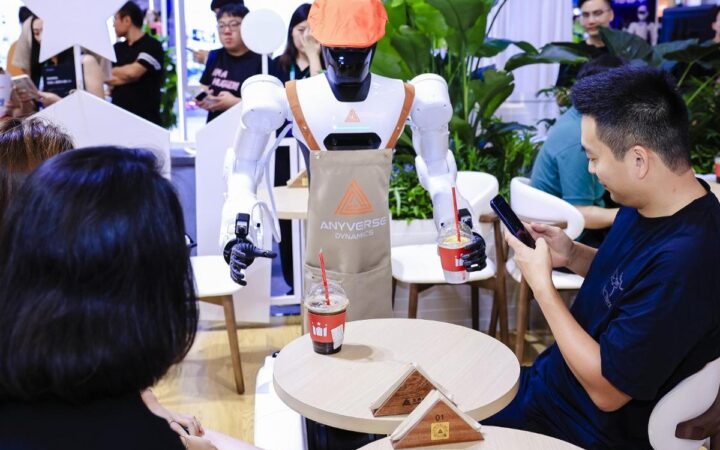
China will open its first heterogeneous humanoid robot training facility in Shanghai in July, at the National and Local Co-Built Humanoid Robotics Innovation Center in the Zhangjiang area. Covering more than 5,000 square meters, the center hosts over 100 robot types from more than a dozen manufacturers – making it the country’s largest humanoid robot training site by variety. The facility is designed to generate large-scale shared training data that can be used across different robot platforms and AI models, addressing one of the most significant structural constraints in the embodied AI sector.
The term heterogeneous is key to the facility’s purpose. Humanoid robots from different manufacturers vary in skeletal structure, joint counts, and motor systems, making their training data mutually incompatible by default. A robot trained on one platform cannot directly apply what it has learned to a different one – a fragmentation that limits the industry’s ability to build on collective experience at scale.
Solving the Data Interoperability Problem
Xu Bin, general manager of the center, described the facility as foundational infrastructure for the humanoid robotics industry rather than a product-specific training environment. The center is designed to enable large-scale data sharing across the industry by bridging compatibility gaps between heterogeneous robot systems – creating databases that multiple manufacturers and AI model developers can draw on regardless of the hardware they are working with.
The facility simulates both household and workplace environments. During training, robots perform real-world tasks continuously, generating data that feeds into databases supporting applications across manufacturing, services, healthcare, and agriculture. The center builds on a humanoid robot training center opened in Beijing in December 2025, where robots practice factory work, household chores, cooking, and parcel handling.
Germany’s TUM RoboGym
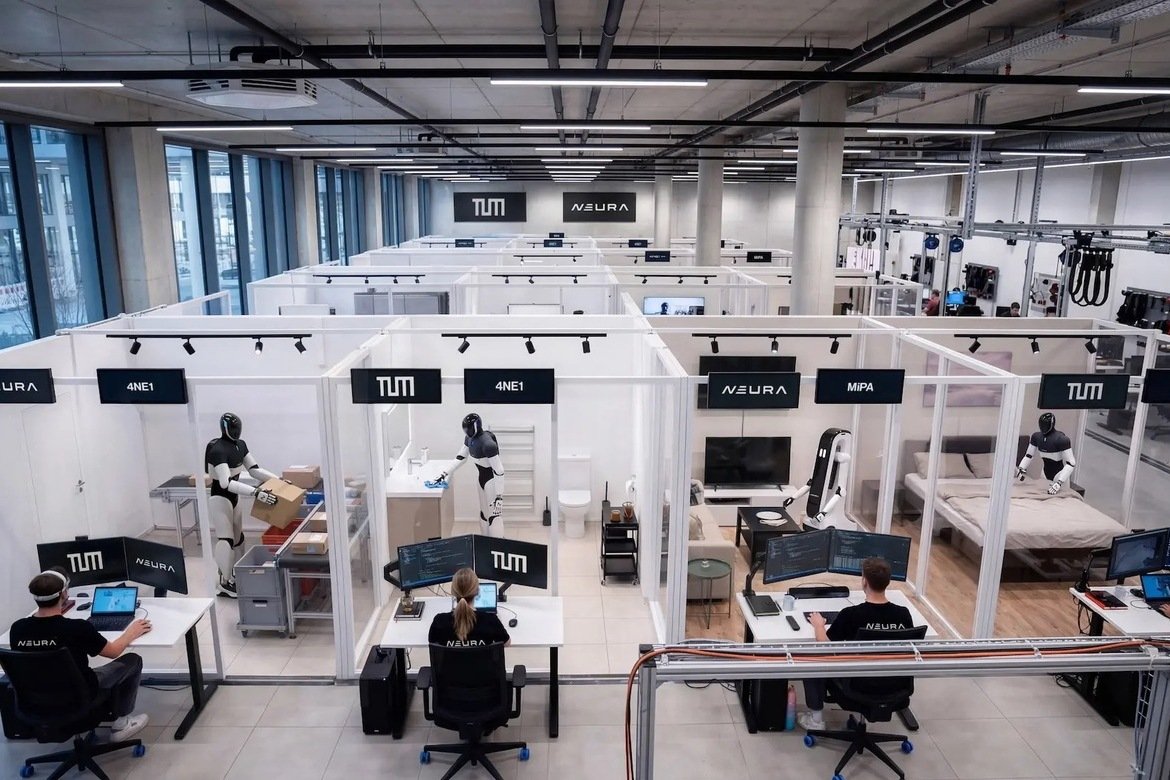
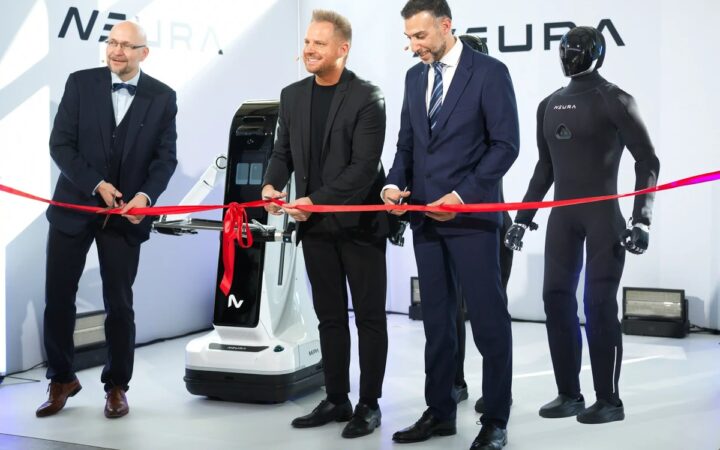
A parallel development is underway in Germany. The Technical University of Munich and NEURA Robotics are building TUM RoboGym near Munich Airport – expected to be one of the world’s largest robotics research and training centers dedicated to humanoid systems. Covering approximately 2,322 square meters, the center will function as a dedicated training environment for AI-powered robotic systems under human supervision.
Key training activities will include object manipulation, component assembly, folding, and other precision tasks that remain challenging for current robotic hardware. The facility aims to generate the physical interaction data that embodied AI systems require but cannot obtain from internet-sourced datasets – the same data scarcity problem that Genesis AI, 1X Technologies, and other humanoid developers have identified as the central bottleneck in physical AI progress.
TUM RoboGym is expected to host hundreds of robots and support both research and engineering education, with a strategic goal of strengthening European capabilities in advanced robotics development.
The Infrastructure Layer
The simultaneous emergence of dedicated humanoid training facilities in China and Germany reflects an industry recognition that robot intelligence cannot be built from data collected in individual company labs. The volume and variety of real-world physical interaction data required to train generalizable embodied AI models is too large for any single manufacturer to generate alone. Shared infrastructure – whether national in China’s case or academic-industrial in Germany’s – is becoming the mechanism through which the industry is attempting to close the data gap at scale.
Disclaimer: RobotsBeat is an independent media brand owned and operated by NuvexMedia LLC, publishing news, research, and insights on artificial intelligence, emerging technologies, automation, and related industries. NuvexMedia LLC invests in and collaborates with companies across the AI, Robotics, technology, software, and digital innovation sectors. These relationships do not influence RobotsBeat's editorial coverage, and the publication maintains full editorial independence to provide accurate, timely, and objective information. © 2026 NuvexMedia LLC. All rights reserved. This content is for informational purposes only and should not be considered legal, tax, investment, financial, or other professional advice.