Key Notes
- NVIDIA released Nemotron 3.5 Bolt E4B for local conversational agents, demonstrating dialogue and scripted animations on Reachy Mini with separate visual understanding.
- The 4GB designation is a target workload footprint, while NVIDIA’s Jetson Orin Nano measurements use 4.2–4.9GB and depend on context and configuration.
- NVIDIA reports average benchmark gains over Nano 4B, but the model remains a text-based interaction layer rather than a complete autonomous robot controller.
NVIDIA has released Nemotron 3.5 Bolt E4B 4GB, a small language model aimed at local conversational agents, device assistants and robotics interfaces. The October 23 release targets a practical robotics problem: letting a machine hold a conversation and invoke the right software tools without relying on a large cloud model for every exchange.
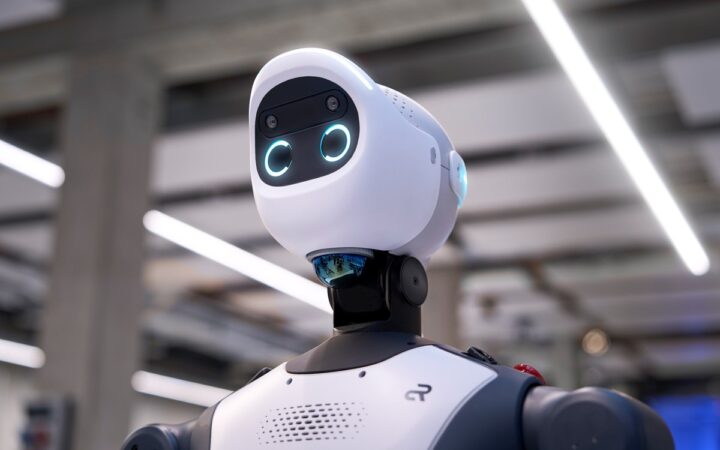
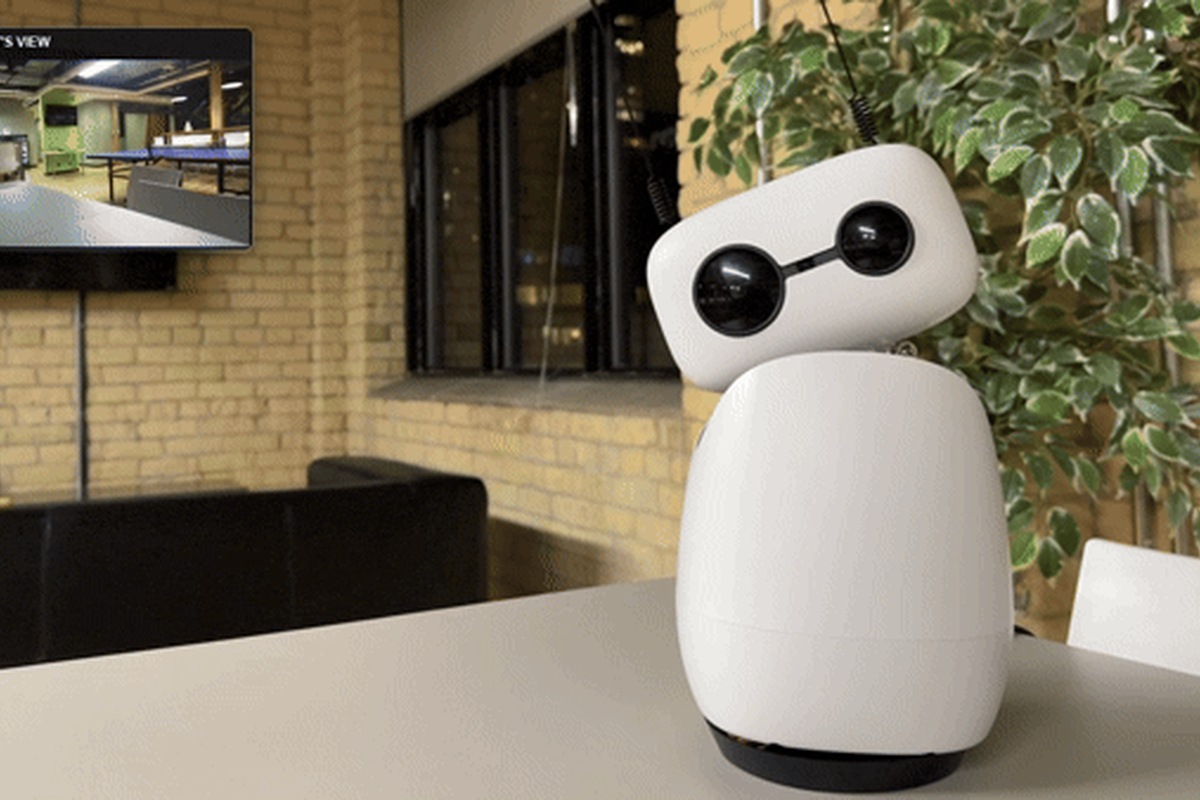
In NVIDIA’s research release, a Reachy Mini robot demonstrates the approach on a Jetson Orin Nano with 8GB of memory. Bolt generates spoken responses and calls scripts from the robot’s animation library, while a separate Cosmos 3 Edge model supplies visual understanding.
A Conversational Interface for Robots
That division of work is important. Bolt is not presented as a complete vision-and-motion controller that can independently perform arbitrary physical tasks. Its model card lists text input and output. Speech, perception, application tools and hardware control must be supplied by the surrounding system.
The model builds on Gemma 4 E4B with NVIDIA post-training. It has 8 billion total parameters, described as 4 billion effective parameters, and the released GGUF version uses Q4_K_M quantization. NVIDIA lists a 64K context window, configurable reasoning and a conversational mode intended to favor concise responses.
For a robot developer, tool use can connect dialogue to a bounded set of actions: a gesture, an information request or an application function. The integration still determines what the robot is allowed to do and how requests are validated before execution.
What the 4GB Target Means in Practice
NVIDIA describes a target footprint of around 4GB for selected workloads, leaving room for other applications and models. That is not a promise that every configuration fits in a device with only 4GB of total memory.
In its Q4_K_M tests at batch size one, NVIDIA reports 4.2GB of model-workload memory use on Jetson Orin Nano for a roughly 3,000-token input and 50-token output. The same test records about 5.8 seconds to the first token and 15.5 generated tokens per second. A longer cached-context configuration uses 4.9GB.
Those numbers show why developers need to evaluate the complete interaction rather than generation speed alone. Microphone processing, visual models, speech synthesis and action execution can add memory use and delay beyond the language model measurement.
Benchmarks Show Gains, With Trade-Offs
NVIDIA reports roughly 40% higher average scores than its previous Nemotron 3 Nano 4B across its selected benchmarks, alongside up to 80% fewer output tokens in reasoning-enabled comparisons. These are vendor-reported aggregate and best-case comparisons, not a claim that every task improves by 40% or every response arrives 80% faster.
The published results also show competitors ahead on individual tests, including some tool-use and long-context evaluations. The benchmark tables distinguish full-precision quality results from quantized runtime measurements, so a headline average should not replace testing the exact configuration used in a robot.
Local AI Becomes Another Part of the Robot Stack
The release complements the development tools covered in RobotsBeat’s Isaac platform coverage. Simulation and robot learning address how machines acquire physical skills; a compact conversational model addresses how users interact with those skills.
Our Microduck coverage examines a different Pollen Robotics platform focused on movement learning. Reachy Mini’s Bolt demonstration instead illustrates dialogue linked to existing animation tools, rather than a new general-purpose manipulation breakthrough.
Model checkpoints and deployment instructions are available through NVIDIA’s Hugging Face release under OpenMDW 1.1. The immediate opportunity is a configurable local interaction layer for developers who can measure its latency, tool accuracy and memory needs within their own robotics application.
Disclaimer: RobotsBeat is an independent media brand owned and operated by NuvexMedia LLC, publishing news, research, and insights on artificial intelligence, emerging technologies, automation, and related industries. NuvexMedia LLC invests in and collaborates with companies across the AI, Robotics, technology, software, and digital innovation sectors. These relationships do not influence RobotsBeat's editorial coverage, and the publication maintains full editorial independence to provide accurate, timely, and objective information. © 2026 NuvexMedia LLC. All rights reserved. This content is for informational purposes only and should not be considered legal, tax, investment, financial, or other professional advice.