Key Notes
- ETH Zurich’s ANYmal-D uses its feet to stabilize, flip and turn a giant Rubik’s Cube while maintaining whole-body balance.
- The system combines onboard perception and a conventional puzzle solver with physical skills trained through reinforcement learning.
- Researchers report three autonomous solves taking 8–9 minutes each, a limited demonstration rather than proof of unrestricted manipulation reliability.
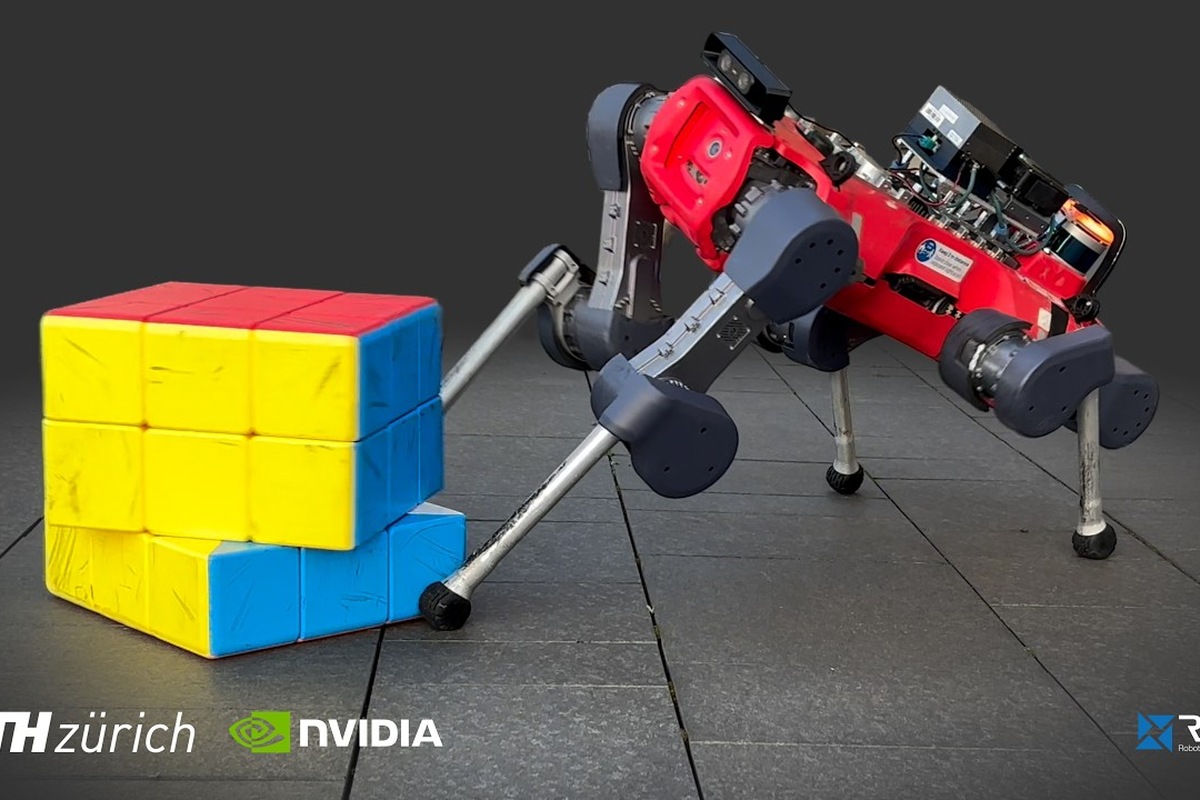
ETH Zurich researchers have taught a four-legged ANYmal-D robot to solve a giant Rubik’s Cube using only its feet. The machine scans the puzzle, plans a solution and executes a sequence of flips and layer turns while keeping its balance, without an added robotic arm.
The work turns a familiar puzzle into a demanding test of physical control. A cube-solving algorithm can calculate the right moves, but a legged robot still has to carry them out without slipping, falling or accidentally rotating the wrong layer.
Feet Become Manipulators
The team’s project page shows the robot combining movement around the cube with whole-body manipulation. During a turn, one front foot stabilizes the object while the other pushes; flips expose different faces and put the puzzle in a useful orientation for the next action.
This approach is called pedipulation: using a robot’s feet to interact with objects as well as support locomotion. The challenge is that every contact also affects balance. A leg cannot simply become a hand without the rest of the body adapting.
The official research video, embedded above, makes that coordination visible. The robot shifts its posture and repositions around the puzzle rather than relying on a fixed fixture to hold the cube.
Classical Planning Meets Learned Control
The research paper describes a layered system. Onboard cameras recover the cube’s position and colors, a conventional solver computes the required moves, and a planner converts them into actions the quadruped can perform.
Reinforcement learning supplies the physical skills. Training first uses information available in simulation, then transfers the behavior into policies driven by onboard depth sensing and the robot’s own body-state measurements. That separates deciding which puzzle move is needed from controlling the contact that makes it happen.
It is a useful division of labor. The mathematical problem already has effective solvers; the research question is whether a mobile machine can repeatedly execute the solution in the physical world.
Three Complete Solves, With Clear Limits
The researchers report three autonomous hardware solves, each taking approximately 8–9 minutes and about 30 manipulation and repositioning steps. The cube measures 40 centimeters along an edge and weighs 4.6 kilograms. The preprint was submitted on October 17, before this week’s wider coverage.
The project also presents individual skills under disturbances and different surface conditions. Those demonstrations show the scope of the tests, rather than establishing that the system can solve every cube configuration under arbitrary conditions.
Three complete runs are an encouraging demonstration, but too small a sample to establish a general reliability rate. Industrial use would require repeated testing across the objects, surfaces and failures a particular job presents.
Beyond Walking and Inspection
The broader opportunity is giving existing legged hardware more ways to act on its surroundings. RobotsBeat’s coverage of the forest research expedition shows the value of mobile robots carrying equipment through difficult terrain. Manipulation adds a different requirement: changing the environment after reaching it.
That does not make a cube-solving policy ready to operate industrial valves or perform maintenance. It demonstrates a building block for sustained interaction without a separate arm. Our coverage of object-rotation research examines the related challenge of controlling contact while preserving an object’s intended state.
Disclaimer: RobotsBeat is an independent media brand owned and operated by NuvexMedia LLC, publishing news, research, and insights on artificial intelligence, emerging technologies, automation, and related industries. NuvexMedia LLC invests in and collaborates with companies across the AI, Robotics, technology, software, and digital innovation sectors. These relationships do not influence RobotsBeat's editorial coverage, and the publication maintains full editorial independence to provide accurate, timely, and objective information. © 2026 NuvexMedia LLC. All rights reserved. This content is for informational purposes only and should not be considered legal, tax, investment, financial, or other professional advice.